Introduction
At first glance, turf vs grass might seem like the same thing. After all, both are green, both grow on the ground, and both are used for lawns, parks, and sports fields. But if you’ve ever wondered why people specifically say “turf field” instead of just “grass,” there’s actually a meaningful difference behind these terms.
The confusion usually comes from everyday language. Many people use “grass” and “turf” interchangeably, even though they’re not always the same.
Although they look/sound similar, they serve completely different purposes.
In this guide, we’ll break down turf vs grass in simple, clear language so you can understand when to use each term—and why it matters.
What Is “Turf”?
Meaning
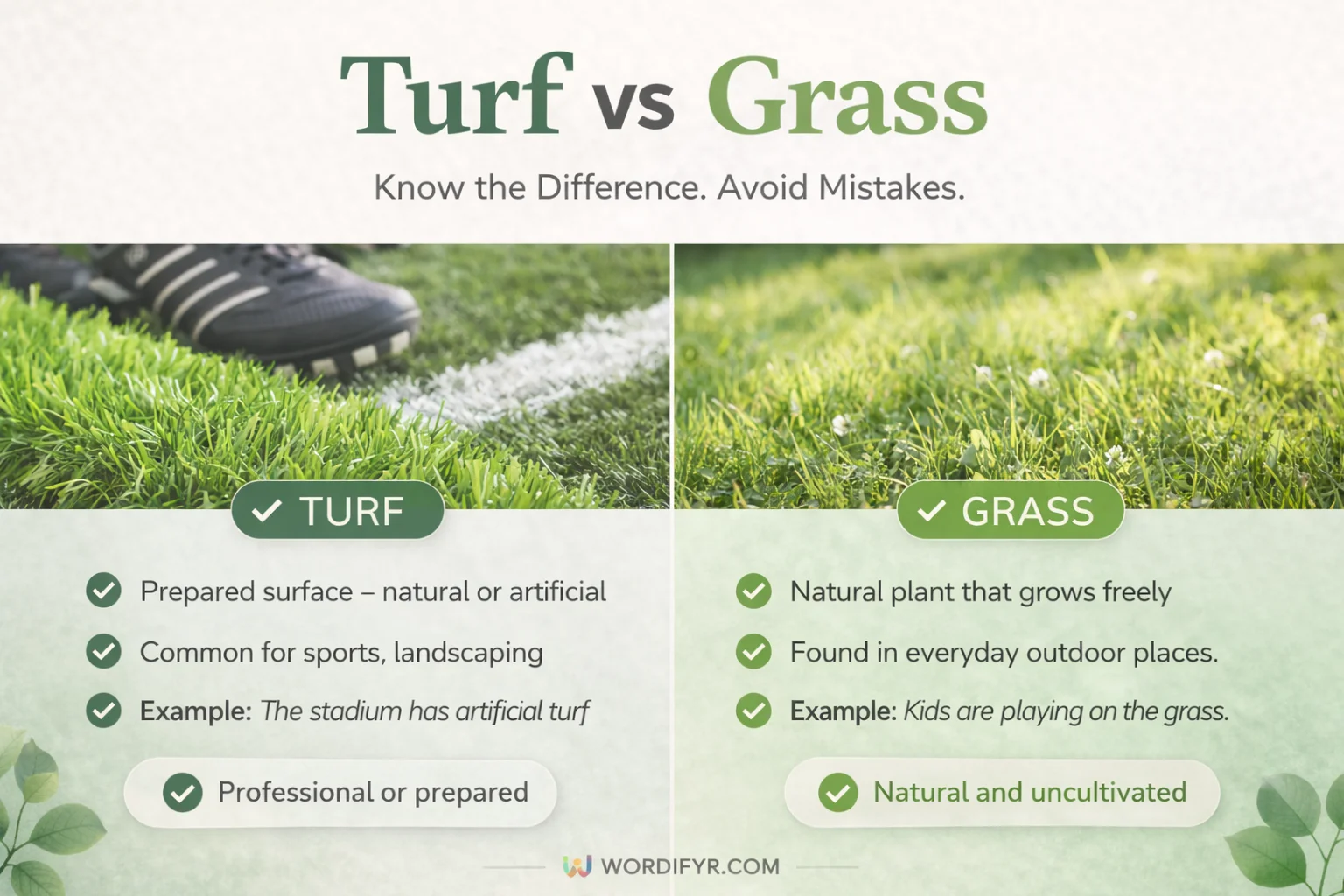
Turf refers to grass that is specially grown and maintained, often as a layer with soil and roots attached or as artificial grass used for sports and landscaping.
How It’s Used
In the comparison of turf vs grass, turf is typically used in professional, landscaping, and sports contexts.
Types of Turf
- Natural Turf
- Real grass grown in sections (sod)
- Installed on lawns or sports fields
- Artificial Turf
- Synthetic material that looks like grass
- Used in stadiums and playgrounds
Where It’s Used
- Sports fields (football, cricket, golf)
- Landscaped lawns
- Stadiums and indoor arenas
Examples in Sentences
- “The stadium uses artificial turf.”
- “They installed fresh turf in the garden.”
- “The players prefer natural turf.”
Key Characteristics
- Carefully maintained
- Even and uniform surface
- Designed for durability
- Can be natural or synthetic
Short Usage Note
The word “turf” originally meant a piece of land covered with grass and soil. Today, it often implies a prepared or managed surface.
👉 In turf vs grass, turf = prepared, installed, or professional surface.
What Is “Grass”?
Meaning
Grass is a natural plant that grows on the ground in fields, gardens, and wild areas.
How It’s Used
In turf vs grass, grass is the general, everyday term for green vegetation covering the land.
Where It’s Found
- Lawns and backyards
- Parks and forests
- Roadsides and open fields
Examples in Sentences
- “The grass is growing quickly after the rain.”
- “Children are playing on the grass.”
- “We need to cut the grass this weekend.”
Key Characteristics
- Grows naturally
- Uneven and varied
- Requires regular care (watering, mowing)
- Not always uniform
Scientific Note
Grass belongs to the plant family Poaceae, one of the most widespread plant groups on Earth.
👉 In turf vs grass, grass = natural plant growth.
Key Differences Between Turf and Grass
Quick Bullet Points
- Grass is natural; turf is prepared or installed
- Turf can be artificial, grass cannot
- Grass grows freely; turf is controlled and maintained
- Turf is common in sports; grass is everywhere
- Turf is uniform; grass is irregular
Comparison Table
| Feature | Turf | Grass |
|---|---|---|
| Type | Natural or artificial surface | Natural plant |
| Growth | Installed or cultivated | Grows naturally |
| Usage | Sports, landscaping | General environment |
| Appearance | Even and uniform | Uneven and natural |
| Maintenance | High (especially sports turf) | Moderate |
| Example | Football turf | Backyard grass |
Real-Life Conversation Examples
Dialogue 1
A: “Is this real grass?”
B: “No, it’s artificial turf.”
🎯 Lesson: Turf can be synthetic.
Dialogue 2
A: “The grass is too long.”
B: “We should mow it this weekend.”
🎯 Lesson: Grass grows naturally and needs trimming.
Dialogue 3
A: “Why is the field so smooth?”
B: “Because it’s professional turf.”
🎯 Lesson: Turf is designed for uniformity.
Dialogue 4
A: “Let’s sit on the grass.”
B: “Sure, it’s nice and soft.”
🎯 Lesson: Grass is commonly used in everyday settings.
Dialogue 5
A: “They replaced the lawn.”
B: “Yes, they installed new turf.”
🎯 Lesson: Turf is often installed, not grown naturally in place.
When to Use Turf vs Grass
Practical Usage Rules
Use turf when:
- Talking about sports fields
- Referring to installed lawns (sod)
- Describing artificial grass
Use grass when:
- Talking about natural plant growth
- Describing everyday outdoor areas
- Referring to general greenery
Memory Tricks
✔️ Turf = Technical & Treated
✔️ Grass = Grows naturally
✔️ Easy trick:
👉 If it’s installed or artificial → turf
👉 If it’s growing naturally → grass
US vs UK Usage
- Both US and UK English use “turf” and “grass” similarly
- “Turf” is more common in:
- Sports and landscaping industries
- “Grass” is universal and informal
Fun Facts or History
1. Artificial Turf Changed Sports
Artificial turf became popular in the 20th century, allowing games to be played in all weather conditions.
2. Grass Covers a Huge Part of Earth
Grasslands are one of the largest ecosystems on Earth, supporting wildlife and agriculture worldwide.
Conclusion
Understanding turf vs grass helps you use these terms correctly in both everyday and professional situations. While grass is a natural plant that grows freely, turf refers to a prepared, managed, or even artificial surface designed for specific uses like sports or landscaping.
The key difference lies in control and purpose—grass grows naturally, while turf is created or maintained for performance and appearance.
Once you remember this simple distinction, choosing the right word becomes easy.
Next time someone uses these two words, you’ll know exactly what they mean!