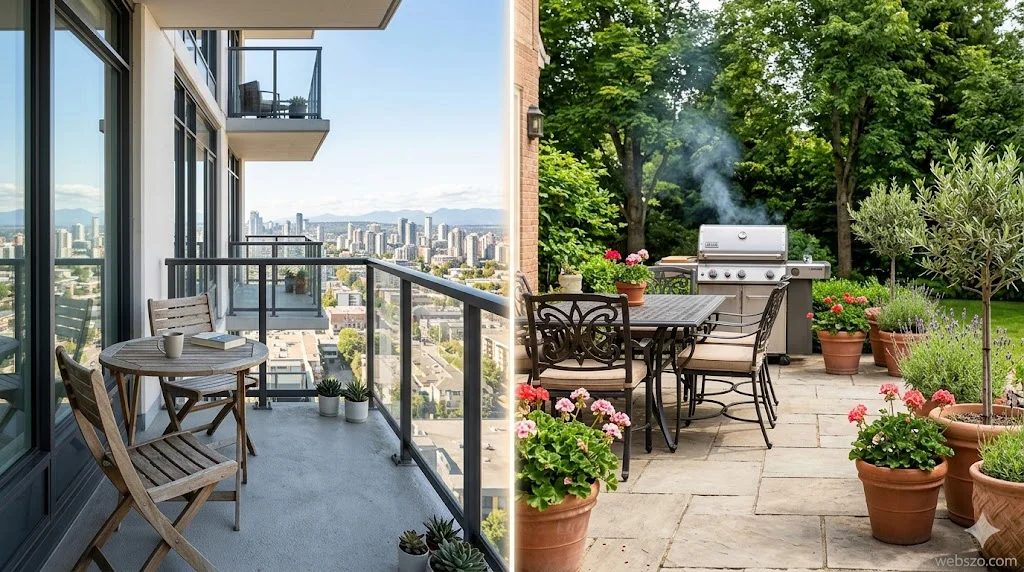
If you have ever stood in a furniture store or browsed home listings, the words balcony and patio have probably caused you to pause. They look and sound similar when we talk about relaxing outdoors, but in architectural and practical terms, they serve completely different purposes.
Because of their similarities, many homeowners—and even some real estate professionals—get confused about which one is correct for their needs. Here is the truth: both are excellent additions to a home, but they are not the same in terms of construction, location, or usage. Whether you are looking for a private perch or a ground-level entertainment hub, clearing this confusion is the first step to mastering your outdoor living space.
What Is a Balcony?
A balcony is an elevated outdoor platform that is attached to the side of a building, typically above the first floor.
Meaning and Essence
The word “balcony” refers to an extension of the indoor living space to the outdoors, usually enclosed by a railing or balustrade for safety. It is a “thing” or an architectural feature. Unlike ground-level spaces, a balcony offers a vertical perspective and is often synonymous with apartment living or upper-story master bedrooms.
How and Where It’s Used
- High-Rise Living: Common in apartments or condos where ground space is limited.
- Private Use: Often used for small activities like morning coffee or reading.
- Visual Appeal: Adds an aesthetic element to the exterior of a building.
Examples in Sentences
- “I need to go out on the balcony to get some fresh air.”
- “The apartment’s balcony overlooks the city park.”
- “We should place some small potted plants on the balcony.”
A Historical Usage Note
The term has roots in the Italian word balcone, meaning scaffold. Historically, they were used for public speeches or as defensive vantage points before becoming the private leisure spots we know today.
What Is a Patio?
A patio is a ground-level outdoor space used for dining or recreation, typically paved and adjoining a house.
Meaning and Essence
In the world of home design, a patio is the act or habit of creating an outdoor “room” directly on the earth. It is used for activities, routines, and habits involving larger groups or heavier furniture. It is generally not elevated and does not require a railing unless it transitions into a steep garden.
How and Where It’s Used
- Backyard Entertaining: Used for BBQ grills, large dining tables, and fire pits.
- Landscaping: Often integrated with gardens, pools, or stone pathways.
- Durability: Built with heavy materials like concrete, brick, or flagstone.
Examples in Sentences
- “We are hosting a dinner party on the patio tonight.”
- “The concrete patio was built last summer.”
- “You need more furniture for your outdoor patio.”
A Usage Note
While a balcony is an “action” of extending a building outward, a patio is a “thing” that sits firmly on the ground. In American English, “patio” is the standard term for these paved ground-level areas.
Key Differences Between Balcony and Patio
Understanding the core differences helps you choose the right furniture and decor.
- Elevation: A balcony is always elevated; a patio is almost always at ground level.
- Construction: Balconies are attached to the building structure; patios are independent or sit on the ground.
- Size: Patios generally offer more space for large crowds, while balconies are intimate.
- Safety: Balconies require railings (C-shaped enclosures), whereas patios are open-air.
Comparison Table: Balcony vs Patio
| Feature | Balcony | Patio |
| Location | Upper floors (Elevated) | Ground level (Earth-bound) |
| Support | Attached to building walls | Supported by the ground |
| Structure Type | Noun (The platform) | Noun (The paved area) |
| Common Use | Private relaxation | Socializing and dining |
| Safety Feature | Railings/Balustrades | None (usually) |
| American Usage | Used for elevated platforms | Used for all ground-level paved areas |
Real-Life Conversation Examples
Dialogue 1: The Apartment Hunt
A: “The listing says it has a patio, but we are on the 10th floor?”
B: “The landlord probably got confused; it’s definitely a balcony.” A: “Right, because we are elevated, it’s a balcony.” 🎯 Lesson: Elevation is the key differentiator; 10 floors up means it’s a balcony.
Dialogue 2: The Social Planner
A: “Should we host the BBQ on the balcony or the patio?”
B: “Is the grill heavy?” A: “Yes, and we have ten guests.” B: “Then use the patio—it’s larger and safer for the weight.” 🎯 Lesson: Patios are for “action” and heavy utility; balconies are for “things” like views.
Dialogue 3: The Design Choice
A: “I want to add a balcony to my bedroom.”
B: “That’s a great action to take for your home’s value.” A: “I just love the idea of stepping out from the second floor.” 🎯 Lesson: Balconies provide a unique “perch” from upper levels.
When to Use Balcony vs Patio
Use “Balcony” when:
- ✔️ You are talking about an elevated outdoor space.
- ✔️ You are referring to a space attached to an apartment or upper bedroom.
- ✔️ The space is enclosed by a railing.
Use “Patio” when:
- ✔️ You are talking about a ground-level paved area.
- ✔️ You are planning a large social gathering with a grill.
- ✔️ The space is made of stone, brick, or concrete on the ground.
Simple Memory Trick
➡️ Balcony = Building-attached (High up).
➡️ Patio = Paved-ground (Down low).
Fun Facts & History
- The Juliet Effect: The most famous balcony in history—Juliet’s in Verona—was actually added to the house in the 1930s to attract tourists!
- Etymology: “Patio” comes from a Spanish word meaning “back garden” or “courtyard.”
- Regional Naming: In some parts of Australia and the UK, a “patio” might be referred to as a “terrace” if it is large and multi-leveled.
Conclusion
The difference between a balcony and a patio is simple once you look at the elevation. A balcony is an elevated platform attached to a building, while a patio is a paved space at ground level. In American English, these terms are distinct and rarely mixed up in professional architectural settings. If you are looking for a view, go for the balcony; if you want a BBQ, stick with the patio.
Next time someone uses these two words, you’ll know exactly what they mean!