Introduction
If you’ve ever replaced a fluorescent tube light in your home, office, garage, or warehouse, you’ve probably come across labels like T8 and T12. At first glance, they look like simple product codes, but they actually represent two different types of fluorescent tubes with distinct sizes, technologies, and energy efficiencies.
Many people searching for T8 vs T12 assume these fluorescent tubes are interchangeable because they have a similar shape and are commonly used in the same kinds of light fixtures. While they may look alike, they differ in power consumption, brightness, ballast compatibility, operating costs, and overall performance. Installing the wrong tube can lead to compatibility issues, reduced efficiency, or even fixture damage if the ballast isn’t suitable.
Over the past few decades, lighting technology has evolved significantly. Older fluorescent systems that once dominated homes and commercial buildings have gradually been replaced by more energy-efficient alternatives. Understanding the difference between T8 and T12 not only helps you choose the right replacement bulb but can also lower your electricity bills and improve lighting quality.
In this complete guide, you’ll learn exactly what T8 and T12 fluorescent tubes are, how they work, their advantages and disadvantages, where each type is commonly used, and which option is the better investment today.
What Is a T8 Fluorescent Tube?
A T8 is a type of fluorescent tube light with a diameter of 8 eighths of an inch, which equals 1 inch (25 mm).
The letter “T” stands for Tubular, while the number represents the tube’s diameter measured in eighths of an inch.
Simply put:
T8 = Tubular fluorescent lamp that is 1 inch in diameter.
Although the size may seem like a minor detail, it has a significant impact on energy efficiency, light output, and compatibility with modern lighting systems.
How Does a T8 Light Work?
Like all fluorescent lamps, a T8 tube produces light by passing electricity through mercury vapor inside the tube.
Here’s a simplified explanation of the process:
- Electricity flows through the ballast.
- The ballast starts the fluorescent tube.
- Mercury vapor inside the tube becomes energized.
- Ultraviolet (UV) light is produced.
- The phosphor coating inside the tube converts UV light into visible light.
Modern T8 fixtures typically use electronic ballasts, which start instantly, eliminate noticeable flickering, and consume less electricity than older magnetic systems.
Common Uses of T8 Lighting
Today, T8 fluorescent tubes are one of the most widely used lighting solutions in commercial and institutional buildings.
You’ll commonly find them in:
- Office buildings
- Schools and universities
- Hospitals
- Retail stores
- Warehouses
- Workshops
- Parking garages
- Supermarkets
- Modern residential garages and basements
Because they provide bright, consistent illumination while using less electricity, T8 lights became the industry standard for many years before LED lighting gained popularity.
Benefits of T8 Fluorescent Lights
Many building owners upgraded from T12 to T8 because of the advantages they offer.
Some of the biggest benefits include:
Better Energy Efficiency
T8 tubes consume significantly less electricity than older T12 lamps while producing similar or even better brightness.
Lower energy use translates into:
- Reduced electricity bills
- Lower operating costs
- Better environmental performance
Brighter, More Consistent Light
T8 lamps produce cleaner and more uniform illumination.
Compared to older fluorescent technology, they generally offer:
- Better color rendering
- More even brightness
- Less flickering
- Faster startup
This makes workplaces more comfortable and productive.
Longer Lifespan
Most T8 fluorescent tubes last considerably longer than traditional T12 lamps.
Depending on the manufacturer and operating conditions, many T8 bulbs provide:
- 20,000–36,000 hours of use
A longer lifespan means fewer replacements and lower maintenance costs.
Compatible with Electronic Ballasts
Unlike T12 systems, most T8 fixtures use electronic ballasts.
Electronic ballasts offer several improvements:
- Quieter operation
- Faster startup
- Better efficiency
- Reduced heat generation
- Longer lamp life
Example Sentences Using T8
Here are a few examples of how the term is used naturally:
- “We upgraded our office lighting from T12 to T8 to reduce electricity costs.”
- “Most modern commercial buildings use T8 fluorescent tubes.”
- “The warehouse became much brighter after installing T8 fixtures.”
- “T8 bulbs usually require an electronic ballast.”
Brief History of T8 Lighting
T8 fluorescent tubes became popular during the 1990s as governments and businesses looked for more energy-efficient lighting solutions.
Compared to T12 lamps, they consumed less electricity while providing similar or better brightness. As energy regulations became stricter, T8 lighting gradually replaced T12 systems in offices, schools, hospitals, and commercial buildings around the world.
Although LED lighting is now becoming the preferred option, T8 fluorescent tubes are still widely used in many existing installations.
What Is a T12 Fluorescent Tube?
A T12 is an older type of fluorescent tube with a diameter of 12 eighths of an inch, which equals 1.5 inches (38 mm).
Like T8, the “T” means Tubular, while the number indicates the tube’s diameter.
Simply put:
T12 = Tubular fluorescent lamp that is 1.5 inches in diameter.
Its larger size reflects older lighting technology developed before energy efficiency became a major priority.
How Does a T12 Light Work?
The basic operating principle is similar to a T8 lamp.
Electricity energizes mercury vapor inside the tube, producing ultraviolet light, which the phosphor coating converts into visible light.
However, most T12 systems rely on magnetic ballasts instead of electronic ones.
Magnetic ballasts consume more electricity and often cause:
- Visible flickering
- Buzzing sounds
- Slower startup
- Lower efficiency
These drawbacks are among the main reasons T12 systems have largely been replaced.
Where Are T12 Lights Commonly Found?
Although they’re becoming less common, T12 fluorescent tubes still exist in many older buildings.
You’ll often find them in:
- Older office buildings
- Warehouses built before the 1990s
- Schools with outdated lighting
- Industrial facilities
- Older residential garages
- Storage buildings
- Workshops
Many property owners continue using them until fixtures require replacement.
Advantages of T12 Lighting
While T12 technology is outdated, it still offers a few benefits.
These include:
Lower Initial Fixture Cost
Older buildings already equipped with T12 fixtures don’t require immediate replacement.
This can reduce short-term renovation expenses.
Easy Replacement in Existing Systems
If your fixture already uses T12 tubes and magnetic ballasts, replacing the bulb is straightforward.
However, finding replacement tubes has become increasingly difficult in many regions.
Disadvantages of T12 Lighting
The disadvantages of T12 lighting outweigh its benefits for most users today.
Common drawbacks include:
- Higher electricity consumption
- Shorter lifespan
- Lower brightness over time
- Increased maintenance costs
- Magnetic ballast failures
- Reduced efficiency
- More environmental impact
Because of these issues, many governments have introduced regulations limiting the production and sale of T12 fluorescent lamps.
Example Sentences Using T12
Here are a few examples:
- “Our warehouse still uses T12 fluorescent lighting.”
- “The electrician recommended replacing the T12 fixtures.”
- “Finding T12 replacement tubes is becoming more difficult.”
- “Older buildings often rely on T12 lighting systems.”
Why Is T12 Being Phased Out?
One of the biggest reasons T12 fluorescent tubes are disappearing is energy efficiency.
Compared with T8 and modern LED lighting, T12 lamps:
- Consume more electricity
- Produce more heat
- Require magnetic ballasts
- Cost more to operate over time
As governments introduced stricter energy regulations, manufacturers shifted production toward more efficient lighting technologies.
Today, many businesses choose to upgrade directly to T8 or LED systems instead of continuing to maintain aging T12 fixtures.
T8 vs T12: Key Differences
Although T8 and T12 fluorescent tubes perform the same basic function—providing illumination—they differ in several important ways. Understanding these differences will help you choose the right lighting system for your home or business.
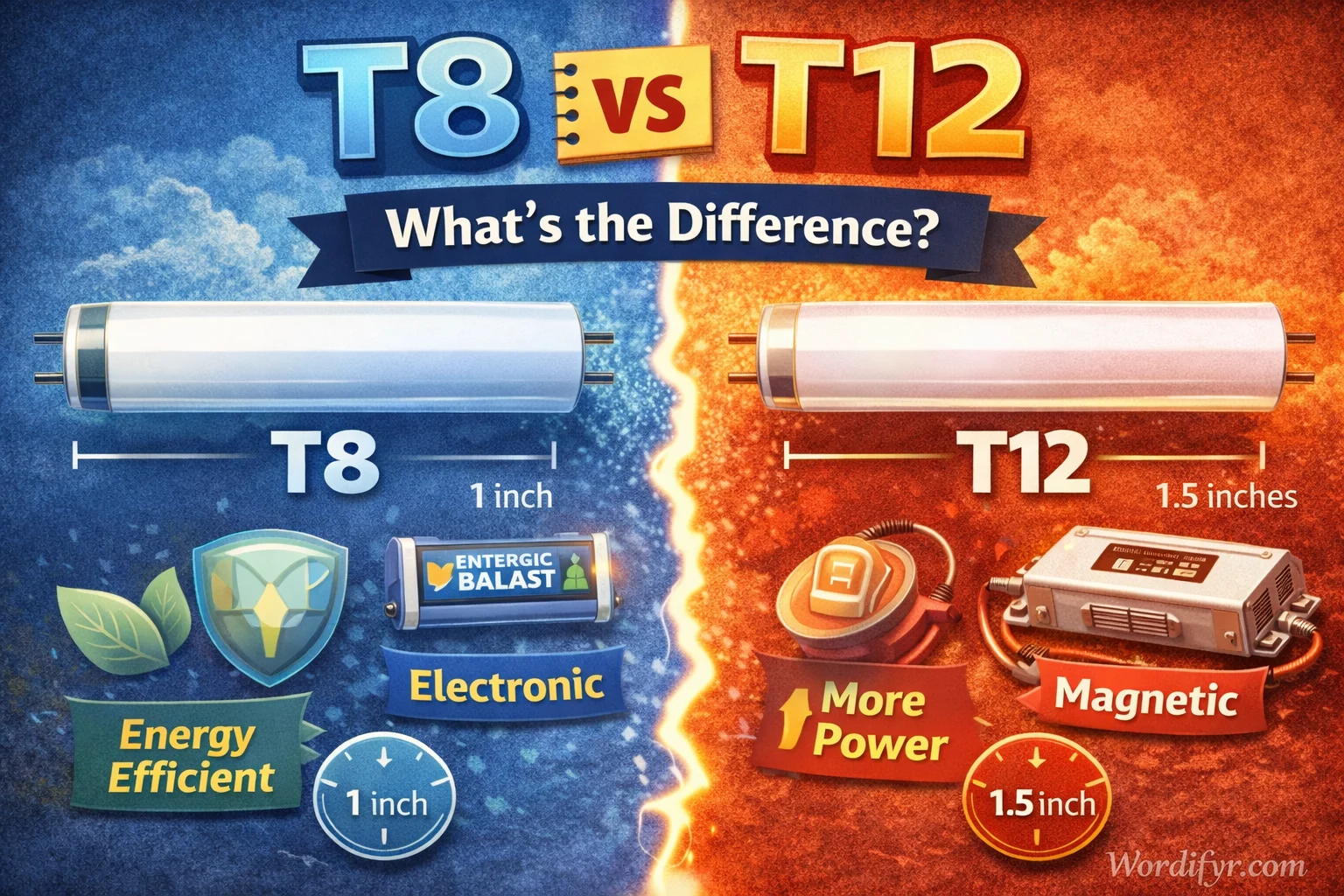
1. Tube Diameter
The most obvious difference is the tube’s thickness.
- T8: 8/8 inch (1 inch or 25 mm)
- T12: 12/8 inch (1.5 inches or 38 mm)
The larger diameter of T12 tubes reflects older fluorescent technology, while T8 tubes have a slimmer and more modern design.
2. Energy Efficiency
Energy consumption is one of the biggest reasons people upgrade from T12 to T8.
T8 fluorescent tubes require less electricity while producing nearly the same amount of light. This makes them a far more economical choice for offices, schools, warehouses, and commercial buildings where lights remain on for long hours.
If lowering your electricity bill is a priority, T8 is the clear winner.
3. Ballast Compatibility
Another major difference is the type of ballast each tube uses.
Most T12 fixtures rely on magnetic ballasts, which are older, heavier, and less efficient.
T8 fixtures use electronic ballasts, offering several advantages:
- Faster startup
- Less flickering
- Silent operation
- Lower power consumption
- Longer lamp life
If you’re replacing a T12 tube with a T8 tube, you may also need to replace the ballast unless your fixture is already compatible.
4. Brightness and Light Quality
Although both lamps provide sufficient illumination, T8 tubes generally deliver brighter and more consistent light.
Compared with T12 lamps, T8 tubes usually offer:
- Better color rendering
- More uniform brightness
- Less flickering
- Improved visual comfort
This is one reason modern offices and educational facilities prefer T8 lighting.
5. Lifespan
Another important consideration is longevity.
Typical lifespan:
- T8: 20,000–36,000 hours
- T12: 12,000–24,000 hours
Longer life means fewer replacements and lower maintenance costs.
6. Availability
Finding replacement T12 tubes has become increasingly difficult.
Many manufacturers have reduced or discontinued production due to energy regulations.
T8 tubes, however, remain widely available in hardware stores and lighting suppliers, although LED replacements are becoming even more popular.
T8 vs T12 Comparison Table
| Feature | T8 | T12 |
|---|---|---|
| Tube Diameter | 1 inch (25 mm) | 1.5 inches (38 mm) |
| Technology | Modern fluorescent | Older fluorescent |
| Ballast | Electronic | Magnetic |
| Energy Efficiency | High | Lower |
| Brightness | Brighter and more stable | Gradually becomes dimmer |
| Lifespan | 20,000–36,000 hours | 12,000–24,000 hours |
| Electricity Cost | Lower | Higher |
| Maintenance | Less frequent | More frequent |
| Availability | Widely available | Becoming limited |
| Best Choice Today | ✔ Yes | ❌ Mostly outdated |
Can You Replace a T12 with a T8?
One of the most common questions homeowners ask is whether a T8 tube can replace a T12 tube.
The answer is:
Yes—but not always directly.
While both tubes often have the same length (such as 4 feet), they usually require different ballasts.
Before replacing a T12 with a T8, check:
- Fixture compatibility
- Ballast type
- Manufacturer recommendations
Many electricians recommend replacing the magnetic ballast with an electronic ballast during the upgrade.
Some people skip fluorescent tubes entirely and install LED retrofit tubes instead.
Which Is Better: T8 or T12?
For most people, T8 is the better option.
It provides:
- Lower energy consumption
- Better brightness
- Longer lifespan
- Lower maintenance costs
- Improved reliability
The only situation where T12 still makes sense is when you’re maintaining an older lighting system temporarily and replacing the entire fixture isn’t practical.
Real-Life Conversation Examples
Dialogue 1
John: Can I replace this old T12 tube with a T8?
Electrician: Yes, but you’ll probably need an electronic ballast first.
🎯 Lesson: Tube compatibility depends on the ballast.
Dialogue 2
Sarah: Why are our electricity bills so high?
Manager: Most of our warehouse still uses T12 lighting.
🎯 Lesson: Older lighting systems consume more electricity.
Dialogue 3
Alex: Our office lights flicker every morning.
Technician: Those old T12 fixtures should be upgraded to T8.
🎯 Lesson: Electronic ballasts improve lighting performance.
Dialogue 4
Emily: Which fluorescent tube lasts longer?
Store Employee: T8 tubes usually have a much longer lifespan.
🎯 Lesson: Modern fluorescent technology reduces maintenance.
Dialogue 5
David: Should I upgrade my entire lighting system?
Contractor: Absolutely. Switching from T12 to T8—or even LED—will save money over time.
🎯 Lesson: Lighting upgrades often pay for themselves through lower energy costs.
When Should You Choose T8?
A T8 lighting system is ideal if you:
- Want lower electricity bills
- Need brighter lighting
- Are renovating a building
- Want modern lighting technology
- Need reliable commercial lighting
- Want longer-lasting fluorescent tubes
T8 works particularly well in:
- Offices
- Retail stores
- Schools
- Hospitals
- Workshops
- Warehouses
Memory Trick
T8 = Today’s Technology
Think of T8 as the modern standard for fluorescent lighting.
When Should You Keep T12?
Although T12 is considered outdated, there are situations where keeping it temporarily makes sense.
Choose T12 only if:
- You’re maintaining an older building.
- The lighting system still functions properly.
- Immediate replacement isn’t financially possible.
- Replacement parts are still available.
However, long-term upgrades should still be planned.
Memory Trick
T12 = Traditional Technology
It represents an older generation of fluorescent lighting.
Should You Upgrade to LED Instead?
Many lighting professionals now recommend skipping T8 entirely and upgrading directly to LED lighting.
LED tubes offer several advantages:
- Even lower energy consumption
- Longer lifespan
- Instant startup
- No mercury
- Better environmental performance
- Lower maintenance costs
Although LEDs typically cost more upfront, they often provide greater savings over time.
If you’re replacing an entire lighting system, LED is worth considering.
Frequently Asked Questions
Are T8 and T12 the same length?
Yes. Many T8 and T12 tubes are available in the same lengths, such as 2-foot, 4-foot, or 8-foot versions. The main difference is their diameter and ballast compatibility.
Is T8 brighter than T12?
Generally, yes. T8 tubes produce brighter, more consistent light while using less electricity.
Can I use a T8 bulb in a T12 fixture?
Sometimes. However, you may need to replace the magnetic ballast with an electronic ballast first.
Why are T12 lights disappearing?
Governments introduced stricter energy-efficiency regulations, making T12 technology less practical than newer alternatives.
Is LED better than both T8 and T12?
For most applications, yes. LED lighting consumes less electricity, lasts much longer, and requires less maintenance.
Interesting Facts About T8 and T12
The “T” Doesn’t Mean Technology
Many people think the “T” refers to the type of technology.
In reality, it simply stands for Tubular.
The number indicates the tube’s diameter measured in eighths of an inch.
T12 Dominated Buildings for Decades
Before T8 became popular during the 1990s, T12 fluorescent tubes were the standard lighting solution for offices, factories, schools, and warehouses worldwide.
Millions of older buildings still contain these original fixtures.
Lighting Technology Continues to Improve
Today’s lighting industry is moving rapidly toward LED technology because it offers better efficiency, lower maintenance costs, and a smaller environmental footprint than fluorescent lighting.
For many businesses, LEDs have become the long-term replacement for both T8 and T12 systems.
Final Thoughts
Understanding the difference between T8 vs T12 is essential when replacing fluorescent tube lights or upgrading an older lighting system. While both types serve the same basic purpose, they differ significantly in size, energy efficiency, ballast compatibility, lifespan, and operating costs.
For most homes and commercial buildings, T8 fluorescent tubes are the better choice. They consume less electricity, provide brighter and more consistent illumination, and require less maintenance than older T12 lamps. They also work with electronic ballasts, which improve efficiency and reduce flickering.
If you’re still using T12 fixtures, consider planning an upgrade. Whether you switch to T8 or invest directly in LED lighting, modern lighting technology can reduce energy costs, improve brightness, and provide long-term savings. By understanding the strengths and limitations of each option, you can confidently choose the lighting solution that best fits your needs.