
Introduction
If you’ve ever watched a dinosaur movie or read about prehistoric creatures, you’ve probably heard the names pterodactyl and pteranodon used almost interchangeably. They both look like flying reptiles with long wings, sharp beaks, and dramatic appearances—so it’s easy to see why people confuse them. But here’s the catch: one of these names is often used incorrectly in everyday language.
Although they look similar, they serve completely different purposes.
In this guide, we’ll break down pterodactyl vs pteranodon in simple, clear terms—covering meanings, scientific differences, examples, and practical ways to remember which is which.
What Is “Pterodactyl”?
The term pterodactyl is commonly used to describe flying reptiles from prehistoric times, but scientifically, it refers to a specific group called Pterodactylus.
Meaning and Purpose
In the context of pterodactyl vs pteranodon, pterodactyl is often used as a general or informal name for flying reptiles known as pterosaurs.
➡️ Simple definition:
Pterodactyl = early, smaller flying reptile (often used broadly)
How It’s Used
- In movies and media, “pterodactyl” is used as a catch-all term
- In science, it refers specifically to Pterodactylus, one of the earliest known pterosaurs
- Often used informally instead of more accurate names
Where It’s Used
- Popular culture (movies, cartoons, games)
- Basic educational content
- Casual conversations
Examples in Sentences
- “The movie showed a giant pterodactyl flying over the island.”
- “Kids often learn the word pterodactyl before more complex names.”
- “In the debate of pterodactyl vs pteranodon, accuracy matters.”
Historical Note
The name Pterodactylus was first described in 1784, making it one of the earliest identified flying reptiles. Over time, the word “pterodactyl” became popular but less precise.
What Is “Pteranodon”?
A pteranodon is a specific type of large flying reptile that lived during the late Cretaceous period. Unlike pterodactyl, it is a scientifically accurate and widely accepted term.
Meaning and Purpose
In pterodactyl vs pteranodon, pteranodon refers to a distinct genus of pterosaur known for its large wingspan and head crest.
➡️ Simple definition:
Pteranodon = large, advanced flying reptile with no teeth
How It’s Used
- Used in scientific discussions
- Common in documentaries and museums
- Represents a more advanced pterosaur species
Where It’s Used
- Paleontology research
- Educational materials
- Accurate dinosaur-related content
Examples in Sentences
- “The pteranodon had a wingspan of over 20 feet.”
- “Unlike early species, the pteranodon had no teeth.”
- “Understanding pterodactyl vs pteranodon helps avoid common mistakes.”
Regional or Scientific Notes
- The name comes from Greek:
- “pteron” = wing
- “anodon” = toothless
- It literally means “toothless wing”
Key Differences Between Pterodactyl and Pteranodon
Understanding pterodactyl vs pteranodon becomes simple when you compare their scientific roles.
Quick Bullet Differences
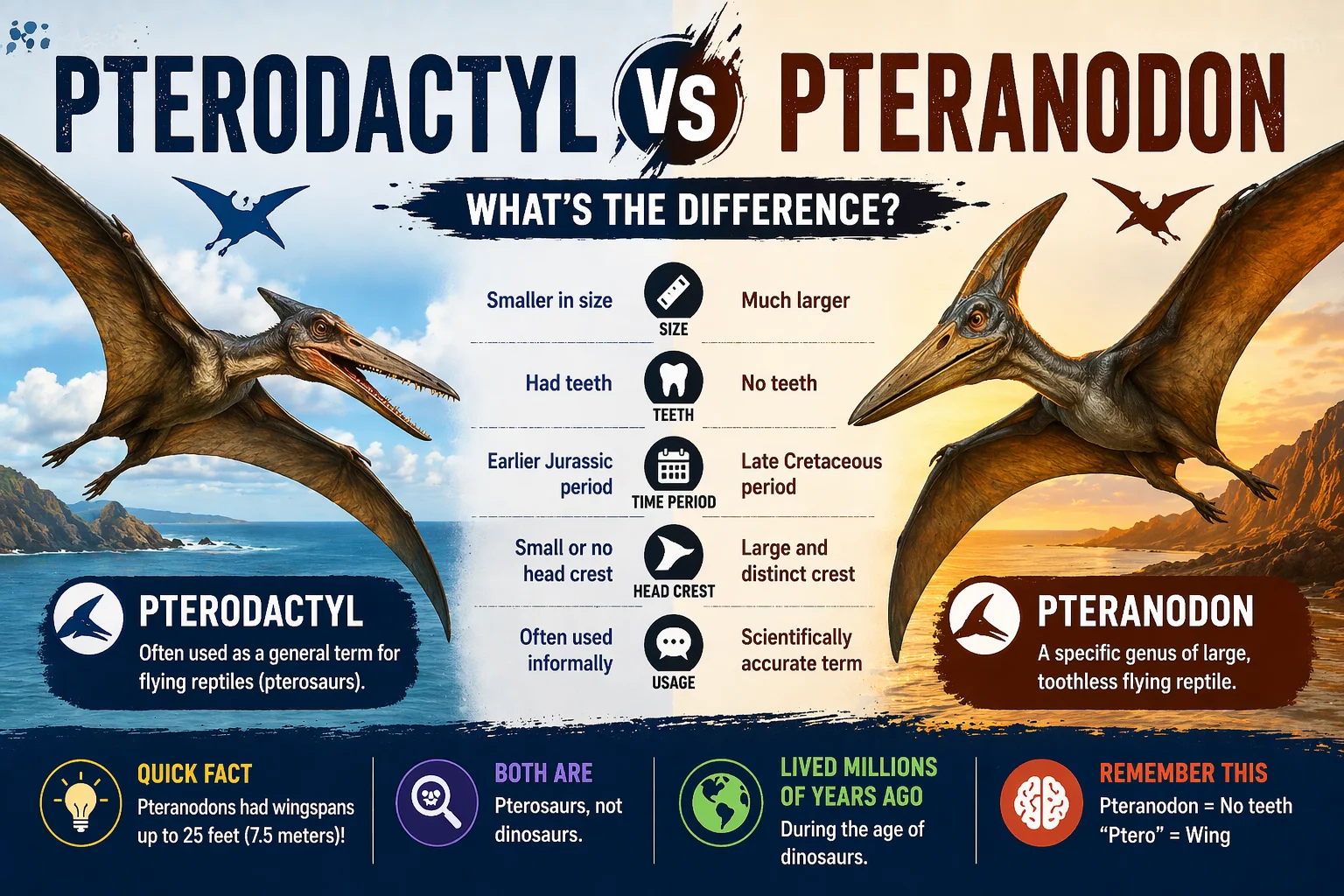
- Pterodactyl is often a general term; pteranodon is specific
- Pterodactyls were smaller; pteranodons were larger
- Pterodactyls had teeth; pteranodons had no teeth
- Pterodactyl is often misused in media
- Pteranodon is scientifically accurate
- Pteranodons had large head crests
Comparison Table
| Feature | Pterodactyl | Pteranodon |
|---|---|---|
| Scientific Accuracy | Often misused | Correct genus |
| Size | Smaller | Much larger |
| Teeth | Yes | No |
| Time Period | Earlier Jurassic | Late Cretaceous |
| Usage | Informal/common | Scientific/accurate |
| Head Crest | Small or none | Large, distinctive |
| Popularity | Common name | Scientific name |
Real-Life Conversation Examples
Dialogue 1
A: “Look, a pterodactyl!”
B: “It’s actually a pteranodon.”
🎯 Lesson: In pterodactyl vs pteranodon, accuracy matters in scientific naming.
Dialogue 2
A: “Why do movies always say pterodactyl?”
B: “Because it’s easier to remember.”
🎯 Lesson: “Pterodactyl” is often used for simplicity, not accuracy.
Dialogue 3
A: “Do pteranodons have teeth?”
B: “No, that’s one key difference.”
🎯 Lesson: Tooth presence is a major distinction in pterodactyl vs pteranodon.
Dialogue 4
A: “Which one is bigger?”
B: “Pteranodon, by a lot.”
🎯 Lesson: Size helps differentiate the two.
Dialogue 5
A: “So are they dinosaurs?”
B: “No, both are flying reptiles, not true dinosaurs.”
🎯 Lesson: Both belong to pterosaurs, not dinosaurs.
When to Use Pterodactyl vs Pteranodon
Use “Pterodactyl” When:
✔️ Speaking casually
✔️ Referring broadly to flying reptiles
✔️ Writing for beginners or kids
Use “Pteranodon” When:
✔️ Writing scientifically accurate content
✔️ Discussing specific species
✔️ Creating educational or research material
Memory Tricks
- Pteranodon = “No-don” → No teeth
- Pterodactyl = general term (like nickname)
US vs UK Usage
There are no regional spelling differences. Both terms are used globally in the same way, especially in scientific contexts.
Fun Facts or History
1. Not Dinosaurs!
Despite popular belief, both pterodactyls and pteranodons are pterosaurs, not dinosaurs.
2. Massive Wingspan
Some pteranodons had wingspans over 25 feet, making them among the largest flying reptiles ever.
Conclusion
The difference between pterodactyl vs pteranodon comes down to accuracy and detail. Pterodactyl is often used as a general or informal term, while pteranodon is a specific, scientifically correct name for a large, toothless flying reptile. They may look similar, but their size, features, and proper usage set them apart.
By understanding these differences, you can speak and write more accurately about prehistoric life. Whether you’re watching a movie or studying fossils, the distinction is worth knowing.
Next time someone uses these two words, you’ll know exactly what they mean!