
Introduction
If you’ve ever come across the terms colostomy and ileostomy, you might have paused for a moment, wondering if they mean the same thing. They sound similar, are both related to surgery, and are often mentioned in medical discussions—so it’s no surprise people mix them up. For patients, caregivers, and even students, understanding the difference between colostomy vs ileostomy is important for making informed decisions about health and treatment options.
Although they look similar, they serve completely different purposes.
In this guide, we’ll break down colostomy vs ileostomy in a simple, clear, and practical way—covering meanings, uses, differences, real-life examples, and helpful memory tricks to make everything stick.
What Is “Colostomy”?
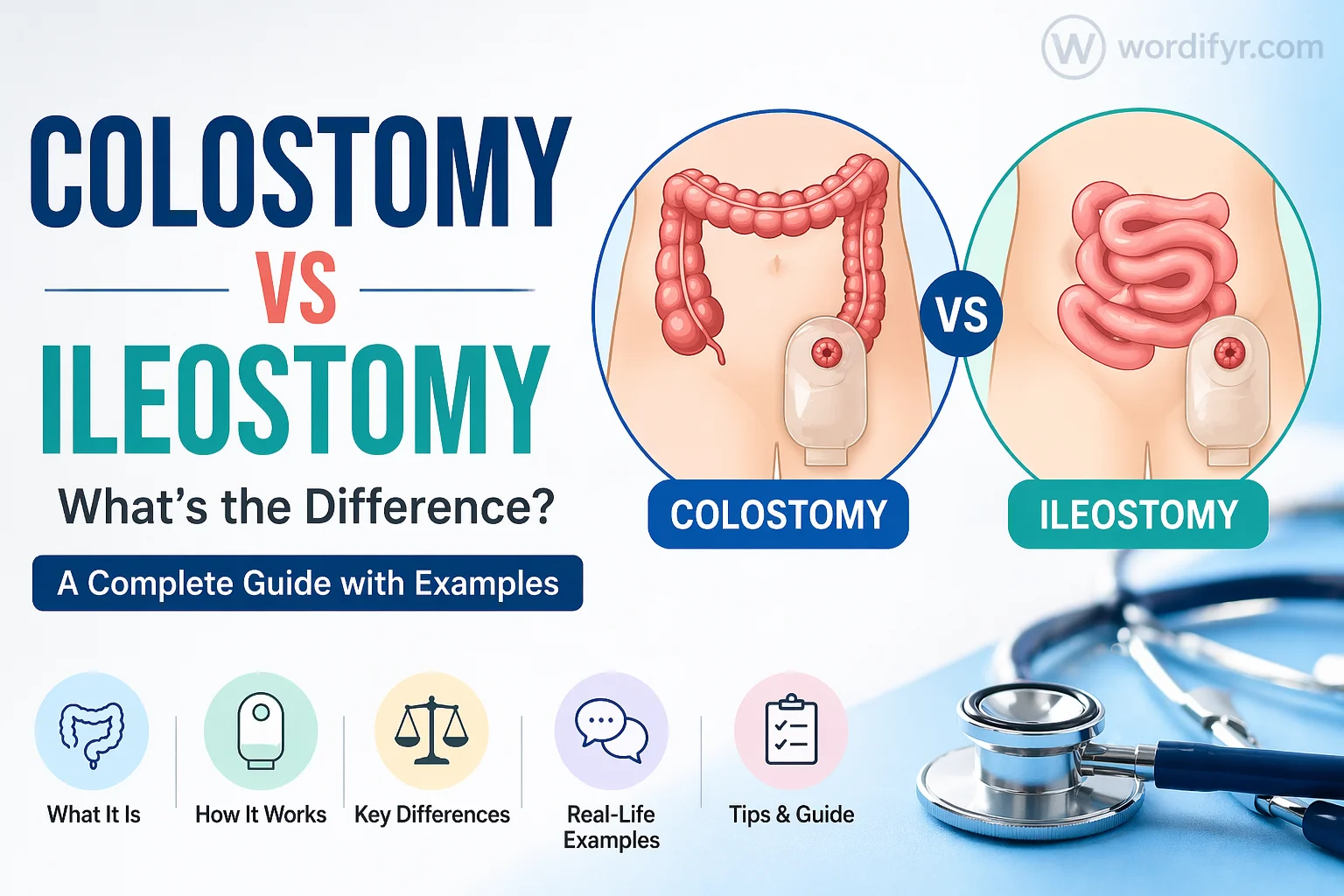
A colostomy is a surgical procedure in which a part of the large intestine (colon) is brought through the abdominal wall to create an opening called a stoma. This opening allows waste (stool) to exit the body into a collection bag.
Meaning and Purpose
In the colostomy vs ileostomy comparison, a colostomy specifically involves the colon, which is the final part of the digestive system. Because of this, the stool is usually more formed and solid, similar to normal bowel movements.
How It’s Used
Doctors perform a colostomy when:
- The colon needs time to heal
- There is damage or disease (e.g., cancer, injury)
- A blockage prevents normal waste passage
It can be temporary or permanent, depending on the condition.
Where It’s Used
Colostomies are common worldwide and are standard procedures in:
- Cancer treatment (colon cancer)
- Trauma surgery
- Inflammatory bowel disease management
Examples in Sentences
- “After surgery, he needed a colostomy to allow his colon to recover.”
- “She learned how to manage her colostomy bag confidently.”
- “The doctor explained the benefits of a colostomy vs ileostomy for her condition.”
Historical Note
The concept of colostomy dates back to the 18th century, but it became safer and more common with advances in anesthesia and surgical techniques in the 19th and 20th centuries.
What Is “Ileostomy”?
An ileostomy is also a surgical procedure, but instead of the colon, it involves the ileum, which is the last part of the small intestine.
Meaning and Purpose
In the colostomy vs ileostomy discussion, the key difference lies in anatomy. An ileostomy bypasses the entire colon, meaning waste does not pass through the large intestine at all.
As a result, the output is:
- Liquid or semi-liquid
- More frequent
- Rich in digestive enzymes
How It’s Used
An ileostomy is typically required when:
- The colon is removed (e.g., due to severe disease)
- Conditions like ulcerative colitis or Crohn’s disease affect the large intestine
- There is a need for complete bowel diversion
Where It’s Used
Ileostomies are commonly performed in:
- Advanced inflammatory bowel disease cases
- Colon removal surgeries
- Emergency abdominal procedures
Examples in Sentences
- “She had an ileostomy after her colon was removed.”
- “Managing an ileostomy requires careful attention to hydration.”
- “Doctors compared colostomy vs ileostomy before recommending surgery.”
Regional or Medical Notes
Unlike language-based differences, colostomy vs ileostomy is purely medical terminology, used consistently worldwide. There are no spelling or grammar variations—only clinical differences.
Key Differences Between Colostomy and Ileostomy
Understanding colostomy vs ileostomy becomes easier when you focus on a few core distinctions.
Quick Bullet Differences
- Colostomy involves the large intestine (colon)
- Ileostomy involves the small intestine (ileum)
- Colostomy output is more solid
- Ileostomy output is liquid or semi-liquid
- Ileostomy requires more frequent bag emptying
- Colostomy may allow more predictable bowel movements
- Ileostomy often requires stricter diet and hydration management
Comparison Table
| Feature | Colostomy | Ileostomy |
|---|---|---|
| Body Part Involved | Colon (large intestine) | Ileum (small intestine) |
| Waste Consistency | Solid or semi-formed | Liquid or semi-liquid |
| Frequency of Output | Less frequent | More frequent |
| Control | More predictable | Less predictable |
| Hydration Needs | Normal | Increased (risk of dehydration) |
| Common Reasons | Colon cancer, injury | Crohn’s disease, ulcerative colitis |
| Permanence | Temporary or permanent | Often permanent |
| Digestive Process | Partially normal | Bypasses colon completely |
Real-Life Conversation Examples
Dialogue 1
A: “Is a colostomy the same as an ileostomy?”
B: “Not really. A colostomy uses the colon, while an ileostomy uses the small intestine.”
🎯 Lesson: The main difference in colostomy vs ileostomy is the part of the intestine used.
Dialogue 2
A: “Why is ileostomy output more liquid?”
B: “Because it skips the colon, which normally absorbs water.”
🎯 Lesson: In colostomy vs ileostomy, the colon plays a key role in forming solid stool.
Dialogue 3
A: “Which one is easier to manage?”
B: “Usually colostomy, since the output is more predictable.”
🎯 Lesson: Colostomy vs ileostomy differs in lifestyle impact and management.
Dialogue 4
A: “Do both require a bag?”
B: “Yes, both use an external pouch system.”
🎯 Lesson: Despite differences, both procedures involve stoma care.
Dialogue 5
A: “Why would someone need an ileostomy instead of a colostomy?”
B: “If the colon is completely removed or too damaged.”
🎯 Lesson: In colostomy vs ileostomy, the condition determines the procedure.
When to Use Colostomy vs Ileostomy
Choosing between colostomy vs ileostomy depends entirely on medical necessity, not preference.
Use Colostomy When:
- The colon is partially functional
- Only a section of the large intestine is affected
- Temporary diversion is needed
- More predictable bowel function is desired
Use Ileostomy When:
- The colon is removed or non-functional
- Severe diseases affect the entire colon
- Complete bowel diversion is required
Practical Memory Tricks
- “C” in Colostomy = Colon
- “I” in Ileostomy = Ileum
Another simple way:
- Colostomy → Closer to normal digestion
- Ileostomy → Immediate output (liquid)
Writing Context (US vs UK)
Unlike grammar topics, colostomy vs ileostomy has no regional spelling differences. Medical terminology remains consistent across:
- US English
- UK English
- International medical standards
Fun Facts or History
1. Life-Saving Innovation
Both colostomy and ileostomy have saved millions of lives, especially in cancer and emergency surgeries.
2. Modern Ostomy Care
Today’s ostomy bags are odor-proof, discreet, and skin-friendly, making life much easier compared to early designs.
Conclusion
Understanding the difference between colostomy vs ileostomy is simpler than it first appears. A colostomy involves the colon and produces more solid, predictable waste, while an ileostomy involves the small intestine and results in more liquid output. Each procedure serves a specific medical purpose and is chosen based on the patient’s condition and needs.
While they may sound alike, their functions, management, and impact on daily life are quite different. With the right knowledge, these terms become much easier to understand and remember.
Next time someone uses these two words, you’ll know exactly what they mean!