Introduction
If you’re planning to buy an off-road vehicle, you’ve probably come across the terms UTV and ATV. At first glance, they seem almost identical. Both are built for rough terrain, outdoor adventures, farming, hunting, and recreational riding. Because they share similar environments, many people assume they’re simply different names for the same type of vehicle.
In reality, that’s far from true.
The UTV vs ATV comparison is one of the most common sources of confusion among first-time buyers. While both are designed for off-road use, they differ significantly in design, seating capacity, safety, performance, handling, cargo capability, and intended use.
Choosing the wrong vehicle could mean paying more than necessary, sacrificing comfort, or ending up with a machine that doesn’t fit your lifestyle.
In this comprehensive guide, you’ll learn:
- What a UTV is
- What an ATV is
- The major differences between them
- Pros and cons of each
- Which vehicle suits different activities
- Real-world examples
- Frequently asked questions
By the end, you’ll know exactly which off-road vehicle is the right choice for you.
What Is a UTV?
Definition
UTV stands for Utility Task Vehicle (sometimes called a Utility Terrain Vehicle).
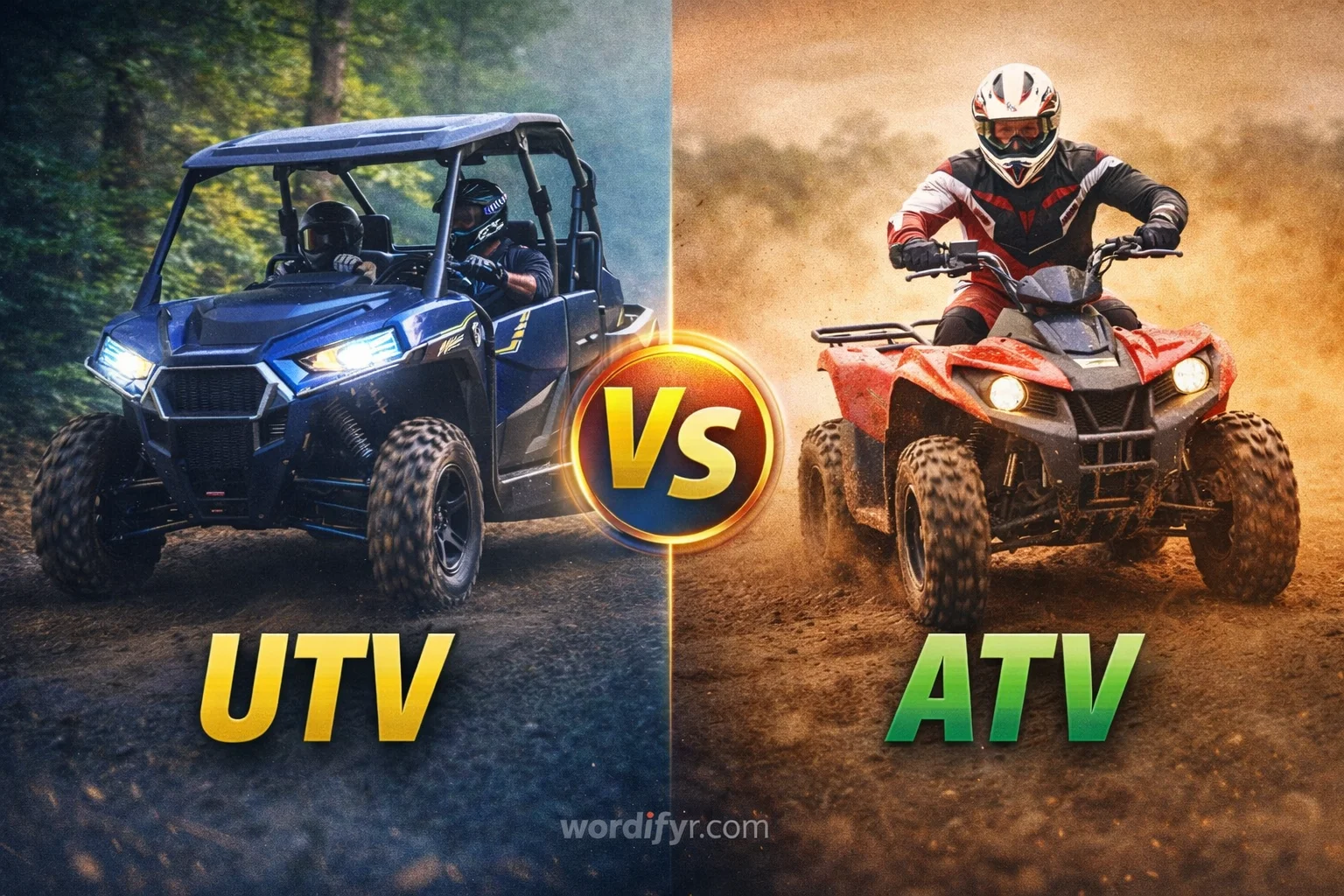
Unlike an ATV, a UTV is designed primarily for work, transporting people, and carrying cargo. It features side-by-side seating, allowing two to six passengers to ride comfortably together.
Because passengers sit next to each other, UTVs are often called Side-by-Sides (SxS).
Simply put:
UTV = A utility-focused off-road vehicle built for work, comfort, and multiple passengers.
How Does a UTV Work?
A UTV drives much like a small car.
Instead of handlebars, it has:
- Steering wheel
- Accelerator pedal
- Brake pedal
- Bucket seats
- Seat belts
- Roll cage
Many modern UTVs also include:
- Automatic transmission
- Four-wheel drive (4WD)
- All-wheel drive (AWD)
- Power steering
- Windshield
- Roof
- Doors
- Air conditioning (premium models)
These features make UTVs much easier for beginners to operate than ATVs.
Common Uses of UTVs
UTVs are incredibly versatile.
They are commonly used for:
- Farming
- Ranch work
- Forestry
- Construction sites
- Landscaping
- Hunting trips
- Trail riding
- Search and rescue operations
- Property maintenance
- Campgrounds
- Outdoor recreation
Many businesses rely on UTVs because they can carry workers, equipment, and supplies in a single trip.
Advantages of a UTV
Some of the biggest benefits include:
- Carries multiple passengers
- Large cargo bed
- Better stability
- Safer for beginners
- Comfortable seating
- Excellent towing capability
- Easier to drive for long hours
- Suitable for both work and recreation
Example Sentences
- “The farmer uses a UTV to transport fencing materials.”
- “Our family rented a UTV for mountain trails.”
- “Construction crews rely on UTVs to move equipment.”
Short History
UTVs became popular during the early 2000s as manufacturers recognized the need for an off-road vehicle that combined the utility of a pickup truck with the mobility of an ATV. Today, they are one of the fastest-growing segments in the off-road industry.
What Is an ATV?
Definition
ATV stands for All-Terrain Vehicle.
An ATV is a compact off-road vehicle designed primarily for one rider, although some models can accommodate two people.
Unlike a UTV, an ATV is controlled using handlebars, similar to a motorcycle.
Simply put:
ATV = A lightweight, rider-focused off-road vehicle built for agility, speed, and adventure.
How Does an ATV Work?
ATVs require the rider to actively control balance while steering.
Typical features include:
- Handlebar steering
- Straddle-style seat
- Thumb throttle
- Foot brakes
- Four large off-road tires
- Compact frame
The rider shifts body weight while turning, climbing hills, or crossing rough terrain.
This riding style makes ATVs more physically demanding but also much more agile.
Common Uses of ATVs
ATVs are widely used for:
- Trail riding
- Outdoor recreation
- Hunting
- Racing
- Exploring forests
- Mountain riding
- Beach riding
- Light farm work
- Snow riding (with tracks)
Many adventure enthusiasts prefer ATVs because they provide a more exciting riding experience.
Advantages of an ATV
ATVs offer several benefits:
- Lightweight
- Faster acceleration
- Excellent maneuverability
- Easier to transport
- Lower purchase price
- Fits narrow trails
- Great for recreational riding
- Less storage space required
Example Sentences
- “He rides his ATV every weekend through forest trails.”
- “ATVs are excellent for navigating rocky paths.”
- “She enjoys exploring mountain terrain on her ATV.”
Brief History
ATVs gained popularity during the 1970s and quickly became a favorite among outdoor enthusiasts. Over the years, manufacturers improved suspension, safety, and engine performance, making ATVs more capable than ever.
UTV vs ATV: Key Differences
Although both vehicles are designed for off-road environments, they serve different purposes.
Quick Comparison
- UTV seats multiple passengers; ATV usually seats one.
- UTV uses a steering wheel; ATV uses handlebars.
- UTV includes seat belts and a roll cage; ATV relies on rider balance.
- UTV is built for work and hauling; ATV focuses on recreation and agility.
- UTV is larger and heavier; ATV is smaller and more nimble.
- UTV offers more storage and towing capacity.
- ATV performs better on narrow, technical trails.
- UTV provides greater comfort during long rides.
UTV vs ATV Comparison Table
| Feature | UTV | ATV |
|---|---|---|
| Full Name | Utility Task Vehicle | All-Terrain Vehicle |
| Seating | 2–6 passengers | Usually 1 rider |
| Steering | Steering wheel | Handlebars |
| Controls | Similar to a car | Similar to a motorcycle |
| Cargo Capacity | High | Limited |
| Passenger Capacity | Excellent | Limited |
| Safety Features | Roll cage, seat belts | Helmet recommended |
| Comfort | High | Moderate |
| Maneuverability | Moderate | Excellent |
| Best For | Work, hauling, family rides | Recreation, racing, trail riding |
| Learning Curve | Easy | Moderate |
| Price | Generally higher | Usually lower |
Real-Life Conversation Examples
Dialogue 1
Alex: I’m buying a vehicle for my farm. Which is better?
Sam: A UTV is the better choice because it can haul equipment and supplies.
🎯 Lesson: UTVs are built for productivity and utility.
Dialogue 2
Chris: Why do trail riders love ATVs?
Taylor: They’re smaller, lighter, and easier to maneuver through tight trails.
🎯 Lesson: ATVs excel where agility matters.
Dialogue 3
Emma: Can four people ride together?
Ryan: Yes—but only in a UTV.
🎯 Lesson: UTVs are designed for passengers.
Dialogue 4
David: Which is safer for beginners?
Mark: Most beginners find UTVs easier because they have seat belts, roll cages, and car-like controls.
🎯 Lesson: UTVs offer greater built-in safety.
Dialogue 5
Lisa: Why does my ATV feel harder to control?
Jake: Because you have to balance your body while riding.
🎯 Lesson: Riding an ATV requires more skill and physical control.
UTV vs ATV: Which Should You Choose?
Choose a UTV If:
A UTV is the better option if you:
- Need to transport passengers
- Carry heavy tools or equipment
- Work on farms or ranches
- Maintain large properties
- Prioritize comfort and safety
- Need towing capability
- Plan long rides
- Want a vehicle for both work and recreation
Memory Trick
👉 UTV = Utility + Teamwork
Think of UTVs as off-road pickup trucks.
Choose an ATV If:
An ATV is the right choice if you:
- Ride mostly for fun
- Enjoy challenging trails
- Want a lighter vehicle
- Prefer speed and maneuverability
- Ride alone most of the time
- Have limited storage space
- Need to navigate narrow paths
- Enjoy adrenaline-filled adventures
Memory Trick
👉 ATV = Adventure + Thrill
Think of ATVs as off-road motorcycles with four wheels.
Can You Use a UTV and ATV for the Same Jobs?
Sometimes—but not always.
A UTV can perform many tasks an ATV can, such as trail riding and exploring.
However, an ATV cannot easily replace a UTV when you need to:
- Carry multiple passengers
- Haul heavy cargo
- Tow trailers
- Transport equipment
Likewise, while a UTV can handle recreational trails, an ATV often performs better on tight, technical terrain where its lighter weight and agility make a noticeable difference.
UTV vs ATV: Pros and Cons
UTV Pros
- Comfortable seating
- Higher safety
- Carries passengers
- Excellent cargo capacity
- Better for work
- Easier for beginners
UTV Cons
- More expensive
- Larger size
- Harder to transport
- Uses more fuel
ATV Pros
- Lower cost
- Lightweight
- Excellent maneuverability
- Great for recreation
- Easier to store
- Better on narrow trails
ATV Cons
- Limited passenger capacity
- Less cargo space
- Requires more riding skill
- Fewer built-in safety features
UTV vs ATV Around the World
Usage varies by region:
- United States: Both UTVs and ATVs are extremely popular for farming, hunting, and recreation.
- Canada: Frequently used for snow trails, forestry, and remote work.
- Australia: UTVs are common on ranches, while ATVs are popular for recreational riding.
- Europe: ATVs are generally more common, though UTVs are increasingly used in agriculture and tourism.
Always check your local laws regarding registration, helmets, licensing, and where off-road vehicles are permitted.
Fun Facts
1. UTVs Are Commonly Called “Side-by-Sides”
The nickname comes from the seating arrangement, where passengers sit next to each other instead of front and back.
2. ATVs Came First
ATVs gained popularity in the 1970s. UTVs were developed later to provide greater utility, comfort, and cargo capacity for work-related tasks.
Frequently Asked Questions (FAQs)
Is a UTV safer than an ATV?
Generally, yes. UTVs include features like seat belts, roll cages, and enclosed seating that provide added protection. However, safe operation and proper protective gear are essential for both.
Which is better for hunting?
It depends on your needs. A UTV is ideal if you’re carrying hunting partners or equipment, while an ATV is better for accessing narrow trails and remote areas.
Can I drive a UTV on public roads?
Road legality varies by state and country. Some areas allow registered UTVs on certain roads, while others restrict them to off-road use.
Which costs more?
UTVs usually cost more because they’re larger, carry more passengers, and include additional safety and utility features.
Conclusion
The UTV vs ATV decision ultimately depends on how you plan to use your off-road vehicle. A UTV is the better choice for work, hauling cargo, carrying passengers, and enjoying a comfortable ride with added safety features. An ATV, on the other hand, is perfect for solo riders who want agility, speed, and the freedom to explore challenging trails.
Neither vehicle is universally better—they’re built for different purposes. By understanding their strengths, limitations, and ideal use cases, you can confidently choose the machine that matches your lifestyle, budget, and outdoor adventures.
The next time someone asks about UTV vs ATV, you’ll know exactly how they differ—and which one is the right fit for the job.