Introduction
English is filled with words that sound alike but have completely different meanings. One pair that often causes confusion is fiend vs fein. You may have seen these words in song lyrics, social media posts, online comments, or casual conversations and wondered whether they’re simply different spellings of the same word.
The confusion is understandable. Both words are pronounced similarly, and internet slang has made the incorrect spelling “fein” much more visible in recent years. Many people assume it’s a modern variation of fiend, while others believe both words are accepted in English.
The truth is much simpler.
Fiend is a real English word with a long history and several recognized meanings. Fein, on the other hand, is not a standard English word. In most situations, it’s simply a misspelling of fiend, although it may appear in internet slang, memes, or informal online writing.
Understanding the difference is important, especially if you’re writing professionally, creating SEO content, or learning English. Using the correct spelling improves your credibility and helps readers understand exactly what you mean.
In this complete guide, you’ll learn the meaning of fiend vs fein, discover why people confuse them, explore their origins, compare their usage, and learn when to use the correct word with confidence.
What Is “Fiend”?
Fiend is a noun in standard English.
Traditionally, it refers to an evil or wicked person, a demon, or someone with an intense obsession for a particular activity or thing.
In simple terms:
Fiend = A devil, a cruel person, or someone who is extremely passionate or addicted to something.
Although the word originally had a negative meaning, modern English often uses it in a much lighter and humorous way.
Meanings of “Fiend”
The word fiend has three common meanings.
1. An Evil Spirit or Demon
Historically, a fiend referred to a devil or supernatural evil being.
Examples:
- “The knight fought a terrifying fiend.”
- “Ancient legends described the forest as home to evil fiends.”
This meaning is common in fantasy novels, horror stories, and mythology.
2. A Cruel or Wicked Person
Fiend can also describe someone who behaves in a heartless or extremely cruel way.
Examples:
- “The criminal was described as a heartless fiend.”
- “Only a fiend would treat people so badly.”
In this sense, the word expresses strong disapproval.
3. Someone Obsessed with Something
Today, this is the meaning you’ll hear most often.
A fiend can be someone who loves or craves something intensely.
Examples include:
- Coffee fiend
- Fitness fiend
- Chocolate fiend
- Book fiend
- Gaming fiend
In these cases, the word is usually playful rather than insulting.
Example:
“I’m a complete coffee fiend—I can’t start my morning without it.”
How Is “Fiend” Used?
The word fiend appears in many different contexts.
You’ll commonly see it in:
- Books
- News articles
- Movies
- Horror stories
- Sports discussions
- Lifestyle blogs
- Everyday conversations
Because it has both literal and figurative meanings, context determines how readers interpret it.
Examples of “Fiend” in Sentences
Here are some natural examples.
- “She’s a fitness fiend who never misses a workout.”
- “The detective finally caught the dangerous fiend.”
- “He’s a technology fiend who buys every new gadget.”
- “The villain was portrayed as a ruthless fiend.”
- “My brother is a football fiend during the season.”
Notice that modern examples usually describe enthusiasm rather than evil.
Origin of the Word “Fiend”
The word fiend comes from the Old English word fēond, meaning enemy or devil.
Over hundreds of years, its meaning gradually expanded.
While it originally referred almost exclusively to evil beings, today’s English speakers often use it humorously to describe someone with an intense interest or obsession.
For example, calling someone a coffee fiend doesn’t mean they’re evil—it simply means they really love coffee.
What Is “Fein”?
Unlike fiend, fein is not a standard English word.
You won’t find it listed in major English dictionaries as a correct alternative to fiend.
In most situations:
Fein = Incorrect spelling or informal internet slang.
Many people write fein simply because it sounds similar when spoken.
Why Do People Write “Fein”?
There are several reasons this spelling appears online.
Phonetic Spelling
Some people spell words exactly as they hear them.
Since fiend and fein can sound similar in casual speech, they accidentally write the wrong version.
Internet Slang
Social media platforms often encourage creative spellings.
Words are shortened, modified, or intentionally misspelled for style or humor.
Although this may become popular online, it doesn’t make the spelling correct in standard English.
Song Lyrics and Pop Culture
Many people first encounter fein through song titles, captions, hashtags, or fan discussions.
For example, the title “FE!N” popularized the spelling in music culture, leading some people to believe it’s an accepted English word.
However, outside of artistic or stylistic contexts, fiend remains the correct spelling.
Typing Errors
Sometimes it’s simply a typo.
Since the letters are similar, many writers accidentally omit the letter d.
Spell check usually catches this mistake.
Is “Fein” Ever Correct?
Generally, no.
For normal English writing:
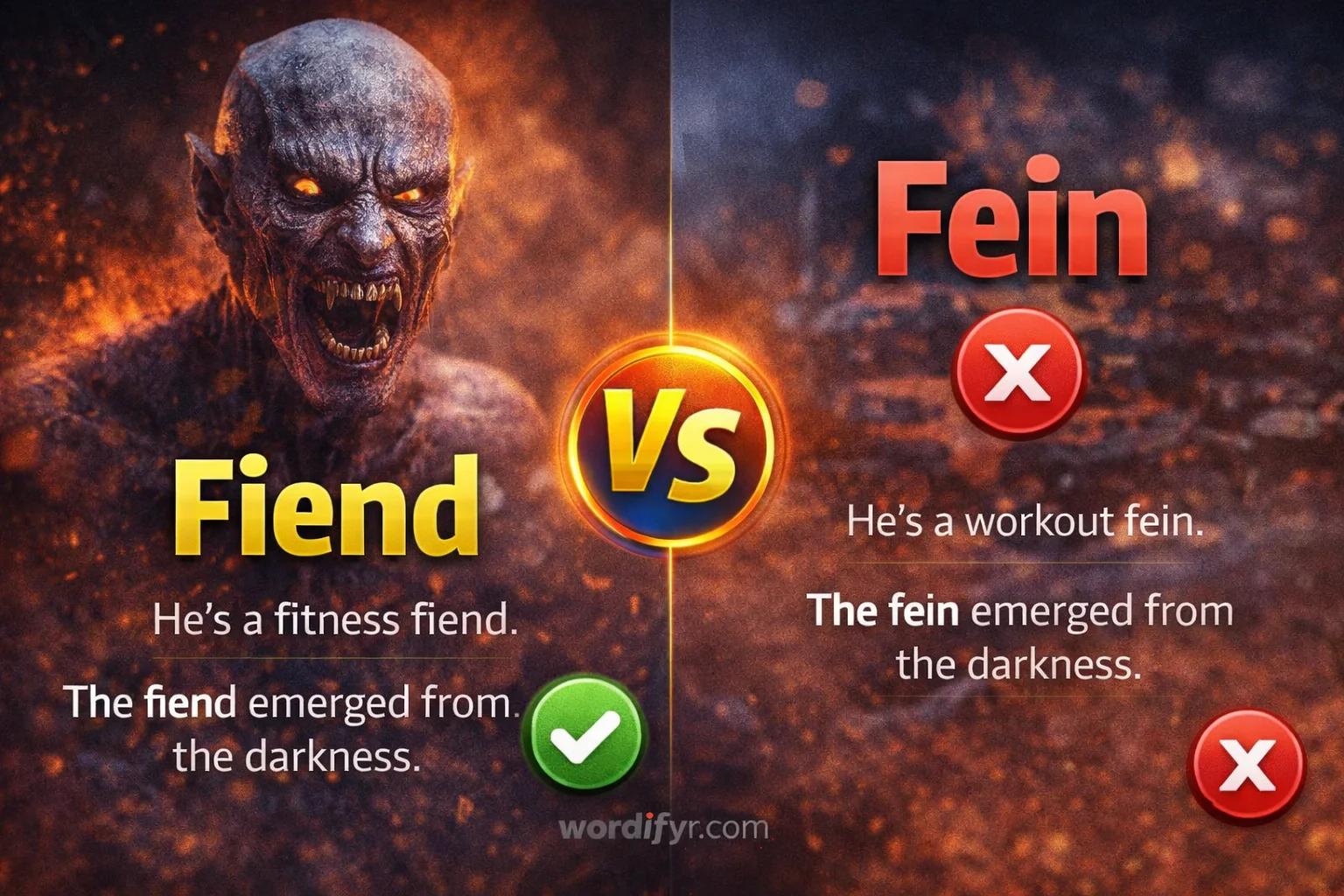
❌ “I’m a coffee fein.”
✔ “I’m a coffee fiend.”
❌ “He’s a workout fein.”
✔ “He’s a workout fiend.”
The only exceptions occur when FEIN is being used as:
- A song title
- A brand name
- An acronym
- A proper noun
Those uses are unrelated to the English noun fiend.
Fiend vs Fein: Key Differences
Although these words look and sound similar, they are very different.
Fiend
- Correct English word
- Listed in dictionaries
- Functions as a noun
- Has several recognized meanings
- Suitable for formal and informal writing
Fein
- Not standard English
- Usually a misspelling
- Common in slang or internet posts
- Not appropriate for professional writing
- Should generally be avoided
Comparison Table
| Feature | Fiend | Fein |
|---|---|---|
| Correct English Word | ✔ Yes | ❌ No |
| Dictionary Entry | Yes | No |
| Part of Speech | Noun | None (standard English) |
| Meaning | Demon, cruel person, or enthusiast | No accepted English meaning |
| Professional Writing | ✔ Recommended | ❌ Avoid |
| Common Online | Moderate | Mostly slang or typos |
| Grammar Correct | ✔ Yes | ❌ No |
Common Mistakes People Make
Many writers accidentally use fein when they really mean fiend.
Here are a few examples.
Incorrect
❌ He’s a gaming fein.
Correct
✔ He’s a gaming fiend.
Incorrect
❌ She’s a coffee fein.
Correct
✔ She’s a coffee fiend.
Incorrect
❌ My brother is a football fein.
Correct
✔ My brother is a football fiend.
Remember, professional editors will almost always correct fein to fiend.
Real-Life Conversation Examples
Dialogue 1
Alex: He’s a complete gym fiend.
Ryan: I know. He’s there every single day.
🎯 Lesson: Fiend can describe someone who’s extremely dedicated.
Dialogue 2
Emma: Is “fein” correct English?
Sophia: No, the correct word is “fiend.”
🎯 Lesson: Fein is usually a spelling mistake.
Dialogue 3
Liam: Why do people write “coffee fein”?
Chris: They’re trying to write “coffee fiend.”
🎯 Lesson: Internet slang often spreads incorrect spellings.
Dialogue 4
Olivia: The villain looked terrifying.
Mason: He was a real fiend.
🎯 Lesson: Fiend still keeps its traditional meaning in literature.
Dialogue 5
Noah: My editor changed “fein” to “fiend.”
Ava: That’s because only “fiend” is standard English.
🎯 Lesson: Professional writing always uses the correct spelling.
When Should You Use “Fiend”?
Use fiend whenever you’re referring to:
- Someone obsessed with a hobby
- A person who loves something intensely
- A cruel individual
- A demon or evil spirit
- Figurative enthusiasm
Examples:
- Coffee fiend
- Fitness fiend
- Book fiend
- Movie fiend
- Horror fiend
When Should You Avoid “Fein”?
Avoid fein when:
- Writing blog posts
- Publishing SEO articles
- Sending professional emails
- Completing school assignments
- Writing reports
- Creating business content
Unless you’re intentionally referring to a specific song title, brand, or acronym, fiend is almost always the correct choice.
Easy Memory Trick
Here’s a simple way to remember the difference.
Fiend ends with “end.”
Think:
A fiend’s obsession never ends.
If you remember the ending, you’ll remember the spelling.
Frequently Asked Questions
Is “fein” a real English word?
No. Fein is not considered a standard English word.
Why do people write “fein” online?
Most people either misspell “fiend” or copy informal internet slang.
What does “fiend” mean?
It can refer to an evil person, a demon, or someone who is extremely enthusiastic about something.
Is “coffee fiend” correct?
Yes. It means someone who loves coffee or drinks it excessively.
Can I use “fein” in professional writing?
No. Use fiend instead unless you’re referring to a proper noun or title.
Interesting Facts About Fiend
The Meaning Has Changed Over Time
Hundreds of years ago, fiend almost always referred to a devil or enemy.
Today, it’s commonly used to describe enthusiasm instead.
For example:
- Fitness fiend
- Travel fiend
- Music fiend
These expressions are now widely accepted in everyday English.
Internet Culture Increased the Confusion
Social media, music, and memes have made the spelling fein much more common online.
However, popularity doesn’t make a spelling grammatically correct.
Professional writers, editors, and dictionaries still recognize fiend as the correct English word.
Final Thoughts
The difference between fiend vs fein is much simpler than many people think. Fiend is a legitimate English noun with centuries of history. Depending on the context, it can describe an evil spirit, a cruel person, or someone with an intense passion for a hobby or activity. Fein, by contrast, is not recognized as a standard English word and is usually the result of a spelling mistake or informal internet slang.
If you’re writing articles, emails, academic papers, or SEO content, always choose fiend when that’s the meaning you intend. Using the correct spelling improves clarity, strengthens your credibility, and ensures your writing meets professional standards. Once you remember that fiend is the real dictionary word, you’ll never confuse these two terms again.