Introduction
If you have ever replaced a fluorescent tube light, you have likely come across the terms T8 vs T12. At first glance, these labels look technical and confusing, especially for homeowners, office managers, or even electricians who do not deal with lighting specifications daily. Both lights serve the same basic purpose—illumination—but they are not the same in size, efficiency, or performance.
People often confuse T8 vs T12 because both are long fluorescent tubes, commonly used in homes, warehouses, schools, and offices. The problem arises when someone installs the wrong type or assumes they are interchangeable. Although they look/sound similar, they serve completely different purposes.
In this detailed guide, we will explain what T8 and T12 lights are, how they differ, where each is used, and which one makes more sense today—especially in terms of energy efficiency and long-term cost savings.
What Is “T8”?
Meaning
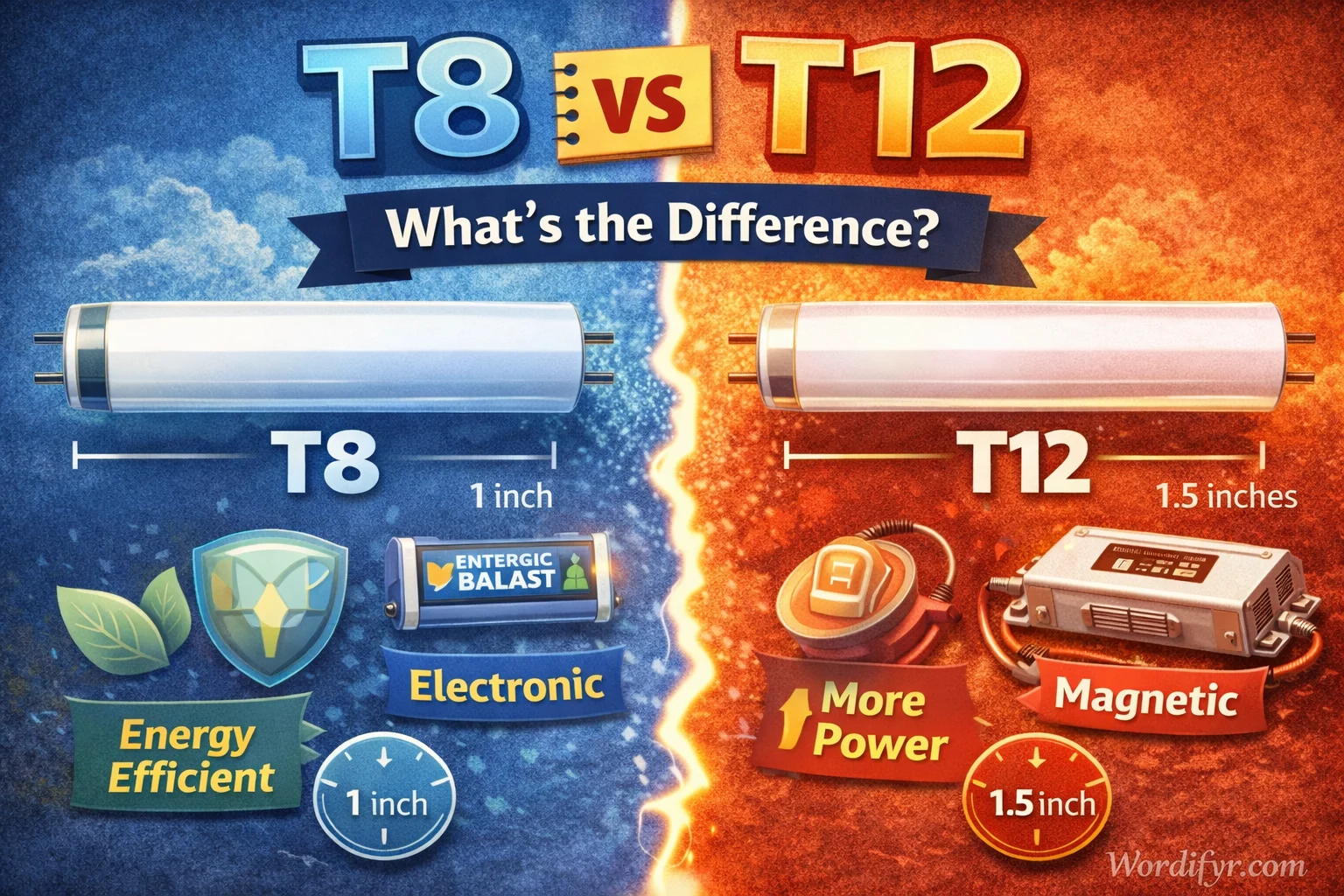
T8 refers to a type of fluorescent tube light with a diameter of 8 eighths of an inch, which equals 1 inch. The “T” stands for tubular, and the number indicates the tube’s thickness.
How It’s Used
T8 lights are widely used in:
- Offices
- Commercial buildings
- Schools
- Hospitals
- Modern homes
They are known for better energy efficiency, brighter light output, and compatibility with electronic ballasts.
Where It’s Used
- Common in modern lighting systems
- Standard in new constructions
- Widely adopted in US, UK, and global markets
T8 tubes are considered the industry standard today.
Examples in Sentences
- “We upgraded all fixtures to T8 lights to save electricity.”
- “T8 bulbs provide brighter and more consistent lighting.”
- “Most offices no longer use T12; they prefer T8.”
Short Historical Note
T8 lights became popular in the 1990s as energy-efficiency standards improved. They gradually replaced older fluorescent technologies due to lower power consumption and better light quality.
What Is “T12”?
Meaning
T12 is another type of fluorescent tube, but it has a diameter of 12 eighths of an inch, which equals 1.5 inches. This makes it noticeably thicker than T8.
How It’s Used
T12 lights were once the most common fluorescent lighting option. They are typically found in:
- Older buildings
- Warehouses built before the 1990s
- Outdated office lighting systems
T12 bulbs require magnetic ballasts, which consume more power.
Where It’s Used
- Mostly in older installations
- Being phased out in many countries
- Rare in new construction projects
Examples in Sentences
- “This fixture still uses T12 bulbs.”
- “T12 lights consume more energy than T8.”
- “Many countries have stopped producing T12 tubes.”
Regional and Regulatory Notes
In many regions, T12 bulbs are banned or discontinued due to energy regulations. Finding replacements can be difficult and expensive.
Key Differences Between T8 and T12
Quick Comparison Points
- T8 is thinner than T12
- T8 is more energy-efficient
- T12 uses outdated technology
- T8 provides better light quality
- T12 is being phased out worldwide
Comparison Table
| Feature | T8 | T12 |
|---|---|---|
| Tube Diameter | 1 inch | 1.5 inches |
| Energy Efficiency | High | Low |
| Ballast Type | Electronic | Magnetic |
| Light Output | Brighter & consistent | Dimmer over time |
| Availability | Widely available | Limited |
| Environmental Impact | Lower | Higher |
| Modern Use | Standard choice | Obsolete |
Real-Life Conversation Examples
Dialogue 1
A: “Can I replace a T12 with a T8?”
B: “Yes, but you may need to change the ballast.”
🎯 Lesson: T8 vs T12 are not always plug-and-play.
Dialogue 2
A: “Why is my old office so dim?”
B: “It’s probably still using T12 lights.”
🎯 Lesson: T12 lighting degrades over time.
Dialogue 3
A: “Which one saves more electricity?”
B: “T8 uses significantly less power.”
🎯 Lesson: T8 is more energy-efficient.
Dialogue 4
A: “Why can’t I find T12 bulbs easily?”
B: “They’re being discontinued in many countries.”
🎯 Lesson: T12 is becoming obsolete.
Dialogue 5
A: “Should I upgrade all fixtures?”
B: “Yes, switching to T8 reduces long-term costs.”
🎯 Lesson: Upgrading improves efficiency and savings.
When to Use T8 vs T12
Use T8 When:
- You want energy efficiency
- You are upgrading lighting systems
- You care about lower electricity bills
- You want brighter, stable lighting
- You are following modern regulations
Memory Trick:
👉 T8 = Today’s Technology
Use T12 When:
- You are maintaining an old system temporarily
- Fixture replacement is not immediately possible
- You are dealing with legacy installations
Memory Trick:
👉 T12 = Traditional & Outdated
US vs UK Usage
- Both the US and UK favor T8 over T12
- Energy regulations discourage T12 usage
- T12 production has significantly declined worldwide
Fun Facts or History
1. Why “T” Matters
The “T” rating directly refers to the tube’s diameter in eighths of an inch—a detail many people overlook.
2. T12 Phase-Out
Environmental regulations played a major role in pushing T12 lights out of the market due to excessive energy consumption.
Conclusion
The difference between T8 vs T12 lies in efficiency, technology, and relevance. T12 lights were once the standard but are now outdated, inefficient, and difficult to source. T8 lights offer better brightness, lower power consumption, and compatibility with modern systems, making them the smarter choice today.
If you are upgrading or installing new lighting, T8 is the clear winner. T12 should only be used for temporary replacements in older systems. Next time someone mentions T8 vs T12, you’ll know exactly which one fits modern lighting needs best.