Introduction
The words live and life are among the most commonly confused terms in English. At first glance, they look almost identical—just one letter apart—but their meanings and usage are completely different. This similarity often causes confusion for learners and even native speakers, especially when pronunciation changes depending on context.
You might see someone write “I want to life happy” or “We live a good live,” and instantly know something feels off—but why? That’s exactly what we’re going to fix in this guide.
Although they look/sound similar, they serve completely different purposes. Once you understand the grammar, meaning, and usage of live vs life, you’ll never mix them up again.
What Is “Live”?
Live is a verb, adjective, and sometimes an adverb, depending on how it’s used. It’s a highly flexible word in English.
Meaning
Live generally means:
- To be alive
- To exist
- To reside somewhere
- To happen in real-time (when used as an adjective)
How It’s Used
Live is commonly used:
- As a verb (to live somewhere or exist)
- As an adjective (live broadcast, live event)
Where It’s Used
- Used globally in all forms of English (American, British, etc.)
- Pronunciation changes:
- /lɪv/ → verb (“I live here”)
- /laɪv/ → adjective (“live show”)
Examples in Sentences
- “I live in Lahore.”
- “They want to live a peaceful life.”
- “We watched a live concert online.”
- “She prefers live music over recordings.”
Usage Note
The word live comes from Old English libban, meaning “to remain alive.” Over time, it expanded to include meanings like residence and real-time events.
What Is “Life”?
Life is a noun, and it refers to existence, living beings, or the experience of being alive.
Meaning
Life means:
- The condition of being alive
- A person’s existence or experience
- The period between birth and death
How It’s Used
Life is used:
- As a thing (noun)
- To describe experiences, existence, or lifestyle
Where It’s Used
- Universal usage in all English-speaking regions
- No variation in spelling across countries
Examples in Sentences
- “Life is full of surprises.”
- “She lived a happy life.”
- “Technology has changed our life.”
- “He risked his life to save others.”
Grammar Note
- Singular: life
- Plural: lives
Example:
- “Many lives were affected by the event.”
Key Differences Between Live and Life
Understanding live vs life becomes easy when you focus on grammar roles and function.
Quick Bullet Points
- Live = action or state (verb/adjective)
- Life = thing or concept (noun)
- Live describes doing or being
- Life describes existence
- Live can change pronunciation
- Life has one consistent pronunciation
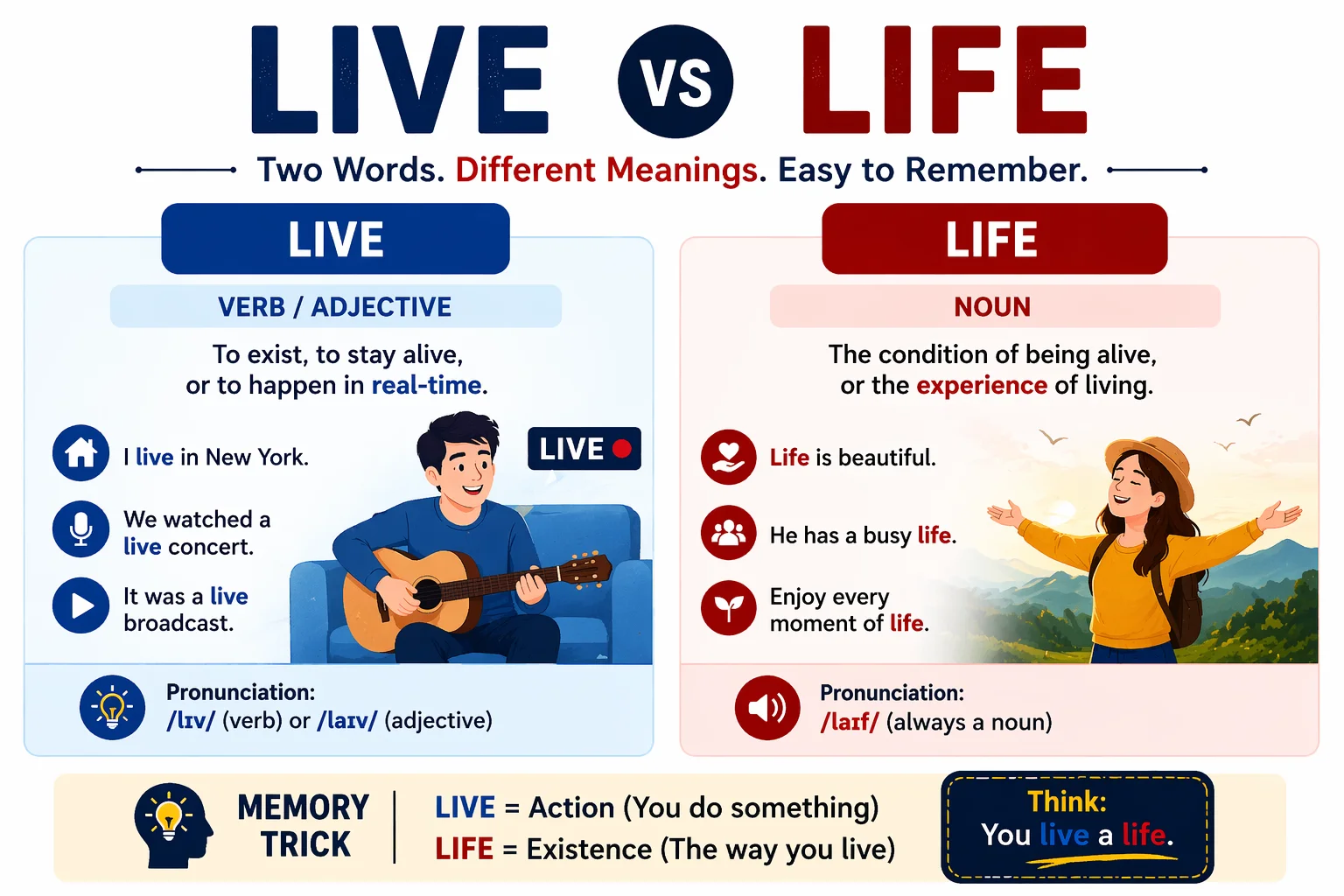
Comparison Table
| Feature | Live | Life |
|---|---|---|
| Part of Speech | Verb / Adjective | Noun |
| Meaning | To exist / real-time event | Existence or living condition |
| Pronunciation | /lɪv/ or /laɪv/ | /laɪf/ |
| Usage Type | Action or description | Concept or thing |
| Example | “I live here.” | “Life is beautiful.” |
Real-Life Conversation Examples
Dialogue 1
A: “Where do you life?”
B: “You mean where do I live?”
🎯 Lesson: Use live for actions or places.
Dialogue 2
A: “I want to live a good life.”
B: “That’s the correct way to say it.”
🎯 Lesson: Use live (verb) + life (noun) together.
Dialogue 3
A: “This is a life show!”
B: “You mean a live show.”
🎯 Lesson: Use live for real-time events.
Dialogue 4
A: “Life in the city is fast.”
B: “Yes, city life can be stressful.”
🎯 Lesson: Life describes experiences and lifestyle.
Dialogue 5
A: “Do you live your life fully?”
B: “I try to!”
🎯 Lesson: Both words can appear together correctly.
When to Use Live vs Life
Choosing between live vs life depends on whether you need a verb/adjective or a noun.
Use “Live” When:
✔️ Talking about actions (exist, reside)
✔️ Describing real-time events
✔️ Referring to ongoing states
Examples:
- “I live in Pakistan.”
- “We watched a live match.”
- “They live happily together.”
Use “Life” When:
✔️ Talking about existence or experience
✔️ Referring to a person’s journey
✔️ Describing lifestyle or condition
Examples:
- “Life is unpredictable.”
- “He has a busy life.”
- “She changed her life completely.”
Memory Trick
- Live = Verb (Action)
- Life = Noun (Thing)
👉 Think:
You live a life.
This simple sentence helps you remember both correctly.
US vs UK Note
There is no difference between American and British English for live vs life. The spelling and meaning remain consistent across regions.
Fun Facts & History
1. One Letter Changes Everything
Adding just one letter (f) transforms live into life, completely changing its grammatical role—from action to concept.
2. Pronunciation Trickiness
Live is one of the few English words with two different pronunciations, depending on meaning—something that often confuses learners.
Conclusion
The difference between live vs life is simple once you break it down. Live is used for actions, states, or real-time events, while life refers to existence, experiences, and the journey of being alive. Even though they look very similar, their grammatical roles are completely different.
Mastering this distinction helps you write and speak more clearly and confidently. Just remember the core rule: you live a life—and everything else falls into place.
Next time someone uses these two words, you’ll know exactly what they mean!