Introduction
Have you ever stopped while writing and wondered whether you should use joyous or joyful? You’re certainly not alone. These two adjectives are closely related because they both describe happiness, delight, and positive emotions. Since they share the same root word—joy—many people assume they mean exactly the same thing.
However, while joyous and joyful are similar, they are not completely interchangeable.
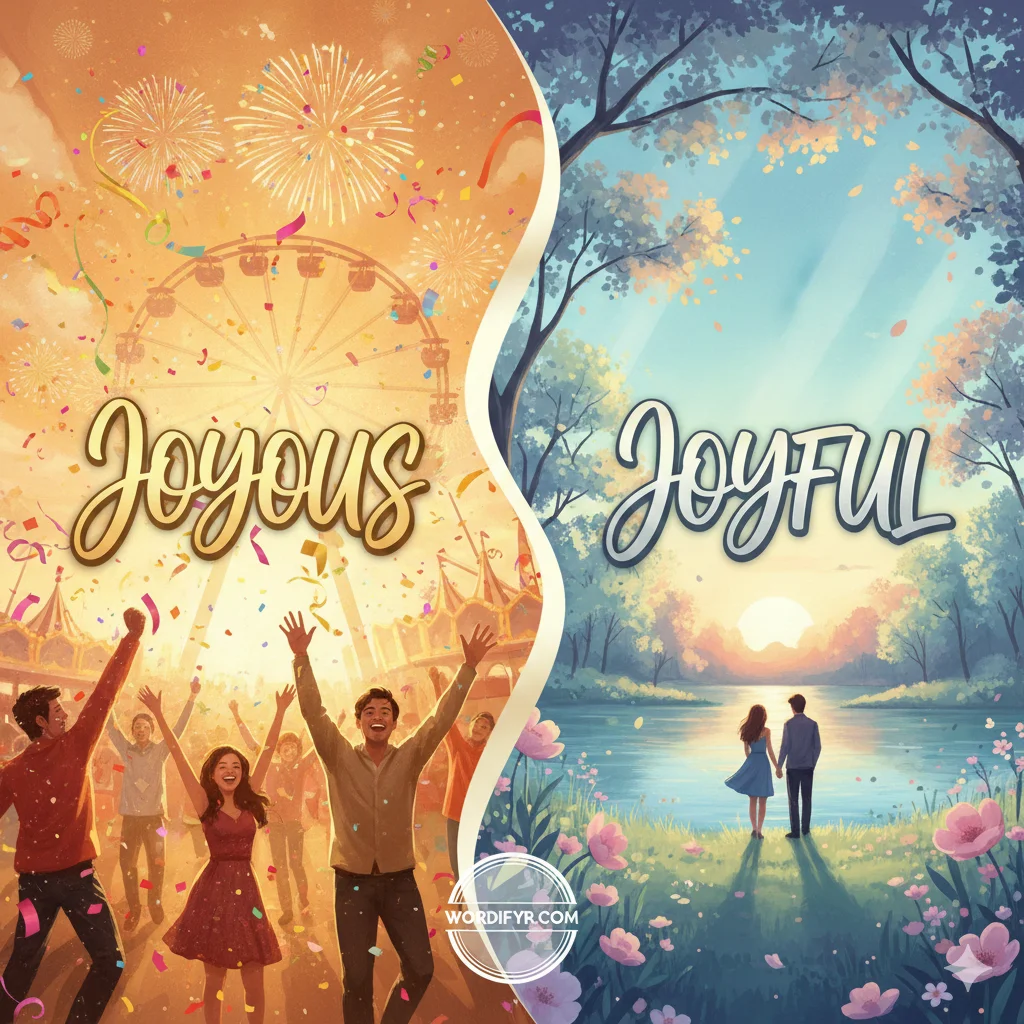
The difference lies in how the happiness is expressed. One usually describes visible, shared celebration, while the other focuses on personal, inner happiness. Choosing the wrong word won’t always be grammatically incorrect, but it can make your writing sound less natural or less precise.
Whether you’re writing an essay, blog post, speech, social media caption, novel, or professional document, understanding the difference between joyous vs joyful will help you communicate emotions more effectively.
In this complete guide, you’ll learn:
- The meaning of joyous
- The meaning of joyful
- Their key differences
- Grammar and usage rules
- Real-world examples
- Common mistakes to avoid
- Memory tricks
- FAQs
- When each word sounds most natural
Let’s make the difference crystal clear.
What Does “Joyous” Mean?
Definition
Joyous is an adjective that describes great outward happiness, celebration, or excitement.
It usually refers to happiness that is visible, energetic, and shared with other people.
Simply put:
Joyous = happiness that can be seen, heard, or celebrated.
Unlike quiet personal emotions, joyous often describes occasions where people openly express their happiness.
How “Joyous” Is Used
The word joyous commonly describes:
- Celebrations
- Festivals
- Weddings
- Holidays
- Victories
- Crowds
- Special occasions
- Public announcements
- Ceremonies
Because it suggests excitement and shared emotion, it often appears in formal writing and storytelling.
Examples of Joyous in Sentences
- The wedding was a joyous celebration filled with laughter.
- Fans erupted into joyous cheers after the championship victory.
- The town enjoyed a joyous holiday festival.
- Graduation day was a joyous occasion for every student.
- The family gathered for a joyous reunion.
Notice that each sentence describes an event or situation rather than someone’s private feelings.
Common Collocations
You’ll often hear:
- joyous celebration
- joyous occasion
- joyous news
- joyous event
- joyous gathering
- joyous ceremony
- joyous welcome
- joyous atmosphere
These combinations sound natural to native speakers.
Historical Note
The word joyous entered English through Old French and has been used for centuries in literature, religious writing, and formal speeches.
Because of its history, it still carries a slightly elegant or ceremonial tone.
What Does “Joyful” Mean?
Definition
Joyful is an adjective that describes a person who feels deep happiness, contentment, or emotional satisfaction.
Unlike joyous, joyful focuses more on internal feelings than outward celebration.
Simply put:
Joyful = happiness that comes from within.
Someone can feel joyful even when they are sitting quietly by themselves.
How “Joyful” Is Used
Joyful commonly describes:
- People
- Feelings
- Hearts
- Smiles
- Attitudes
- Personal experiences
- Emotional well-being
- Lasting happiness
It emphasizes emotional depth rather than excitement.
Examples of Joyful in Sentences
- She felt joyful after helping those in need.
- His children give him a joyful life.
- Meditation helps her maintain a joyful mindset.
- The teacher had a joyful personality.
- They remained joyful despite life’s challenges.
Here, the focus is on personal emotions instead of public celebration.
Common Collocations
You’ll frequently see:
- joyful heart
- joyful spirit
- joyful smile
- joyful life
- joyful feeling
- joyful experience
- joyful person
- joyful attitude
These expressions emphasize someone’s emotional state.
Usage Note
In modern English, joyful appears more often in everyday conversation than joyous because it fits a wider variety of situations.
It is especially common in motivational writing, self-improvement books, and personal stories.
Joyous vs Joyful: Key Differences
Although both words express happiness, they create different images in the reader’s mind.
Quick Differences
- Joyous emphasizes celebration.
- Joyful emphasizes emotion.
- Joyous often describes events.
- Joyful usually describes people.
- Joyous sounds more energetic.
- Joyful sounds calmer and more personal.
- Joyous is slightly more formal.
- Joyful is more common in everyday English.
Joyous vs Joyful Comparison Table
| Feature | Joyous | Joyful |
|---|---|---|
| Part of Speech | Adjective | Adjective |
| Main Meaning | Outward celebration | Inner happiness |
| Focus | Shared excitement | Personal emotion |
| Commonly Describes | Events, crowds, occasions | People, feelings, personalities |
| Emotional Tone | Energetic and expressive | Calm, warm, sincere |
| Formality | Slightly formal | Neutral |
| Common Examples | Joyous celebration | Joyful heart |
Can Joyous and Joyful Be Used Interchangeably?
Sometimes—but not always.
Consider these examples:
✅ The wedding was joyous.
✅ She felt joyful during the wedding.
Both are correct because they describe different things.
Now compare:
❌ The wedding was joyful.
While grammatically acceptable, native speakers usually prefer joyous wedding because the emphasis is on celebration.
Similarly:
❌ He is a joyous person.
This isn’t wrong, but joyful person sounds much more natural because it describes personality.
Common Mistakes
Mistake 1
❌ She has a joyous personality.
✅ She has a joyful personality.
Mistake 2
❌ The joyful parade filled the streets.
✅ The joyous parade filled the streets.
Mistake 3
❌ It was a joyful celebration.
✅ It was a joyous celebration.
Although “joyful celebration” isn’t incorrect, “joyous celebration” is the more natural collocation.
Real-Life Conversation Examples
Dialogue 1
Emma: How was the wedding?
Sophia: It was absolutely joyous. Everyone was dancing and celebrating.
🎯 Lesson: Use joyous for celebrations and public happiness.
Dialogue 2
Alex: How did volunteering make you feel?
Chris: It made me feel incredibly joyful.
🎯 Lesson: Use joyful for personal emotions.
Dialogue 3
Sarah: Should I write “joyous occasion” or “joyful occasion”?
Teacher: “Joyous occasion” sounds much more natural.
🎯 Lesson: Events are usually joyous.
Dialogue 4
Ben: My grandmother has such a joyous heart.
Lisa: I’d probably say “joyful heart.”
🎯 Lesson: Feelings and hearts are generally described as joyful.
Dialogue 5
David: What’s the difference?
Teacher: Joyous describes celebrations; joyful describes feelings.
🎯 Lesson: Think event vs emotion.
When Should You Use Joyous?
Choose joyous when you’re describing:
- Weddings
- Festivals
- Holidays
- Public celebrations
- Family gatherings
- Victories
- Ceremonies
- Announcements
- Exciting events
- Crowds
Examples
- A joyous Christmas celebration
- Joyous applause filled the theater.
- It was a joyous reunion after many years.
When Should You Use Joyful?
Choose joyful when talking about:
- Personal feelings
- Emotional well-being
- Happiness
- Attitudes
- Personal growth
- Character
- Inner peace
- Gratitude
Examples
- She lives a joyful life.
- Helping others makes me joyful.
- His joyful attitude inspires everyone.
Easy Memory Trick
Here’s a simple way to remember the difference:
Joyous = Public Joy 🎉
Think:
Joyous → Celebration
Joyful = Personal Joy ❤️
Think:
Joyful → Feeling
If everyone around you can see the happiness, joyous is usually the better choice.
If the happiness exists inside someone, joyful is often the right word.
Joyous vs Joyful in American and British English
There is no significant difference between American and British English.
Both varieties use:
- Joyous
- Joyful
with the same meanings and grammatical rules.
The only difference is frequency:
- Joyful is more common in everyday speech.
- Joyous appears more often in literature, speeches, religious texts, and formal writing.
Fun Facts About Joyous and Joyful
1. Both Come from the Same Root
Both words originate from the noun joy, but English developed two different adjectives to express different shades of happiness.
2. Joyous Appears More in Ceremonial Writing
Words like:
- joyous occasion
- joyous celebration
- joyous festival
have been common in literature and religious texts for hundreds of years.
3. Joyful Has Become More Popular
Modern books, motivational writing, and psychology articles often use joyful because it emphasizes emotional well-being rather than celebration.
Frequently Asked Questions
Is “joyous” more formal than “joyful”?
Yes. Joyous generally sounds slightly more formal and is often used in speeches, literature, and ceremonial writing.
Can I describe a person as joyous?
You can, but joyful usually sounds more natural when describing a person’s personality or emotional state.
Which word is better for weddings?
Joyous is typically preferred because weddings are celebrations.
Which word is better for someone’s feelings?
Joyful is the better choice because it describes inner emotions.
Conclusion
Although joyous and joyful both express happiness, they highlight different aspects of that emotion. Joyous refers to outward, energetic, and shared happiness, making it ideal for celebrations, festivals, weddings, and public events. Joyful, on the other hand, focuses on inner contentment, emotional warmth, and personal happiness, making it the natural choice for describing people, feelings, attitudes, and everyday experiences.
Understanding the subtle distinction between joyous vs joyful allows your writing to sound more precise, natural, and expressive. Instead of treating them as interchangeable synonyms, choose the one that best matches the context and emotion you want to convey.
The next time you find yourself deciding between joyous and joyful, you’ll know exactly which word fits—and why.