Introduction
If you’ve ever dealt with a court case, construction project, government contract, or financial agreement, you’ve probably come across the terms cash and surety. At first glance, they may seem similar because both are used to secure obligations and provide financial assurance. However, when comparing cash vs surety, the differences are much more significant than most people realize.
Many people assume that paying cash and obtaining a surety bond accomplish the same thing. While both help guarantee that an obligation will be fulfilled, they work in completely different ways. One requires you to provide your own money upfront, while the other relies on a third party to guarantee your commitment.
Choosing the wrong option can affect your cash flow, increase financial risk, or even make certain projects impossible to pursue. That’s why understanding the difference between cash vs surety is essential for business owners, contractors, legal professionals, and anyone dealing with financial guarantees.
In this complete guide, you’ll learn:
- What cash means in legal and financial situations
- What a surety is and how it works
- The major differences between cash vs surety
- Real-world examples
- When to choose cash and when surety is the smarter option
- Common misconceptions people have about both terms
By the end, you’ll confidently know which option best fits different situations.
What Is Cash?
Definition of Cash
In legal and financial contexts, cash refers to money that is paid directly to satisfy or secure an obligation. Unlike financing or guarantees, cash involves using your own available funds immediately.
Cash may include:
- Physical currency
- Money in a checking or savings account
- Certified bank checks
- Cashier’s checks
- Electronic bank transfers
When discussing cash vs surety, cash represents the most direct way to fulfill a financial requirement because no third party is involved.
How Cash Works
When someone uses cash as security, they deposit the full required amount themselves.
For example:
- Paying cash bail
- Making a rental security deposit
- Paying court fines
- Providing an earnest money deposit
- Paying suppliers upfront
Once the obligation has been fulfilled, the money may either be returned (such as a refundable deposit) or permanently used to satisfy the payment.
Where Cash Is Commonly Used
Cash is widely accepted in almost every industry, including:
- Court systems
- Real estate transactions
- Government payments
- Retail businesses
- Banking
- Property rentals
- Vehicle purchases
Because cash is universally recognized, there are no differences between American and British English regarding its meaning.
Advantages of Using Cash
Using cash offers several benefits:
- Immediate payment
- No approval process
- No third-party involvement
- Simple legal documentation
- Widely accepted
Many organizations prefer cash because it eliminates uncertainty.
Disadvantages of Using Cash
Despite its simplicity, cash has drawbacks:
- Large amounts tie up your money
- Reduces available working capital
- Can affect business cash flow
- Opportunity cost of idle funds
- Large deposits may create liquidity problems
This is where the comparison between cash vs surety becomes especially important.
Examples of Cash in Sentences
- He posted cash bail and was released the same day.
- The company paid the entire security deposit in cash.
- Many landlords prefer cash deposits because they are straightforward.
- Paying cash avoids financing fees but reduces available funds.
Historical Background
Cash has been used as a form of financial security for thousands of years. Long before banks and insurance companies existed, merchants relied on coins, precious metals, and currency to guarantee agreements.
Even today, cash remains the simplest form of financial assurance.
What Is Surety?
Definition of Surety
A surety is a legally binding guarantee in which a third party promises to fulfill an obligation if the original party fails to do so.
Rather than paying the entire amount upfront, the individual or business purchases a surety bond from a licensed surety company.
In simple terms:
Cash = You provide your own money.
Surety = Someone else guarantees your promise.
This is the most important distinction in cash vs surety.
How Surety Works
A surety arrangement always involves three parties:
1. Principal
The person or business responsible for fulfilling the obligation.
Example:
- Contractor
- Defendant
- Business owner
2. Obligee
The party requiring the guarantee.
Example:
- Government agency
- Court
- Project owner
- Customer
3. Surety
Usually an insurance or bonding company that guarantees performance.
If the principal fails to meet their obligation, the surety compensates the obligee and then seeks reimbursement from the principal.
Unlike insurance, a surety bond does not eliminate responsibility.
Where Surety Is Used
Surety bonds are common in:
- Construction projects
- Court proceedings
- Bail bonds
- Government contracts
- Contractor licensing
- Commercial developments
- Customs and import businesses
- Public infrastructure projects
Many government projects legally require contractors to obtain surety bonds before work begins.
Types of Surety Bonds
There are many different kinds of surety bonds.
Contract Bonds
Guarantee that construction work will be completed according to contract terms.
Performance Bonds
Ensure projects are finished properly.
Payment Bonds
Protect subcontractors and suppliers.
Court Bonds
Required during legal proceedings.
License and Permit Bonds
Required before certain businesses receive licenses.
Bail Bonds
Guarantee a defendant’s court appearance.
Advantages of Surety
Surety provides several important benefits:
- Preserves cash flow
- Requires only a small premium
- Enables businesses to qualify for larger contracts
- Builds credibility
- Meets legal requirements
- Reduces upfront financial burden
Many businesses prefer surety because it allows them to continue operating without locking up large amounts of cash.
Disadvantages of Surety
Surety also has limitations:
- Requires credit approval
- Premiums are non-refundable
- Default creates repayment obligations
- More legal paperwork
- Not everyone qualifies
Unlike cash, surety involves ongoing legal responsibilities.
Examples of Surety in Sentences
- The contractor submitted a surety bond before construction began.
- The court accepted a surety bond instead of full cash bail.
- Many public projects require surety before awarding contracts.
- A surety company guaranteed the contractor’s performance.
Brief History of Surety
Suretyship dates back to ancient civilizations, including Roman law, where individuals guaranteed another person’s obligations.
Modern surety bonds evolved during the nineteenth century as insurance companies began offering professional bonding services for businesses and governments.
Today, surety remains one of the most important financial tools in construction, infrastructure, and legal systems.
Cash vs Surety: Key Differences
Although both provide financial security, they operate very differently.
Quick Differences
- Cash uses your own money immediately.
- Surety uses a third-party guarantee.
- Cash affects liquidity.
- Surety preserves working capital.
- Cash is simple.
- Surety involves contracts and underwriting.
- Cash carries no repayment obligation.
- Surety requires reimbursement if a claim is paid.
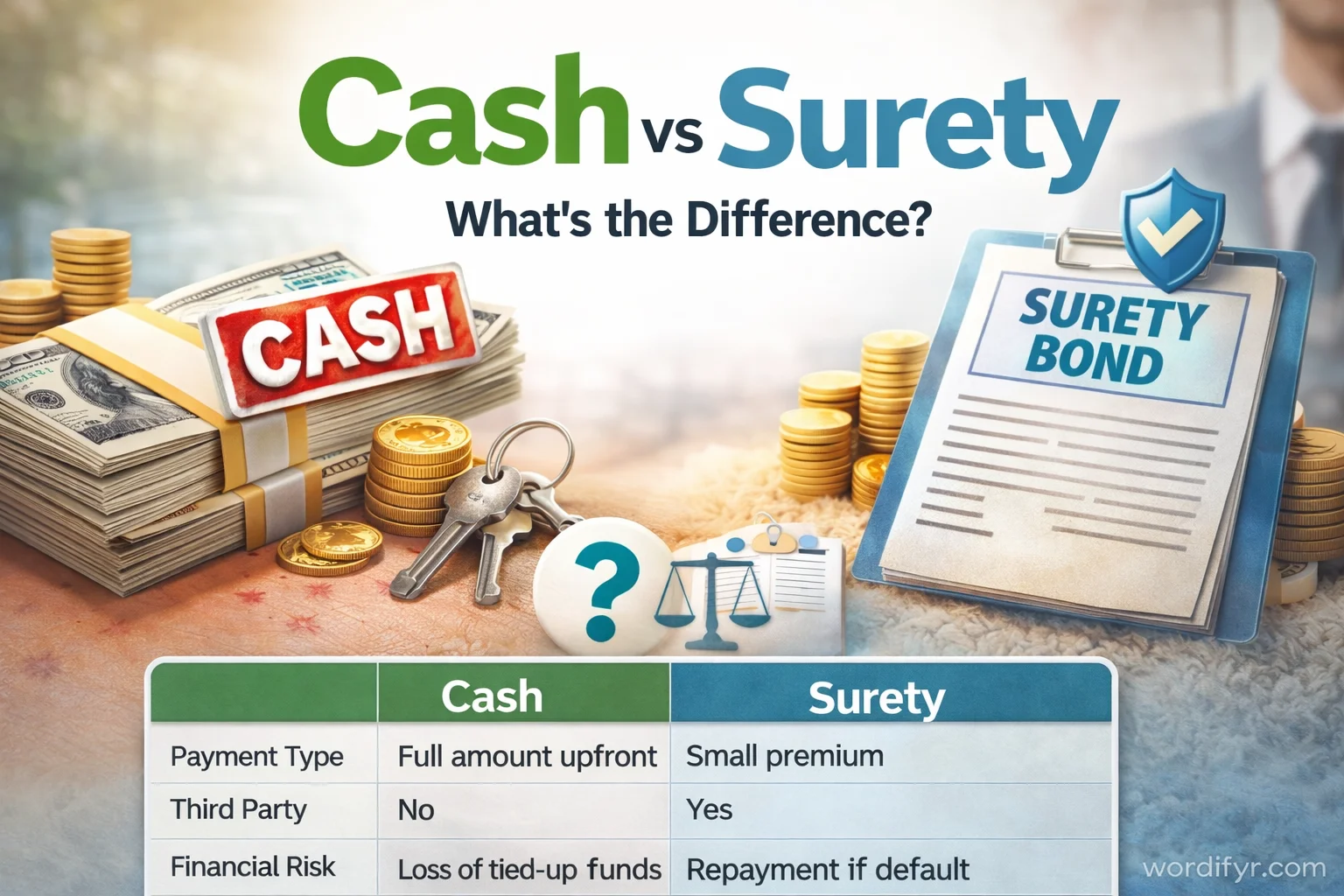
Cash vs Surety Comparison Table
| Feature | Cash | Surety |
|---|---|---|
| Definition | Direct payment using your own funds | Third-party financial guarantee |
| Upfront Cost | Full amount required | Small premium |
| Third Party | No | Yes |
| Cash Flow | Reduced | Preserved |
| Risk | Money is tied up | Repayment required if default occurs |
| Approval Needed | Usually no | Yes |
| Best For | Small payments and deposits | Large contracts and legal guarantees |
| Complexity | Simple | More complex |
| Common Industries | Retail, courts, rentals | Construction, government, legal |
This comparison clearly illustrates why cash vs surety is a financial decision rather than simply a payment choice.
Real-Life Conversation Examples
Conversation 1
Alex: Should I post cash bail?
Lawyer: If you qualify for a surety bond, you may not need to pay the full amount upfront.
Lesson: Surety can significantly reduce immediate financial pressure.
Conversation 2
Contractor: Why does the city require a surety bond?
Engineer: It protects taxpayers if the project isn’t completed.
Lesson: Surety protects the project owner rather than the contractor.
Conversation 3
Business Owner: I don’t want thousands of dollars locked up.
Financial Advisor: Then a surety bond may be a better option than paying cash.
Lesson: Surety helps preserve working capital.
Conversation 4
Homeowner: Isn’t cash always safer?
Attorney: Cash is simpler, but surety spreads financial risk.
Lesson: The best choice depends on the situation.
Conversation 5
Developer: Why can’t I just pay cash instead?
Government Official: This project specifically requires a surety bond by law.
Lesson: Some contracts legally require surety rather than cash.
When Should You Choose Cash?
Cash is often the better option when:
- The required amount is relatively small.
- You have enough available funds.
- Speed is important.
- You want to avoid paperwork.
- No bonding company is required.
- The obligation is short-term.
- You prefer complete control over the transaction.
Examples
- Apartment security deposits
- Small court fines
- Retail purchases
- Earnest money deposits
- Minor legal obligations
When Should You Choose Surety?
Surety is usually the better choice when:
- The obligation is expensive.
- You need to preserve business cash flow.
- Government contracts require bonding.
- Construction projects demand guarantees.
- You regularly bid on public projects.
- Legal regulations specify surety bonds.
Examples
- Construction contracts
- Court bonds
- Contractor licensing
- Government tenders
- Commercial development projects
Common Misconceptions About Cash vs Surety
Myth 1: Surety Is Insurance
Not exactly.
Insurance protects the policyholder from losses.
Surety guarantees someone else’s obligation and expects repayment if it pays a claim.
Myth 2: Cash Is Always Better
Cash is simple, but tying up large sums can hurt personal or business finances.
Sometimes preserving liquidity is more valuable than paying everything upfront.
Myth 3: Surety Eliminates Responsibility
False.
The principal remains legally responsible for fulfilling the obligation and repaying the surety if a claim occurs.
Myth 4: Anyone Can Get a Surety Bond
Bond companies evaluate:
- Credit history
- Financial stability
- Business experience
- Risk level
Approval is not automatic.
Simple Memory Trick
A quick way to remember cash vs surety is:
💵 Cash = You Pay
🛡️ Surety = Someone Guarantees
If your money secures the obligation, it’s cash.
If another company guarantees your obligation, it’s surety.
Cash vs Surety Around the World
The basic concepts remain the same worldwide, but their use varies.
United States
- Surety bonds are common in construction, courts, and government contracts.
- Cash bail is widely used, although reforms are changing practices in some states.
United Kingdom
- Cash deposits are common.
- Surety may refer to a person acting as a guarantor in certain legal contexts.
Canada and Australia
Both cash and surety are recognized, especially in legal and commercial settings.
Interesting Facts About Cash and Surety
1. Surety Bonds Date Back Thousands of Years
Ancient Roman law recognized suretyship as one of the earliest legal guarantee systems, proving that the concept has existed for centuries.
2. Billions of Dollars in Construction Projects Depend on Surety
Many large public infrastructure projects cannot begin without approved surety bonds, making them essential to modern construction industries.
3. Cash Isn’t Always the Cheapest Option
Although paying cash avoids bond premiums, tying up significant funds can create opportunity costs, especially for businesses that rely on steady cash flow.
Frequently Asked Questions
Is cash better than surety?
Not necessarily. Cash is simpler, while surety is often better for preserving liquidity and meeting contractual requirements.
Can I use cash instead of a surety bond?
Sometimes, but not always. Many government and construction contracts specifically require a surety bond.
Does a surety bond protect me?
A surety bond primarily protects the obligee. If the surety pays a claim, you are generally responsible for reimbursing the surety company.
Is surety the same as insurance?
No. Insurance transfers risk to the insurer, while surety guarantees performance and expects repayment if a claim is paid.
Which option costs less upfront?
Surety usually requires only a premium, making the initial cost much lower than paying the full amount in cash.
Final Thoughts
Understanding the difference between cash vs surety is essential whenever you’re dealing with legal obligations, construction contracts, or financial guarantees. While both provide security, they work in fundamentally different ways.
Cash requires you to commit the full amount immediately, making it simple but potentially restrictive for your finances. Surety, on the other hand, allows a qualified third party to guarantee your obligation, helping preserve cash flow while meeting legal or contractual requirements.
Neither option is universally better. The right choice depends on the amount involved, your financial situation, the applicable legal requirements, and how much flexibility you need. By understanding how cash vs surety works, you can make informed decisions, reduce financial risk, and choose the solution that best fits your needs.