
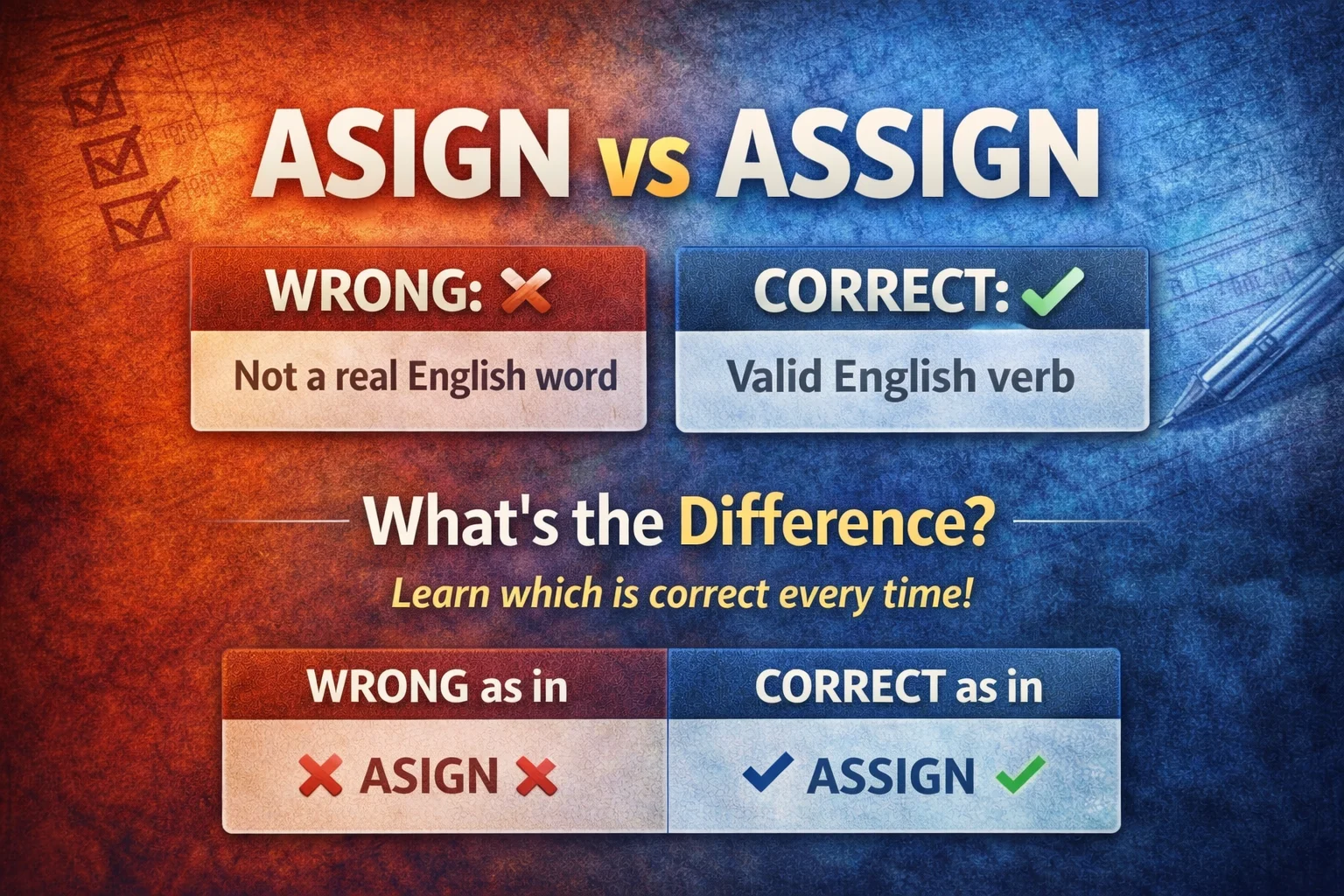
If you’ve ever typed “asign” and watched your spell checker instantly underline it in red, you’re certainly not alone. Thousands of students, professionals, bloggers, and English learners search for asign vs assign because the two spellings look almost identical. With only one extra letter separating them, it’s easy to assume both words are acceptable.
The good news is that the answer is surprisingly simple.
Assign is the correct spelling in modern English, while asign is simply a spelling mistake. Unlike many confusing English word pairs such as affect vs effect or advice vs advise, this isn’t a case where both words are correct in different situations. Only one spelling belongs in dictionaries, academic writing, business communication, legal documents, and everyday English.
Although the difference is small, using the wrong spelling can make your writing appear careless or unprofessional. Whether you’re writing an assignment, sending a business email, preparing a report, or publishing a blog post, knowing the correct spelling helps you communicate clearly and confidently.
In this complete guide, you’ll learn exactly what assign means, why asign is incorrect, common examples, grammar rules, real-life conversations, easy memory tricks, and practical tips to avoid making this mistake in the future.
Let’s clear up the confusion once and for all.
What Is “Assign”?
Assign is a commonly used English verb that means to give, allocate, appoint, designate, or officially give responsibility for something to someone.
It is used in schools, businesses, government offices, legal documents, healthcare, technology, and everyday conversations. Whenever a task, role, responsibility, project, or piece of work is given to someone, the verb assign is usually the correct choice.
Meaning
➡️ Assign = to officially give a task, duty, role, responsibility, or resource to someone.
The action can involve people, objects, rights, projects, homework, responsibilities, or even legal ownership.
Where Is “Assign” Used?
The word assign appears in many different situations.
1. Education
Teachers assign homework, projects, presentations, essays, and research papers.
Examples:
- The teacher assigned homework for Monday.
- Our professor assigned us a group project.
- Students were assigned different presentation topics.
2. Business
Managers assign responsibilities to employees every day.
Examples:
- The manager assigned new duties to the sales team.
- Our supervisor assigned me to the marketing department.
- The company assigned additional staff to the project.
3. Technology
Developers and IT professionals frequently use the word assign.
Examples:
- Assign an IP address to the server.
- The system automatically assigns user IDs.
- The software assigned permissions to each account.
4. Legal Documents
In legal English, assign means transferring rights, ownership, or responsibilities from one party to another.
Examples:
- The company assigned its patent rights.
- The landlord assigned the lease.
- The contract assigns ownership to the buyer.
Grammar Forms of Assign
Like most English verbs, assign changes depending on tense.
| Form | Word |
|---|---|
| Base Verb | assign |
| Third Person | assigns |
| Past Tense | assigned |
| Past Participle | assigned |
| Present Participle | assigning |
Examples:
- She assigns homework every Friday.
- The manager assigned the project yesterday.
- They are assigning tasks now.
- The work has already been assigned.
Pronunciation
Assign is pronounced as:
/əˈsaɪn/
It sounds like:
uh-SINE
The pronunciation remains the same in both American and British English.
What Is “Asign”?
Many people assume asign is another accepted spelling, but that isn’t true.
Asign is not a standard English word.
It does not appear in modern English dictionaries and should never be used in formal or informal writing.
Whenever you write asign, grammar checkers, spell checkers, and editing software automatically mark it as incorrect because it is simply a spelling error.
Meaning
➡️ Asign has no accepted meaning in modern English.
It is simply a misspelling of assign.
Where Does “Asign” Appear?
Although incorrect, you may occasionally see asign because of:
- Typing mistakes
- Fast keyboard input
- Missing one “S”
- Non-native English learners
- OCR scanning errors
- Social media posts with spelling mistakes
None of these situations make the spelling correct.
Incorrect Examples
❌ Please asign this project to David.
❌ The teacher will asign homework tomorrow.
❌ We need to asign responsibilities.
Each sentence above should use assign instead.
Correct versions:
✅ Please assign this project to David.
✅ The teacher will assign homework tomorrow.
✅ We need to assign responsibilities.
Why Do People Confuse Asign and Assign?
Since only one spelling is correct, why do so many people write asign?
There are several reasons.
1. Double-Letter Confusion
English contains many words with double consonants.
Examples include:
- address
- accommodate
- committee
- necessary
- assign
Writers often remove one letter by mistake.
2. Fast Typing
Typing quickly increases the chance of accidentally leaving out the second “S.”
This is especially common on mobile phones.
3. Pronunciation
When spoken aloud, the double “S” isn’t strongly emphasized.
Because the pronunciation sounds smooth, some writers incorrectly assume only one “S” is needed.
4. English Learners
Many languages rarely use double consonants.
As a result, learners naturally simplify words like:
- assign
- assess
- possess
- address
5. Auto-Correction Dependence
Many people rely on spell checkers instead of learning correct spelling.
When writing without software assistance, mistakes become more common.
Key Differences Between Asign and Assign
Quick Summary
- Assign is the correct English spelling.
- Asign is always a spelling mistake.
- Assign is a verb.
- Asign has no grammatical function.
- Assign appears in dictionaries.
- Asign should never appear in professional writing.
Comparison Table
| Feature | Asign | Assign |
| Correct English Word | ❌ No | ✅ Yes |
| Dictionary Entry | ❌ No | ✅ Yes |
| Modern Usage | ❌ Never | ✅ Always |
| Professional Writing | ❌ Incorrect | ✅ Correct |
| Academic Writing | ❌ Incorrect | ✅ Correct |
| Business English | ❌ Incorrect | ✅ Correct |
| Legal Documents | ❌ Incorrect | ✅ Correct |
| Grammar Valid | ❌ No | ✅ Yes |
| Meaning | None | Give or allocate responsibility |
Real-Life Examples of Assign
Understanding a word becomes easier when you see it used naturally.
Workplace
The project manager assigned every employee a different responsibility.
School
Our English teacher assigned two chapters for homework.
Hospital
The nurse assigned each patient to a specific doctor.
Software
The administrator assigned access permissions to new users.
Government
Officials assigned emergency workers to the affected area.
Sports
The coach assigned every player a specific position.
Family
Dad assigned chores to everyone before the weekend.
Common Phrases Using Assign
The word assign appears in many everyday expressions.
Some of the most common include:
- assign homework
- assign a task
- assign responsibility
- assign a role
- assign duties
- assign work
- assign resources
- assign ownership
- assign priority
- assign permissions
- assign a seat
- assign a project
These combinations appear frequently in education, business, technology, and administration.
Synonyms of Assign
Depending on the context, you may also use:
- Allocate
- Designate
- Delegate
- Appoint
- Entrust
- Distribute
- Allocate
- Transfer
- Allocate responsibility
- Hand over
Each synonym has a slightly different meaning, but all involve giving something to someone.
For example:
The manager delegated the task.
The teacher assigned the homework.
The organization allocated additional funding.
While these words are similar, assign remains the most common choice when giving someone a task or responsibility.
Real-Life Conversation Examples
Dialogue 1
A: Did you asign today’s project?
B: You mean assign? Yes, I assigned it this morning.
🎯 Lesson: Always use assign, never asign.
Dialogue 2
A: Why is my document showing a spelling error?
B: Because “asign” isn’t a real English word.
🎯 Lesson: Spell check correctly identifies the mistake.
Dialogue 3
A: Can you assign someone to customer support?
B: Sure, I’ll assign Sarah.
🎯 Lesson: Businesses commonly use assign when giving responsibilities.
Dialogue 4
A: The teacher assigned another essay.
B: Looks like we’ll have a busy weekend!
🎯 Lesson: Schools frequently use assign.
Dialogue 5
A: Why does everyone write assign with two S’s?
B: Because that’s the only correct spelling.
🎯 Lesson: The second “S” is essential.
When Should You Use Assign?
Use assign whenever you’re talking about giving responsibility, work, ownership, or a role to someone.
Common situations include:
✅ Assign homework
✅ Assign employees
✅ Assign seats
✅ Assign projects
✅ Assign priorities
✅ Assign roles
✅ Assign permissions
✅ Assign resources
If you’re describing the act of officially giving something to someone, assign is almost always the correct verb.
When Should You Avoid Asign?
The answer is simple.
Always avoid it.
There are no modern grammar rules, regional dialects, or English varieties where asign is accepted.
Whether you’re writing in:
- American English
- British English
- Australian English
- Canadian English
- Pakistani English
…the correct spelling is always assign.
Easy Memory Tricks
Remembering the correct spelling doesn’t have to be difficult.
Trick 1
Assign has two S letters.
Think:
SS = Standard Spelling
Trick 2
One S = Spelling Slip
Two Ss = Success
Trick 3
Whenever your keyboard underlines asign in red, trust the correction.
Trick 4
Imagine assigning two responsibilities.
Two responsibilities → Two “S” letters.
Common Mistakes to Avoid
People often make these spelling errors:
❌ asign
❌ assing
❌ assigne
❌ assighn
❌ assin
Correct spelling:
✅ assign
Fun Facts About Assign
1. Latin Origin
The word assign comes from the Latin word assignare, meaning to mark out, appoint, or designate.
That original meaning still survives today.
2. Used in Many Professions
Assign is one of the most frequently used verbs in:
- Education
- Business
- Software Development
- Healthcare
- Law
- Project Management
- Government Administration
3. Computer Programming
Programmers also use the word “assign” when storing values in variables.
Example:
Assign the value 10 to variable x.
Although the technical meaning differs slightly, the idea of giving something to something else remains the same.
Frequently Asked Questions
Is asign ever correct?
No.
Modern English does not recognize asign as a correct word.
Why does spell check underline asign?
Because dictionaries recognize assign, not asign.
Is assign a noun?
No.
Assign is primarily used as a verb.
Can assign mean transfer ownership?
Yes.
In legal English, assign can refer to transferring rights, ownership, contracts, or property.
Is assign used in both American and British English?
Yes.
Both American and British English use the same spelling: assign.
There are no regional differences.
How can I remember the correct spelling?
Remember this simple rule:
Assign always has two “S” letters.
If there’s only one “S,” the spelling is incorrect.
Conclusion
The difference between asign and assign is much simpler than many people think. While the two spellings look similar, only assign is accepted in modern English. It is the correct verb for giving someone a task, responsibility, project, role, or legal right. On the other hand, asign is simply a spelling mistake and should never appear in emails, school assignments, business reports, websites, or professional documents.
Whenever you’re unsure, remember the easy rule: assign always contains two “S” letters. That single extra letter is what makes the spelling correct. By understanding this difference and practicing the correct form, you’ll write with greater confidence, improve your grammar, and present a more professional image in every piece of writing.
The next time you need to describe giving work, assigning responsibilities, or allocating a task, you’ll know exactly which spelling to choose—assign, every single time.