
Introduction
Have you ever typed asign and felt something was… off? You’re not alone. Many people confuse asign vs assign, especially when typing quickly or relying on spellcheck. The words look almost identical, sound very similar when spoken, and appear frequently in professional, academic, and legal writing. This confusion is even more common among non-native English speakers and students learning formal English.
The truth is simple—but important. One of these words is correct English, while the other is a common spelling mistake. Although they look/sound similar, they serve completely different purposes. Understanding this difference can instantly improve your writing accuracy, credibility, and SEO quality. Let’s break down asign vs assign in a clear, friendly, and practical way so you never mix them up again.
Section 1: What Is “Asign”?
Meaning of Asign
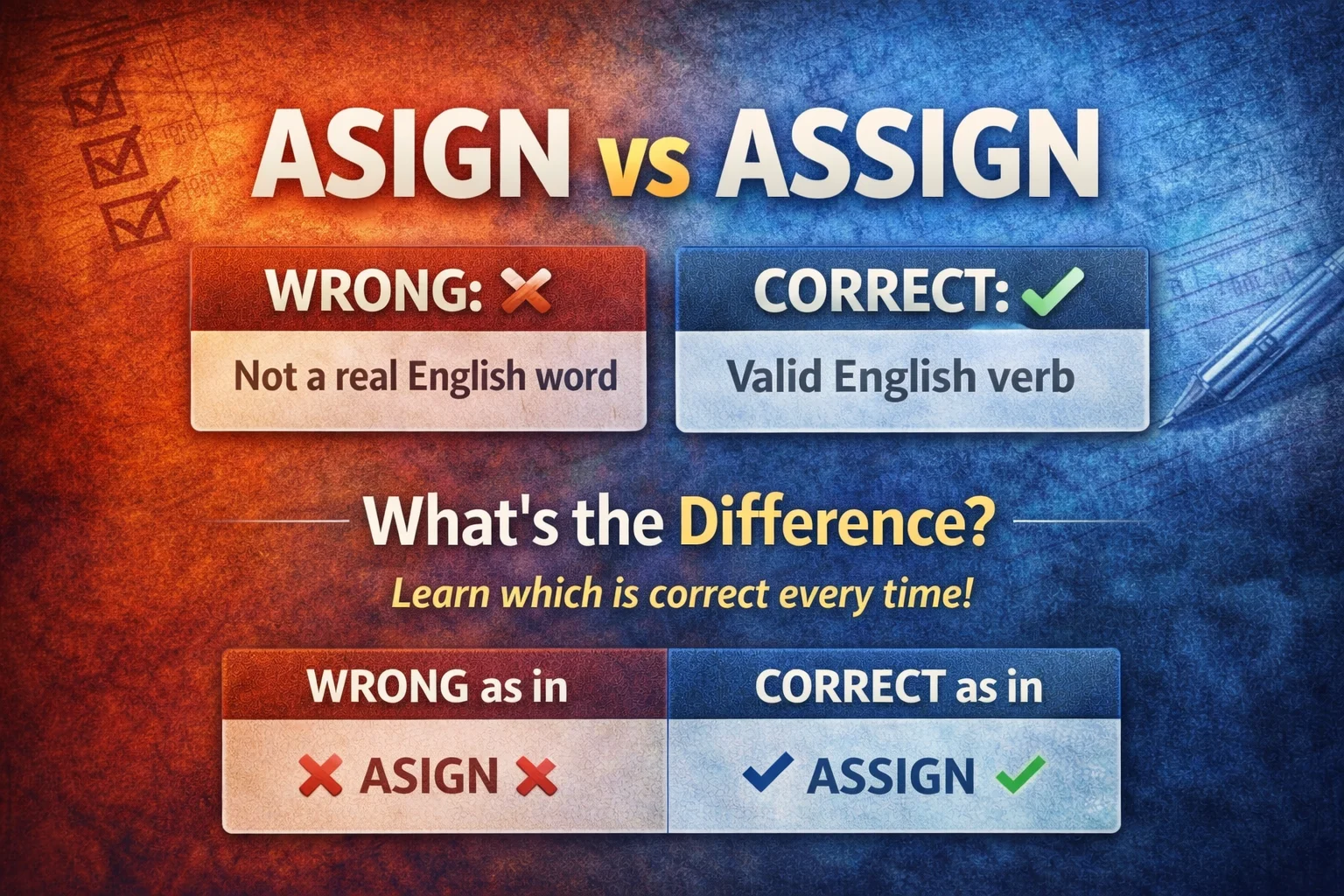
Asign is not a correct English word in standard modern English. In the asign vs assign comparison, asign is simply a misspelling of assign.
How It’s Used
- Asign has no grammatical function
- It does not appear in dictionaries
- It should never be used in formal or informal writing
If you use asign in emails, articles, contracts, or academic papers, it will be marked as an error.
Where It’s Used (If at All)
- Appears in typing mistakes
- Common among learners confusing single vs double consonants
- Occasionally seen in informal online text, but still incorrect
There are no regional differences (US or UK) where asign is acceptable.
Examples (Incorrect Usage)
❌ Please asign the task to John.
❌ The manager will asign roles today.
✅ Correct version:
- Please assign the task to John.
Short Usage Note
Historically, asign existed in very old or non-standard forms of English centuries ago, but it is obsolete and invalid today. In modern usage, asign vs assign is not a true comparison—only one form is correct.
Section 2: What Is “Assign”?
Meaning of Assign
Assign is a correct and commonly used verb in English. It means to give, allocate, designate, or officially give responsibility for something to someone.
In the asign vs assign discussion, assign is the only correct choice.
How It’s Used
You use assign when:
- Giving someone a task or duty
- Allocating work, homework, or projects
- Designating roles or responsibilities
- Referring to legal or official distribution
Spelling and Grammar Notes
- Correct spelling: A-S-S-I-G-N
- The double “s” is essential
- Verb form: assign, assigns, assigned, assigning
Examples in Sentences
- The teacher will assign homework today.
- She was assigned to the new project.
- Please assign this task to the marketing team.
- The judge assigned the case to another court.
In every professional context, assign is the only valid form in asign vs assign.
Regional or Grammatical Notes
- Same spelling and meaning in US and UK English
- Widely used in business, education, law, and tech
Key Differences Between Asign and Assign
Bullet-Point Differences
- Asign ❌ is incorrect and not a real word
- Assign ✅ is a valid English verb
- Asign should never be used
- Assign means to give or allocate responsibility
- Asign vs assign is a spelling issue, not a meaning issue
Comparison Table
| Feature | Asign | Assign |
|---|---|---|
| Correct English Word | ❌ No | ✅ Yes |
| Dictionary Entry | ❌ None | ✅ Yes |
| Meaning | ❌ No meaning | To allocate or give |
| Professional Use | ❌ Never | ✅ Always |
| Grammar Valid | ❌ Invalid | ✅ Valid |
Real-Life Conversation Examples
Dialogue 1
A: Did you asign the report to Sarah?
B: You mean assign? Yes, I did.
🎯 Lesson: Asign is always a spelling mistake.
Dialogue 2
A: The teacher assigned homework today.
B: Good thing you didn’t write asign in your essay!
🎯 Lesson: Academic writing requires assign, never asign.
Dialogue 3
A: Can you assign roles for the event?
B: Of course. I’ll do it now.
🎯 Lesson: Professional contexts always use assign.
Dialogue 4
A: Spellcheck keeps correcting asign.
B: That’s because only assign is correct.
🎯 Lesson: Spellcheck confirms the asign vs assign difference.
When to Use Asign vs Assign
Practical Usage Rules
- Never use “asign” ❌
- Always use “assign” ✅ when:
- Giving tasks
- Allocating work
- Designating responsibility
- Writing formally or informally
There are no exceptions to this rule.
Simple Memory Tricks
- Assign has “SS” → “Seriously Standard” English
- One S = Spelling Slip ❌
- Two S’s = Success ✅
If your word processor underlines asign in red—trust it.
US vs UK Usage
There is no difference between American and British English. Assign is correct everywhere, making asign vs assign universally consistent.
Fun Facts or History
- Assign comes from the Latin assignare, meaning “to mark out or designate.”
- English often doubles consonants (like ss) to preserve pronunciation clarity.
This history explains why assign survived and asign did not.
Conclusion
The debate between asign vs assign is easy to settle: only “assign” is correct. Asign is a common spelling error with no place in modern English. Whether you’re writing emails, academic papers, blog posts, or legal documents, using assign ensures clarity, professionalism, and grammatical accuracy. Once you remember the double S, you’ll never make this mistake again. Next time someone uses these two words, you’ll know exactly what they mean!