Introduction
If you work with live streaming, video broadcasting, or OTT platforms, you’ve probably come across MPEGTS vs HLS and wondered which one is better. Both formats are widely used for delivering video content, yet they often get mixed up because they can work together and sometimes look interchangeable on the surface. Many beginners assume they’re competing technologies, while professionals know the choice depends on use case, latency, and device support.
Although they look/sound similar, they serve completely different purposes. One is a transport container designed for real-time broadcasting, and the other is a streaming protocol built for adaptive delivery over the internet. Understanding MPEGTS vs HLS is essential if you want smooth playback, low buffering, and the right balance between latency and reliability. This guide explains everything in simple terms, with examples, comparisons, and practical tips you can apply immediately. 🎥
What Is MPEGTS?
MPEGTS stands for MPEG Transport Stream. It is a container format designed to transmit audio, video, and data reliably over unreliable networks.
Meaning and Purpose
MPEGTS is built for real-time delivery. It breaks media into small packets, making it resilient to packet loss. This is why it’s commonly used in broadcasting.
How It’s Used
MPEGTS is widely used for:
- Live TV broadcasting
- Satellite and cable transmission
- IPTV
- Low-latency streaming pipelines
In the MPEGTS vs HLS comparison, MPEGTS is often chosen for contribution feeds and internal streaming.
Where It’s Used
MPEGTS is popular in:
- Broadcast stations worldwide
- Professional video workflows
- Hardware encoders and decoders
It’s format-agnostic and works across regions without language or regional rules.
Examples in Sentences
- “The live feed is delivered using MPEGTS over UDP.”
- “Broadcasters prefer MPEGTS for its reliability.”
- “MPEGTS works well for real-time video transport.”
Short Historical Note
MPEGTS was standardized in the 1990s for digital TV systems like DVB and ATSC. Long before internet streaming became common, MPEGTS was already powering global broadcasts—giving it a strong legacy in the MPEGTS vs HLS discussion.
What Is HLS?
HLS, or HTTP Live Streaming, is a streaming protocol developed by Apple for delivering video over standard HTTP.
Meaning and Purpose
HLS works by breaking video into small segments and delivering them over the internet using HTTP. It supports adaptive bitrate streaming, meaning video quality adjusts automatically based on network conditions.
How It’s Used
HLS is commonly used for:
- OTT platforms
- Web and mobile streaming
- Video-on-demand (VOD)
- Live streaming at scale
In MPEGTS vs HLS, HLS is the go-to solution for consumer-facing streaming.
Where It’s Used
HLS is widely supported on:
- iOS and macOS devices
- Android devices
- Smart TVs
- Web browsers (via players)
It has become an industry standard across regions.
Examples in Sentences
- “The platform uses HLS for adaptive streaming.”
- “HLS ensures smooth playback on mobile networks.”
- “Most CDNs are optimized for HLS delivery.”
Regional or Technical Notes
HLS streams often use .m3u8 playlists and may contain MPEGTS segments, which is why MPEGTS vs HLS is sometimes misunderstood. HLS is the protocol; MPEGTS is often the container inside it.
Short Historical Note
Apple introduced HLS in 2009, and it quickly gained popularity due to its simplicity and scalability. Today, HLS dominates online video delivery in the MPEGTS vs HLS ecosystem.
Key Differences Between MPEGTS and HLS
Understanding MPEGTS vs HLS becomes much easier when you compare them directly.
Bullet Point Summary
- MPEGTS is a container format; HLS is a streaming protocol
- MPEGTS is optimized for low latency
- HLS is optimized for scalability and compatibility
- MPEGTS works well in closed networks
- HLS works best over the public internet
Comparison Table (Mandatory)
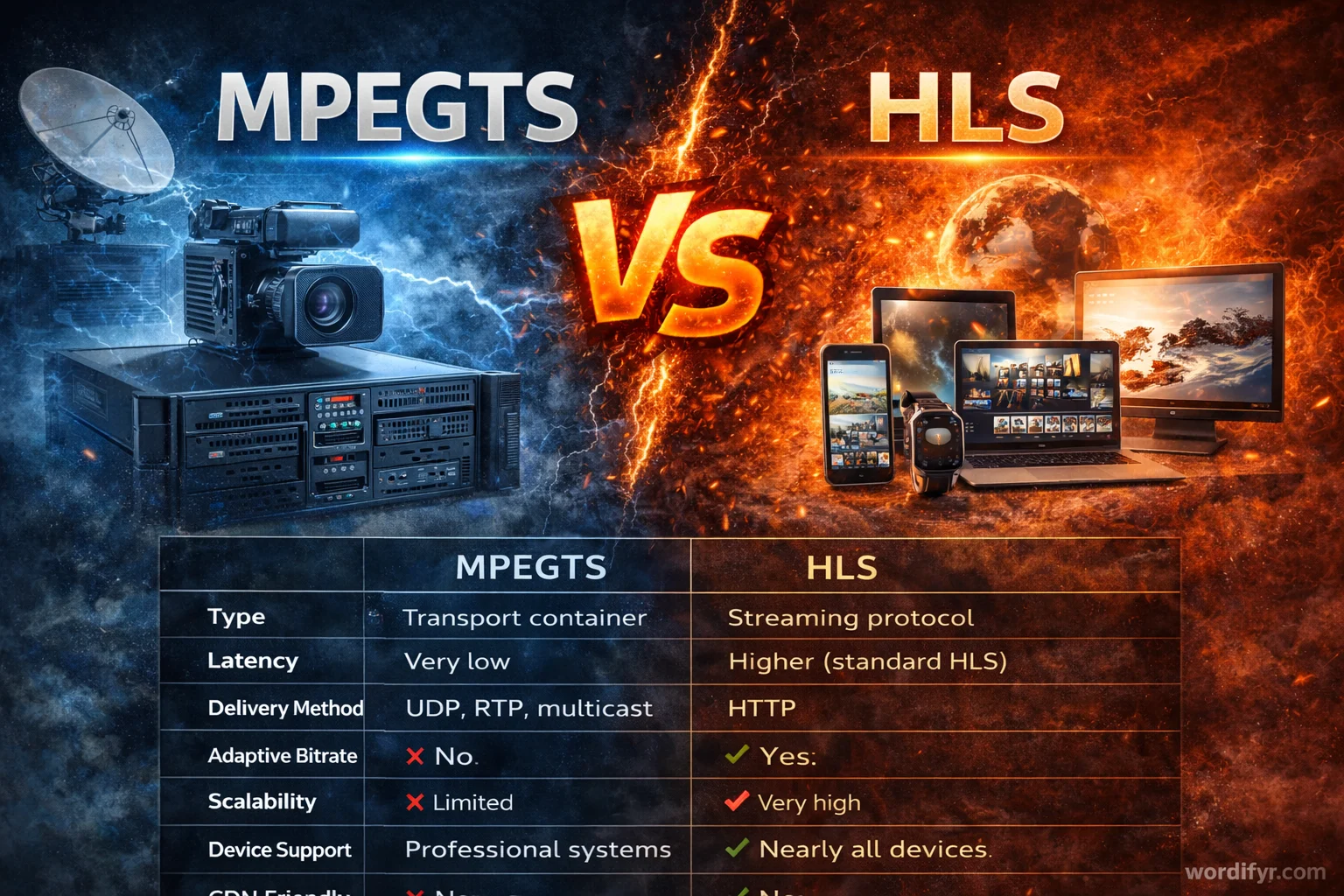
| Feature | MPEGTS | HLS |
|---|---|---|
| Type | Transport container | Streaming protocol |
| Latency | Very low | Higher (standard HLS) |
| Delivery Method | UDP, RTP, multicast | HTTP |
| Adaptive Bitrate | ❌ No | ✔️ Yes |
| Scalability | Limited | Very high |
| Device Support | Professional systems | Nearly all devices |
| CDN Friendly | ❌ No | ✔️ Yes |
This table highlights why MPEGTS vs HLS is about choosing the right tool, not picking a winner.
Real-Life Conversation Examples
Dialogue 1
Engineer: “Why are we using MPEGTS internally?”
Producer: “Because we need ultra-low latency.”
🎯 Lesson: MPEGTS excels in real-time delivery.
Dialogue 2
Developer: “Why does our app use HLS?”
Manager: “It works on every device.”
🎯 Lesson: HLS is built for wide compatibility.
Dialogue 3
Streamer: “Can HLS use MPEGTS?”
Technician: “Yes, HLS often uses MPEGTS segments.”
🎯 Lesson: MPEGTS and HLS can work together.
Dialogue 4
Client: “Why is there a delay on HLS?”
Engineer: “Because buffering improves stability.”
🎯 Lesson: HLS trades latency for reliability.
When to Use MPEGTS vs HLS
Choosing between MPEGTS vs HLS depends on your goals.
Use MPEGTS When:
- You need ultra-low latency
- Streaming is within a controlled network
- You’re working with broadcast hardware
- You’re sending contribution feeds
Memory Trick:
👉 TS = Transport Speed
Use HLS When:
- You’re streaming to large audiences
- You need adaptive bitrate
- You want device compatibility
- You rely on CDNs
Memory Trick:
👉 HLS = Huge Live Scale
US vs Global Usage
Both MPEGTS and HLS are used worldwide, but HLS dominates consumer streaming platforms globally, while MPEGTS remains common in professional broadcast environments.
Fun Facts or History
- 📡 Many live streams use MPEGTS inside HLS, combining both technologies.
- 🍎 Apple still requires HLS for many iOS streaming applications, reinforcing its dominance in MPEGTS vs HLS comparisons.
Conclusion
The difference between MPEGTS vs HLS comes down to purpose. MPEGTS is a robust, low-latency transport format built for real-time broadcasting, while HLS is a scalable, adaptive streaming protocol designed for the modern internet. They are not enemies—in fact, they often work together. Once you understand latency, scalability, and device support, choosing the right option becomes simple. Next time someone mentions these two formats, you’ll know exactly what they mean!