Introduction
A confident smile can change the way you feel about yourself—and the way others see you. That’s why modern cosmetic dentistry offers multiple solutions to improve teeth appearance. Two of the most talked-about options today are Invisalign and veneers. At first glance, they may seem interchangeable because both can dramatically transform a smile. However, many people feel confused when choosing between them.
Some assume Invisalign and veneers do the same thing. Others think one is simply a faster version of the other. That misunderstanding often leads to poor decisions and unrealistic expectations.
Although they look/sound similar, they serve completely different purposes.
In this detailed guide, you’ll learn the real difference between Invisalign vs veneers, how each treatment works, who they’re best for, and how to choose the right option based on your dental goals, budget, and long-term oral health.
What Is Invisalign?
Invisalign is a modern orthodontic treatment designed to straighten teeth gradually using clear, removable aligners instead of traditional metal braces.
Clear Meaning
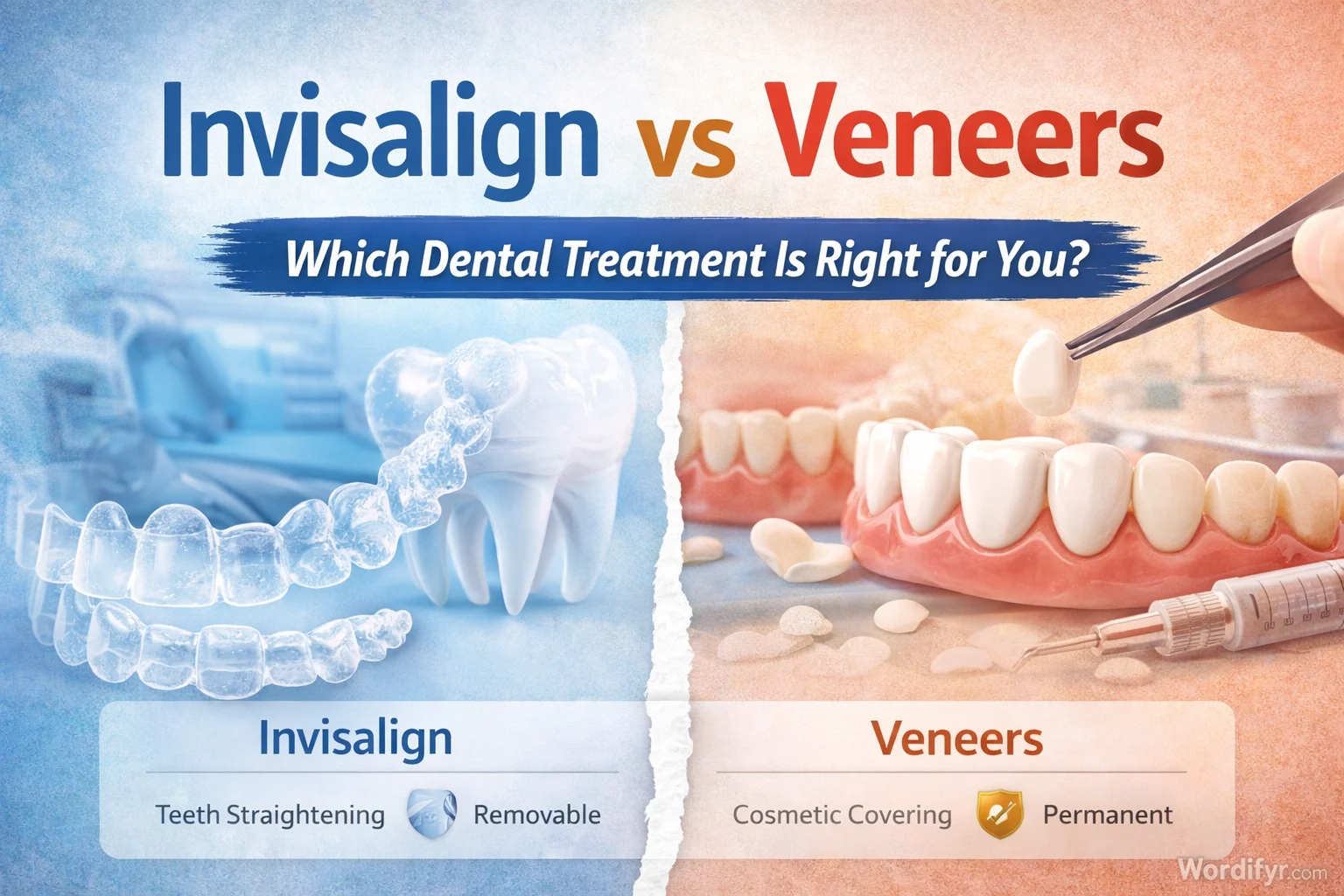
Invisalign focuses on correcting tooth alignment and bite issues over time. It does not cover teeth or permanently alter them. Instead, it gently moves teeth into better positions using custom-made aligners.
In simple terms:
Invisalign = teeth straightening
How It’s Used
- Uses a series of clear plastic aligners
- Each aligner is worn for 1–2 weeks
- Aligners apply controlled pressure to shift teeth
- Treatment typically lasts 6–18 months
Patients wear Invisalign for 20–22 hours per day, removing them only for eating, drinking, and oral hygiene.
Where It’s Used
Invisalign is used worldwide and approved by dental boards in:
- United States
- United Kingdom
- Europe
- Australia
- Asia
It is suitable for teenagers and adults seeking a discreet orthodontic solution.
Examples of Invisalign Results
- Straightening crowded teeth
- Closing gaps between teeth
- Correcting mild to moderate overbites
- Improving overall bite alignment
Example sentences:
- “She chose Invisalign to straighten her teeth without braces.”
- “Invisalign helped fix my crowded teeth naturally.”
- “He completed Invisalign treatment in 12 months.”
Short Historical or Usage Note
Invisalign was introduced in 1997 and revolutionized orthodontics by offering an almost invisible alternative to metal braces. Since then, millions of patients worldwide have used Invisalign to improve alignment without compromising appearance.
What Are Veneers?
Veneers are thin, custom-made shells that are permanently bonded to the front surface of teeth to improve appearance.
Clear Meaning
Veneers focus on cosmetic enhancement, not tooth movement. They instantly change how teeth look by covering imperfections.
In simple terms:
Veneers = cosmetic cover for teeth
How They’re Used
- Made from porcelain or composite resin
- Bonded permanently to natural teeth
- Require enamel removal
- Provide immediate visual results
The procedure usually takes 2–3 dental visits.
Where They’re Used
Veneers are commonly used worldwide, especially in:
- Cosmetic dentistry clinics
- Smile makeover treatments
- Hollywood-style dental transformations
Examples of Veneer Use
- Covering stained or discolored teeth
- Fixing chipped or cracked teeth
- Creating uniform tooth shape and size
- Closing small gaps instantly
Example sentences:
- “She got veneers to fix her stained teeth.”
- “Veneers transformed his smile in weeks.”
- “Many celebrities use veneers for perfect smiles.”
Short Historical or Usage Note
Veneers were first developed in Hollywood during the 1920s for actors who needed perfect smiles on camera. Modern veneers are far more durable and can last 10–15 years with proper care.
Key Differences Between Invisalign and Veneers
While both treatments improve smiles, Invisalign vs veneers differ significantly in purpose, process, and permanence.
Key Differences (Bullet Points)
- Invisalign moves teeth; veneers cover teeth
- Invisalign is reversible; veneers are permanent
- Invisalign treats alignment issues
- Veneers treat cosmetic imperfections
- Invisalign takes months; veneers give instant results
- Veneers require enamel removal; Invisalign does not
Comparison Table
| Feature | Invisalign | Veneers |
|---|---|---|
| Primary Purpose | Straightening teeth | Cosmetic enhancement |
| Permanence | Removable & reversible | Permanent |
| Treatment Time | 6–18 months | 2–4 weeks |
| Enamel Removal | ❌ No | ✔️ Yes |
| Fixes Alignment | ✔️ Yes | ❌ No |
| Covers Stains/Chips | ❌ No | ✔️ Yes |
| Cost Range | Medium to high | High |
| Maintenance | Retainers required | Routine dental care |
Real-Life Conversation Examples
Dialogue 1
A: “Should I get veneers to straighten my teeth?”
B: “Veneers won’t move teeth. Invisalign is better for that.”
🎯 Lesson: Invisalign fixes alignment; veneers don’t.
Dialogue 2
A: “I want perfect white teeth fast.”
B: “Then veneers might be better than Invisalign.”
🎯 Lesson: Veneers deliver instant cosmetic results.
Dialogue 3
A: “I don’t want anything permanent.”
B: “Invisalign is removable. Veneers aren’t.”
🎯 Lesson: Invisalign is reversible; veneers are not.
Dialogue 4
A: “Why does Invisalign take so long?”
B: “Because it moves teeth naturally, not just covers them.”
🎯 Lesson: Invisalign changes structure, veneers change appearance.
Dialogue 5
A: “Can I get veneers after Invisalign?”
B: “Yes, many people do both.”
🎯 Lesson: Treatments can be combined strategically.
When to Choose Invisalign vs Veneers
Choosing between Invisalign vs veneers depends on your dental needs and goals.
Choose Invisalign If:
- Your teeth are crooked or misaligned
- You have spacing or bite issues
- You want a natural, conservative approach
- You prefer a non-permanent solution
- Oral health is your top priority
Best for:
Alignment, orthodontic correction, long-term dental health
Choose Veneers If:
- Teeth are stained or discolored
- You want instant cosmetic improvement
- Teeth are chipped, uneven, or worn
- Alignment issues are minor
- You want a dramatic smile makeover
Best for:
Aesthetic perfection and fast results
Simple Memory Trick
- Movement = Invisalign
- Makeover = Veneers
US vs Global Usage Note
In both the US and UK:
- Invisalign refers to orthodontic treatment
- Veneers refer to cosmetic dental coverings
There is no regional spelling or grammar difference—only clinical application differences.
Fun Facts and History
1. Invisalign Uses AI Technology
Invisalign treatment plans are created using advanced 3D imaging and AI simulations to predict tooth movement accurately.
2. Veneers Are Stronger Than Natural Enamel
Porcelain veneers can be stronger than natural teeth, but once placed, they cannot be reversed.
Conclusion
The debate between Invisalign vs veneers is not about which is better—it’s about which is right for you. Invisalign corrects alignment issues naturally over time, preserving your teeth. Veneers deliver fast, dramatic cosmetic changes but permanently alter tooth structure.
Understanding the difference helps you avoid costly mistakes and unrealistic expectations. Many people even choose Invisalign first and veneers later for optimal results.
Next time someone asks about Invisalign and veneers, you’ll know exactly what they mean—and which option truly fits their smile goals.