Introduction
Have you ever seen the words deactivate and inactivate used almost interchangeably and wondered if they really mean the same thing? You’re not alone. These two verbs appear in technical manuals, software settings, medical reports, and everyday writing—often causing confusion even among professionals.
At first glance, they seem like perfect synonyms. After all, both suggest that something is no longer active. But when you look closer, their meanings, usage contexts, and implications are quite different. Choosing the wrong one can subtly change the meaning of a sentence or make your writing sound inaccurate or unprofessional.
Although they look/sound similar, they serve completely different purposes.
In this complete guide, we’ll clearly explain deactivate vs inactivate, show how each word is used in real life, compare them side by side, and give you easy memory tricks so you’ll never mix them up again.
What Is “Deactivate”?
Meaning of Deactivate
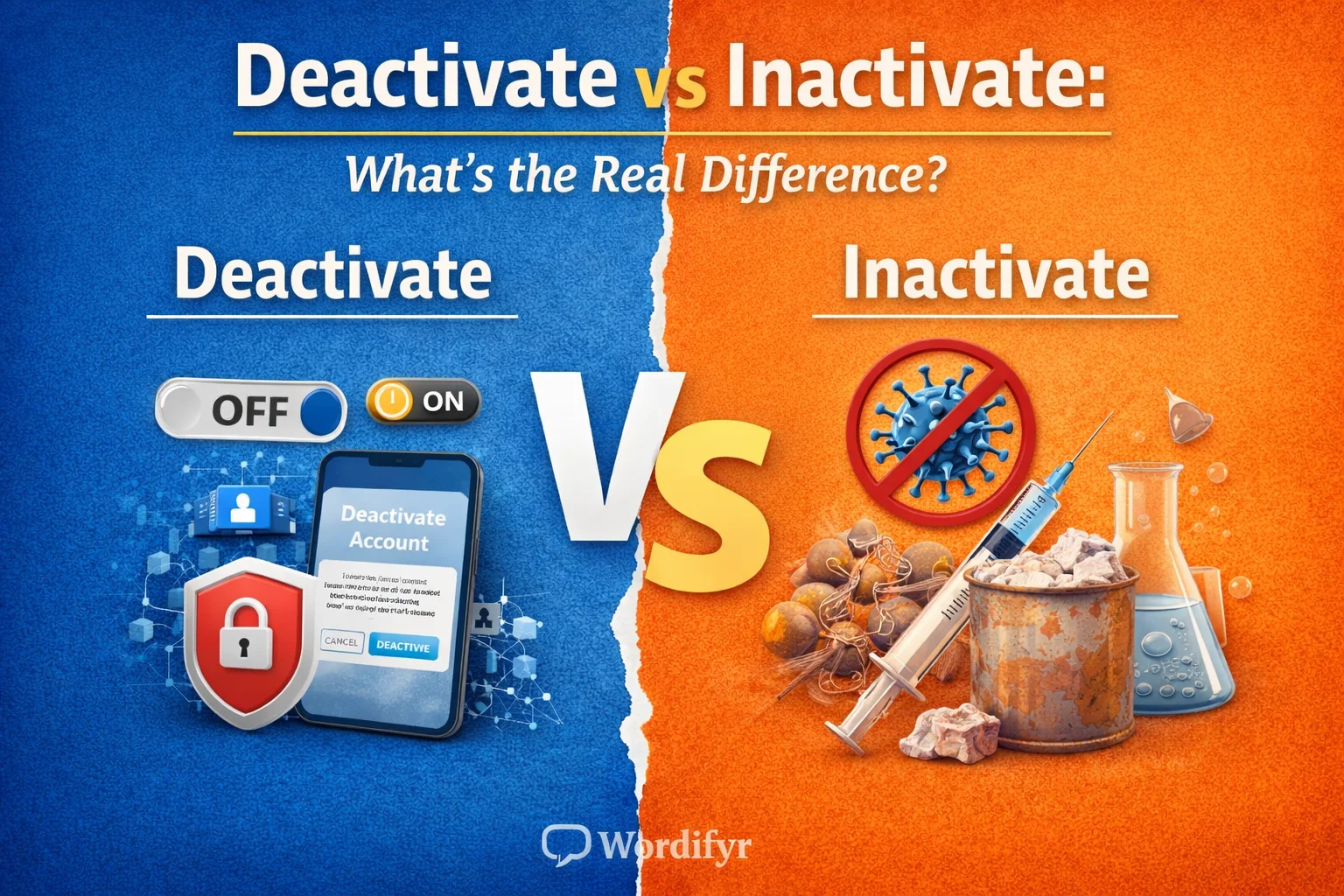
Deactivate means to intentionally turn something off or stop it from functioning, usually with the option to turn it back on later. The action is often temporary and deliberate.
In simple terms, deactivate = switch off by choice.
How Deactivate Is Used
Deactivate is commonly used when talking about:
- Accounts
- Devices
- Systems
- Features
- Services
- Security functions
It implies control, reversibility, and user intent.
Where Deactivate Is Used
- Common in both American and British English
- Frequently used in:
- Software & apps
- IT & cybersecurity
- Business operations
- Social media platforms
- Military and technical systems
Examples of Deactivate in Sentences
- You can deactivate your account anytime from the settings page.
- The technician deactivated the alarm before entering the building.
- Please deactivate the software before uninstalling it.
- She temporarily deactivated her social media profile.
- The system will deactivate unused features automatically.
Short Usage / History Note
The word deactivate comes from the prefix de- (meaning “remove or reverse”) and activate (“to make active”). It entered common usage in the 20th century with the rise of machines, electronics, and digital systems—where things could be turned on and off at will.
What Is “Inactivate”?
Meaning of Inactivate
Inactivate means to render something inactive so it can no longer function normally, often permanently or biologically/chemically rather than by choice.
In simple terms, inactivate = disable at a functional level.
How Inactivate Is Used
Inactivate is most often used in:
- Medical contexts
- Biology and chemistry
- Science and research
- Legal or formal documentation
It implies a process rather than a simple switch-off.
Where Inactivate Is Used
- Common in scientific and medical English
- Used globally in:
- Pharmaceuticals
- Virology
- Genetics
- Public health research
- Less common in casual or everyday language
Examples of Inactivate in Sentences
- Heat was used to inactivate the virus.
- The chemical compound inactivates harmful enzymes.
- Vaccines contain inactivated pathogens.
- The mutation inactivated the gene.
- Alcohol can inactivate certain bacteria.
Spelling & Grammar Notes
- Inactivate is always a process-based verb
- It does not imply easy reversal
- Often used with scientific agents (viruses, enzymes, proteins)
Key Differences Between Deactivate and Inactivate
Quick Bullet Summary
- Deactivate = intentionally turn off
- Inactivate = render unable to function
- Deactivate is often temporary
- Inactivate is often permanent
- Deactivate implies choice and control
- Inactivate implies biological or chemical change
- Deactivate is common in technology
- Inactivate is common in science and medicine
Deactivate vs Inactivate Comparison Table
| Feature | Deactivate | Inactivate |
|---|---|---|
| Core Meaning | Turn off intentionally | Disable functionally |
| Reversibility | Usually reversible | Often irreversible |
| Common Fields | Tech, apps, systems | Medicine, science |
| User Control | ✔️ Yes | ❌ No |
| Casual Usage | ✔️ Common | ❌ Rare |
| Scientific Usage | ❌ Limited | ✔️ Common |
| Example | Deactivate account | Inactivate virus |
Real-Life Conversation Examples
Dialogue 1
A: Should I inactivate my Facebook account?
B: You mean deactivate. Inactivation sounds medical.
🎯 Lesson: Accounts are deactivated, not inactivated.
Dialogue 2
A: How does the vaccine work?
B: It uses an inactivated virus to trigger immunity.
🎯 Lesson: Medical processes use inactivate.
Dialogue 3
A: Can I reactivate this feature later?
B: Yes, once you deactivate it.
🎯 Lesson: Deactivate implies reversibility.
Dialogue 4
A: Did the heat kill the bacteria?
B: It actually inactivated them.
🎯 Lesson: Scientific effects use inactivate.
Dialogue 5
A: Why did IT inactivate my account?
B: They didn’t—inactivate would mean permanent. They deactivated it.
🎯 Lesson: Word choice changes severity.
When to Use Deactivate vs Inactivate
Use Deactivate When:
- You are turning something off
- You expect it can be turned back on
- You’re writing about:
- Apps
- Accounts
- Devices
- Systems
- Features
- You’re writing for general or business audiences
Examples:
- Deactivate notifications
- Deactivate a subscription
- Deactivate security software temporarily
Use Inactivate When:
- You are describing a scientific or medical process
- Something is being neutralized or disabled biologically
- The change is not easily reversible
- You’re writing formal or technical content
Examples:
- Inactivate pathogens
- Inactivate enzymes
- Inactivated vaccine strains
Simple Memory Tricks 🧠
- Deactivate = Device / Decision
- Inactivate = Infection / Internal process
- If a button can turn it back on → Deactivate
- If science permanently changes it → Inactivate
US vs UK Usage Notes
- Both words are used in US and UK English
- Deactivate is far more common in everyday writing
- Inactivate appears mostly in academic or medical texts
- Context matters more than region
Fun Facts & History
1️⃣ Why “Inactivated Vaccines” Exist
Inactivated vaccines use pathogens that are killed or neutralized, not just switched off—making inactivate the precise scientific term.
2️⃣ Tech Popularized “Deactivate”
The explosion of apps, subscriptions, and digital services made deactivate a household word in the last two decades.
Conclusion
The difference between deactivate vs inactivate lies in intent and impact. When you deactivate something, you intentionally turn it off—usually temporarily and with the option to restore it later. When you inactivate something, you disable it at a functional or biological level, often permanently and through a scientific process.
Understanding this distinction helps your writing sound clearer, more accurate, and more professional.
Next time someone uses these two words, you’ll know exactly what they mean! 😊