
Introduction
Have you ever written a sentence and stopped to wonder whether damping or dampening is the correct word? You’re not alone. These two terms look almost interchangeable, sound similar, and are often used in overlapping contexts—especially in engineering, physics, audio, and everyday writing. As a result, many people mix them up or assume they mean the same thing.
The confusion usually comes from how language evolves and how certain technical terms spill into everyday usage. In casual conversation, both words are often treated as synonyms. But in formal writing, technical documentation, and professional communication, the difference actually matters. Although they look/sound similar, they serve completely different purposes.
In this guide, we’ll clearly explain damping vs dampening, show how each word is used, and help you choose the right one every time—without overthinking it.
What Is “Damping”?
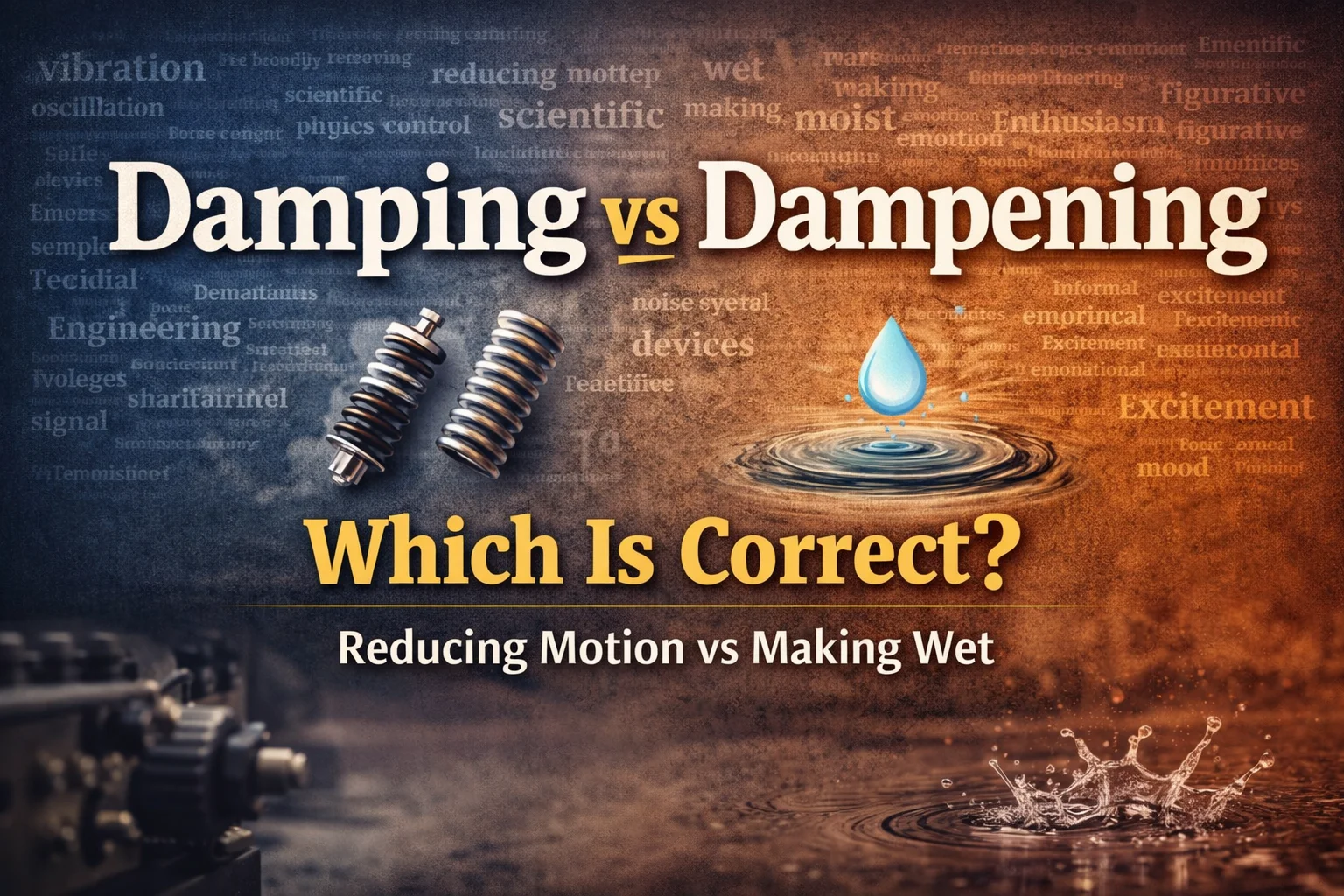
Damping refers to the process of reducing, controlling, or suppressing oscillations, vibrations, noise, or motion—especially in technical or scientific contexts. It is a precise term widely used in engineering, physics, mechanics, acoustics, and signal processing.
In the damping vs dampening comparison, damping is the technically correct and preferred term when you’re talking about systems, forces, waves, or signals.
How “Damping” Is Used
- To describe reduction of vibration or oscillation
- To control motion in mechanical systems
- To reduce noise or resonance in audio systems
- To stabilize signals in electronics or control systems
Where It’s Used
- Mechanical and civil engineering
- Physics and applied mathematics
- Audio engineering and DSP
- Scientific and academic writing
- Technical manuals and research papers
Examples in Sentences
- Shock absorbers provide damping to reduce vehicle vibrations.
- The system uses electromagnetic damping to stabilize motion.
- Proper damping prevents excessive oscillations in bridges.
- Audio engineers adjust damping to control resonance.
Short Historical or Usage Note
The term damping comes from the idea of restraining or deadening motion. It has been part of scientific vocabulary for centuries. In professional contexts, especially when comparing damping vs dampening, damping is the word experts expect to see.
What Is “Dampening”?
Dampening literally means making something wet or moist. However, in modern informal English, it is sometimes used figuratively to mean reducing intensity—such as dampening enthusiasm or excitement.
This is where damping vs dampening becomes tricky. While dampening is not technically wrong in casual writing, it is usually incorrect in scientific or engineering contexts.
How “Dampening” Is Used
- To describe adding moisture or liquid
- Figuratively, to describe emotional or abstract reduction
- Common in informal speech and general writing
Where It’s Used
- Everyday conversation
- Creative writing
- Journalism (non-technical)
- Emotional or metaphorical contexts
Examples in Sentences
- The rain dampened the ground.
- His harsh comments dampened the mood.
- Unexpected delays dampened their excitement.
Regional or Grammatical Notes
In technical writing, dampening is often considered a misuse when damping is intended. In the damping vs dampening debate, professionals almost always favor damping unless moisture is literally involved.
Key Differences Between Damping and Dampening
Although they’re often confused, damping vs dampening differs in meaning, usage, and correctness depending on context.
Quick Differences
- Damping = reducing motion, vibration, or oscillation
- Dampening = making wet OR figuratively reducing enthusiasm
- Damping = technical and scientific
- Dampening = literal moisture or informal expression
Comparison Table (Mandatory)
| Feature | Damping | Dampening |
|---|---|---|
| Core Meaning | Reducing vibration or oscillation | Making wet or reducing emotion |
| Technical Use | ✅ Yes | ❌ No |
| Engineering Context | Correct | Incorrect |
| Literal Meaning | Abstract/technical | Moisture-related |
| Informal Use | Rare | Common |
| Preferred in Science | Always | Almost never |
This table alone resolves most damping vs dampening confusion.
Real-Life Conversation Examples
Dialogue 1
A: “Should I write vibration dampening or vibration damping?”
B: “If it’s engineering, use damping.”
🎯 Lesson: Technical contexts require damping.
Dialogue 2
A: “The rain really dampened the field.”
B: “Yes, that’s correct—it made it wet.”
🎯 Lesson: Use dampening for moisture.
Dialogue 3
A: “Noise dampening materials reduce echo.”
B: “Technically, that should be noise damping.”
🎯 Lesson: Informal usage doesn’t always equal correct usage.
Dialogue 4
A: “His comments dampened the excitement.”
B: “That works—it’s emotional, not technical.”
🎯 Lesson: Figurative use allows dampening.
When to Use Damping vs Dampening
Choosing correctly between damping vs dampening becomes easy when you follow a few practical rules.
Practical Usage Rules
- Use damping for:
- Vibrations
- Oscillations
- Signals
- Noise control
- Engineering or physics topics
- Use dampening for:
- Water or moisture
- Emotional tone
- Mood, enthusiasm, or excitement
Simple Memory Tricks
- Damping = Devices, Data, Dynamics
- Dampening = Damp (wet)
If no moisture is involved, damping is almost always the safer choice.
Professional Writing Tip
In academic, scientific, and SEO-focused content, always prefer damping unless you are explicitly talking about wetness. Search engines and expert readers recognize the difference clearly in the damping vs dampening debate.
Fun Facts or History
- In engineering textbooks, dampening is often marked as an error when used instead of damping.
- Despite this, phrases like “noise dampening” became popular through marketing—even though “noise damping” is technically correct.
Conclusion
The confusion between damping vs dampening is understandable, but the distinction is important. Damping is the correct term for reducing vibrations, oscillations, noise, or motion—especially in technical and scientific writing. Dampening, on the other hand, refers to making something wet or figuratively reducing emotion or enthusiasm. Knowing when to use each word improves clarity, credibility, and professionalism in your writing. Once you understand the difference, you’ll avoid a common mistake that even experienced writers make. Next time someone uses these two words, you’ll know exactly what they mean!