Introduction
If you’ve ever shopped for jewelry or accessories, you’ve probably wondered whether to call something a brooch or a pin. Many people use these words interchangeably, and at first glance, that seems reasonable—they both attach to clothing, both can be decorative, and both often sit on jackets, dresses, or scarves. This overlap is exactly why confusion happens. Some stores label everything as a pin, while others insist on the word brooch. Social media, fashion blogs, and even jewelers don’t always agree either. Although they look/sound similar, they serve completely different purposes. The difference mainly lies in design, formality, and intent. In this guide, you’ll learn what each term really means, how and where it’s used, and how to choose the right word with confidence in everyday conversation, fashion writing, and professional content.
What Is a Brooch?
A brooch is a decorative piece of jewelry designed to be worn on clothing, usually for style, elegance, or formality.
Meaning and Definition
A brooch is an ornamental accessory, often made of metal, gemstones, pearls, or enamel, and attached to garments using a clasp or pin mechanism on the back.
How It’s Used
- Used as a fashion accessory
- Focuses on decoration rather than function
- Common in formal or traditional attire
Examples:
- “She wore a diamond brooch on her coat.”
- “The vintage brooch belonged to her grandmother.”
Where It’s Used
- Formal events
- Traditional clothing
- Fashion jewelry collections
- Museums and antique stores
Grammar Notes
- Singular: brooch
- Plural: brooches
- Often paired with adjectives like vintage, floral, jeweled
Short Historical Note
The word brooch comes from Old French broche, meaning “a pointed object.” Brooches date back thousands of years and were originally used by Romans and Celts to fasten cloaks—long before buttons existed.
Example Sentences
- “The gold brooch added elegance to her dress.”
- “Antique brooches are highly collectible.”
- “She inherited a sapphire brooch.”
What Is a Pin?
A pin is a small object used to fasten, attach, or display something, often with a practical or symbolic purpose.
Meaning and Definition
A pin is a simple fastening item that may be decorative, functional, or symbolic. It usually has a straight metal shaft with a clasp or backing.
How It’s Used
- Used for function, identification, or expression
- Often lightweight and minimal
- Can be decorative but not necessarily jewelry
Examples:
- “He wore a flag pin on his lapel.”
- “She pinned a badge to her bag.”
Where It’s Used
- Offices and uniforms
- Campaigns and events
- Badges and name tags
- Casual clothing and accessories
Grammar Notes
- Singular: pin
- Plural: pins
- Common types: lapel pin, enamel pin, safety pin
Usage Note
Pins are more casual and versatile than brooches. Many modern pins are used for branding, fandoms, or personal expression rather than fashion elegance.
Example Sentences
- “She collects enamel pins.”
- “The company logo pin was mandatory.”
- “He attached a poppy pin to his jacket.”
Key Differences Between Brooch and Pin
Bullet Point Summary
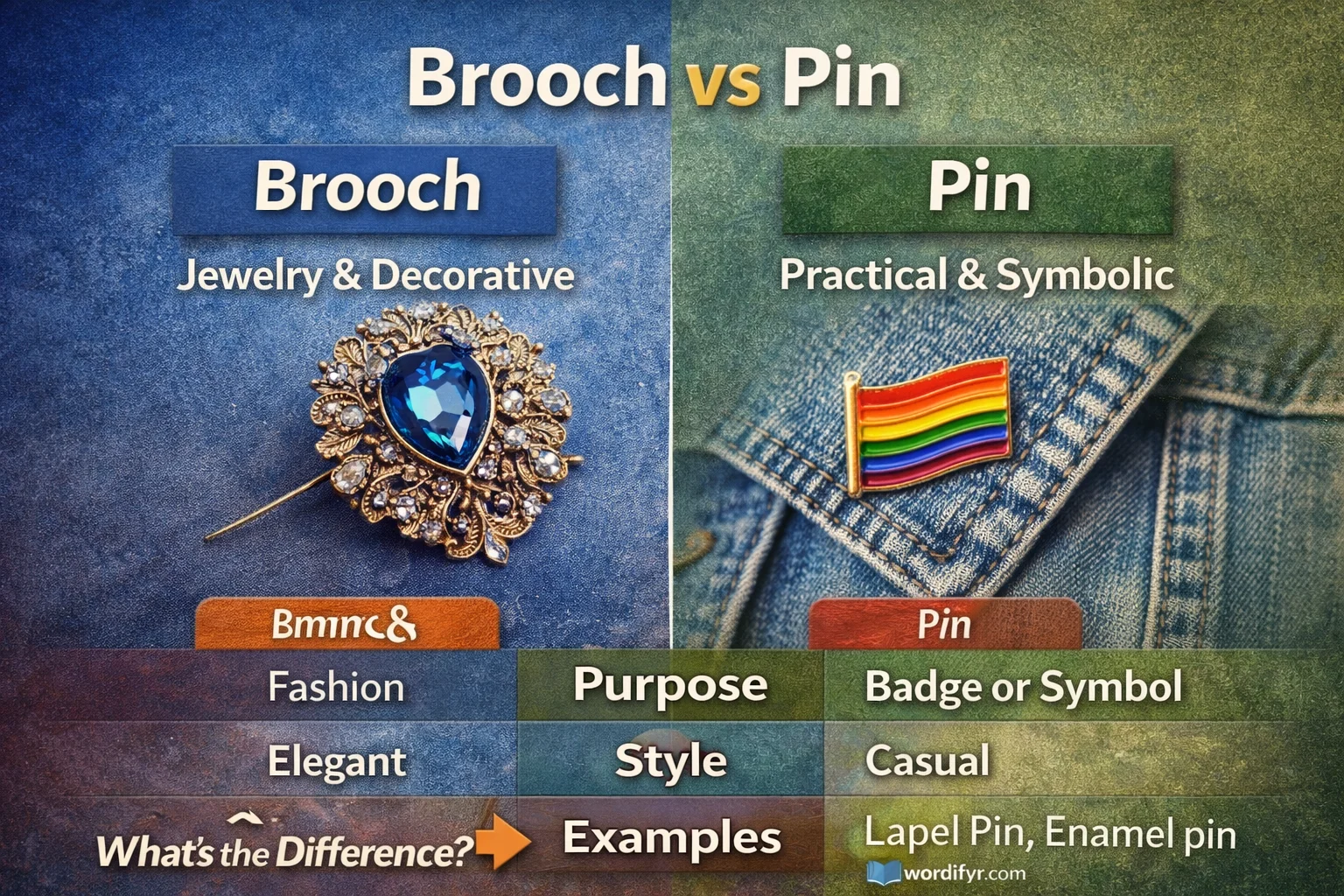
- Brooch is primarily decorative jewelry
- Pin is usually functional or symbolic
- Brooches are more formal
- Pins are more casual and versatile
- All brooches use a pin, but not all pins are brooches
Comparison Table
| Feature | Brooch | Pin |
|---|---|---|
| Type | Jewelry | Fastener / accessory |
| Purpose | Decorative | Functional or symbolic |
| Style | Elegant, formal | Casual, practical |
| Materials | Gold, silver, gems | Metal, enamel, plastic |
| Occasions | Formal events | Daily wear, uniforms |
| Examples | Floral brooch | Lapel pin, badge |
| Tone | Fashion-focused | Utility-focused |
Real-Life Conversation Examples
Dialogue 1
A: “Is this a brooch or a pin?”
B: “It’s jeweled and decorative, so it’s a brooch.”
🎯 Lesson: Jewelry-focused pieces are brooches.
Dialogue 2
A: “Why do they call it a lapel pin?”
B: “Because it represents something, not just decoration.”
🎯 Lesson: Symbolic items are usually pins.
Dialogue 3
A: “My grandmother wore brooches every day.”
B: “Yes, they were very popular in classic fashion.”
🎯 Lesson: Brooches have a traditional feel.
Dialogue 4
A: “I bought a cartoon pin for my bag.”
B: “That wouldn’t be called a brooch.”
🎯 Lesson: Casual items = pins.
Dialogue 5
A: “This pin has gemstones—does that make it a brooch?”
B: “Yes, decorative design changes the category.”
🎯 Lesson: Design and intent matter.
When to Use Brooch vs Pin
Use Brooch When:
- Referring to fashion jewelry
- Writing about formal or vintage accessories
- Describing elegance or luxury
- Talking about heirloom pieces
Examples:
- “She accessorized with a pearl brooch.”
- “The exhibition featured antique brooches.”
Use Pin When:
- Referring to badges, symbols, or fasteners
- Writing casually or practically
- Talking about branding or identification
- Describing modern accessories
Examples:
- “He wears a company pin.”
- “She collects enamel pins.”
Simple Memory Tricks
- Brooch = Beauty
- Pin = Purpose
If it’s mainly for style, say brooch.
If it’s mainly for use or message, say pin.
Fun Facts or History
- Queen Elizabeth II famously used brooches to send subtle messages through fashion.
- The modern enamel pin became popular through pop culture, fandoms, and activism.
Conclusion
The difference between brooch or pin comes down to intent and design. A brooch is a decorative piece of jewelry meant to enhance an outfit, often formal or traditional. A pin, on the other hand, is more practical or symbolic and commonly used for identification, expression, or function. While they may look similar and even share a fastening mechanism, their purposes are distinct. Once you focus on whether the item is meant for fashion or function, the correct word becomes obvious. Next time someone uses these two words, you’ll know exactly what they mean!