Introduction
If you grew up loving dinosaurs, chances are you’ve heard the names Brontosaurus and Brachiosaurus many times. They often appear in movies, books, museums, and even children’s toys. Because both dinosaurs were gigantic, long-necked plant eaters, people frequently assume they were the same creature—or at least closely related in appearance and lifestyle.
This confusion is completely understandable. Both dinosaurs lived millions of years ago, both were enormous, and both had long necks and tails. On top of that, Brontosaurus disappeared from science books for decades, which made the confusion even worse.
Although they look/sound similar, they serve completely different purposes.
In this in-depth guide, you’ll learn the true difference between Brontosaurus vs Brachiosaurus, how scientists distinguish them, where each lived, how they moved, and why mixing them up is one of the most common dinosaur mistakes.
What Is Brontosaurus?
Brontosaurus is a massive, long-necked dinosaur belonging to a group called sauropods. Its name means “thunder lizard,” referring to the ground-shaking sound its footsteps were once believed to make.
Clear Meaning
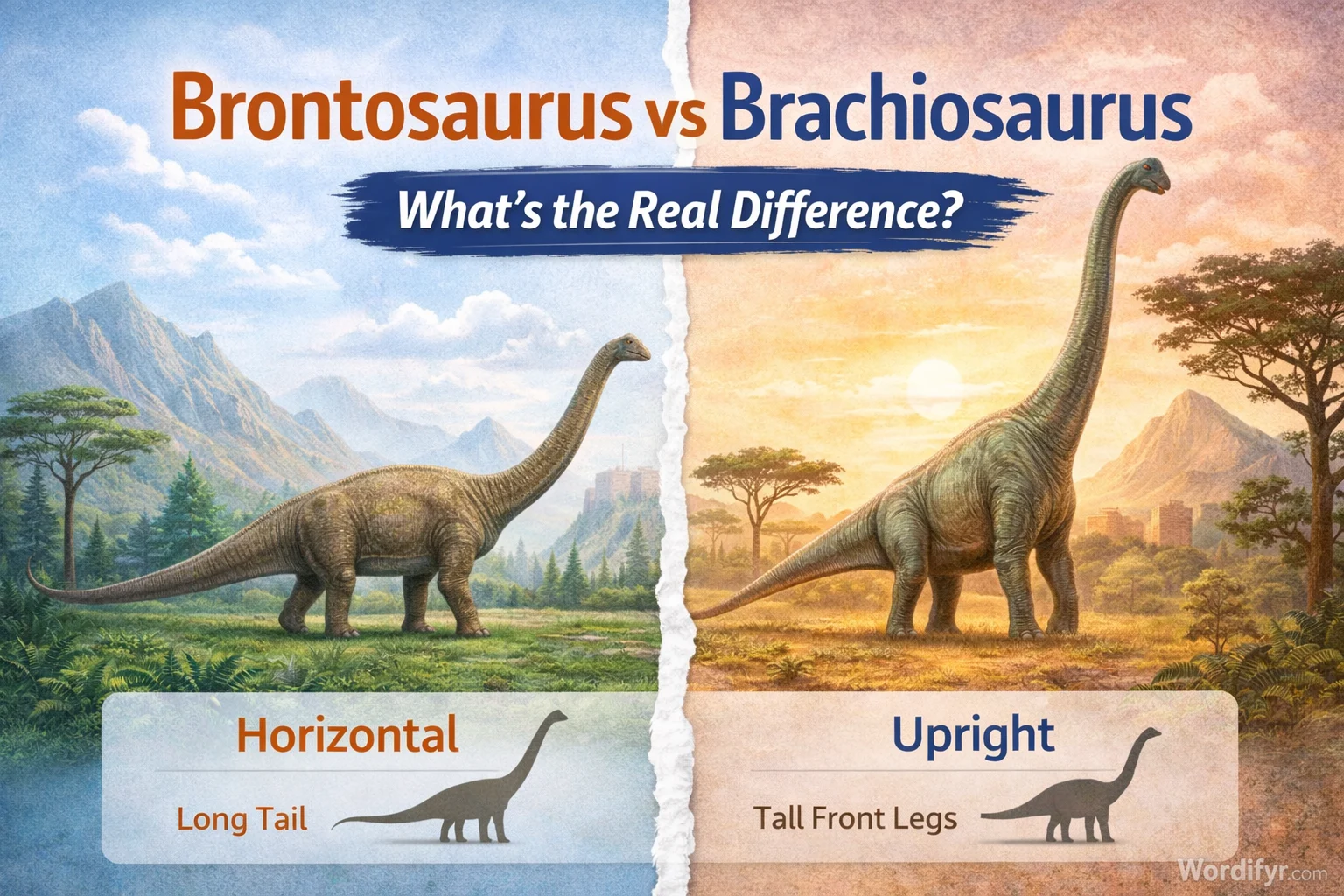
Brontosaurus was a herbivorous (plant-eating) dinosaur known for its long tail, long neck, and relatively horizontal body posture.
In simple terms:
Brontosaurus = long, low-necked plant eater
How It’s Described
- Walked on four strong legs
- Long neck held mostly straight forward
- Very long, whip-like tail
- Small head compared to body size
Brontosaurus used its long neck to sweep vegetation at mid-level heights rather than reaching extremely tall trees.
Where It Lived
Brontosaurus lived during the Late Jurassic Period, around 155–150 million years ago, in what is now:
- North America (especially present-day USA)
Fossils have been found mainly in the Morrison Formation, a famous dinosaur fossil region.
Examples in Context
- “The Brontosaurus used its long tail for balance.”
- “Brontosaurus fossils were found in Colorado.”
- “Scientists once believed Brontosaurus didn’t exist.”
Short Historical or Usage Note
Brontosaurus has one of the most controversial histories in paleontology. In the early 1900s, scientists claimed it was actually the same dinosaur as Apatosaurus and removed the name from textbooks. However, in 2015, new research confirmed that Brontosaurus is a valid, distinct genus, restoring its scientific status.
What Is Brachiosaurus?
Brachiosaurus is another giant sauropod dinosaur, but it looks and behaves very differently from Brontosaurus.
Clear Meaning
Brachiosaurus was a tall, long-necked herbivore that stood higher than most dinosaurs of its time.
In simple terms:
Brachiosaurus = tall, giraffe-like plant eater
How It’s Described
- Front legs longer than back legs
- Body sloped upward toward the head
- Neck held high in a vertical position
- Shorter tail compared to Brontosaurus
Its posture allowed Brachiosaurus to feed on very tall trees, giving it access to food other dinosaurs couldn’t reach.
Where It Lived
Brachiosaurus lived during the Late Jurassic Period, around 154–150 million years ago, and fossils have been found in:
- North America
- Africa (close relatives)
Examples in Context
- “The Brachiosaurus could reach treetops.”
- “Brachiosaurus stood taller than most dinosaurs.”
- “Its body shape resembled a giraffe.”
Short Historical or Usage Note
Brachiosaurus was first described in 1903 and has never lost its scientific validity. Its unique body structure made it one of the most recognizable dinosaurs in museums and films, including Jurassic Park.
Key Differences Between Brontosaurus and Brachiosaurus
Although both dinosaurs were sauropods, Brontosaurus vs Brachiosaurus differ in anatomy, posture, feeding style, and overall appearance.
Key Differences (Bullet Points)
- Brontosaurus had a horizontal posture
- Brachiosaurus had a vertical, upright posture
- Brontosaurus had a longer tail
- Brachiosaurus had longer front legs
- Brontosaurus fed at mid-level plants
- Brachiosaurus fed from tall trees
- Brontosaurus had a longer body
- Brachiosaurus appeared taller overall
Comparison Table
| Feature | Brontosaurus | Brachiosaurus |
|---|---|---|
| Dinosaur Group | Sauropod | Sauropod |
| Time Period | Late Jurassic | Late Jurassic |
| Body Posture | Horizontal | Upright |
| Neck Position | Forward | Vertical |
| Front Legs | Shorter than back legs | Longer than back legs |
| Feeding Height | Low to mid vegetation | Tall trees |
| Tail Length | Very long | Shorter |
| Overall Shape | Long and low | Tall and giraffe-like |
Real-Life Conversation Examples
Dialogue 1
A: “Isn’t Brontosaurus just another name for Brachiosaurus?”
B: “No, they’re completely different dinosaurs.”
🎯 Lesson: Similar names don’t mean same species.
Dialogue 2
A: “Which dinosaur stood taller?”
B: “Brachiosaurus was much taller.”
🎯 Lesson: Brachiosaurus had a vertical posture.
Dialogue 3
A: “Why does Brontosaurus look longer?”
B: “Because its body and tail were stretched horizontally.”
🎯 Lesson: Body shape defines feeding style.
Dialogue 4
A: “Why was Brontosaurus removed from books?”
B: “Scientists thought it was Apatosaurus.”
🎯 Lesson: Scientific classification can change.
Dialogue 5
A: “Which one ate treetops?”
B: “Brachiosaurus.”
🎯 Lesson: Feeding height is a major difference.
When to Use Brontosaurus vs Brachiosaurus
Understanding when to use Brontosaurus vs Brachiosaurus depends on the context.
Use “Brontosaurus” When:
- Referring to a long, low-necked sauropod
- Discussing dinosaur classification history
- Talking about restored dinosaur genera
- Describing mid-level plant feeding
Examples:
- “Brontosaurus had a powerful tail.”
- “The Brontosaurus controversy lasted decades.”
Use “Brachiosaurus” When:
- Referring to a tall, giraffe-like dinosaur
- Discussing treetop feeding behavior
- Describing upright sauropods
- Talking about Jurassic Park dinosaurs
Examples:
- “Brachiosaurus could reach tall trees.”
- “The museum displays a Brachiosaurus skeleton.”
Simple Memory Trick
- Bronto = broad and long
- Brachio = arms (long front legs)
This makes it easier to remember posture differences.
Fun Facts and History
1. Brontosaurus Made a Scientific Comeback
After being removed for nearly 100 years, Brontosaurus was officially recognized again in 2015, making it one of the most famous scientific “comebacks” ever.
2. Brachiosaurus May Have Had Air Sacs
Scientists believe Brachiosaurus had air-filled bones similar to birds, helping support its massive size without collapsing under its own weight.
Conclusion
The difference between Brontosaurus vs Brachiosaurus goes far beyond their similar names. Brontosaurus was long, low, and built for sweeping vegetation, while Brachiosaurus stood tall, reaching treetops with its giraffe-like posture. Both were giants of the Jurassic world, but they filled very different ecological roles.
Understanding these differences not only clears confusion but also highlights how diverse dinosaurs truly were. Science continues to evolve, and so does our understanding of prehistoric life.
Next time someone mixes up these two dinosaurs, you’ll know exactly what they mean—and which one they’re talking about!