
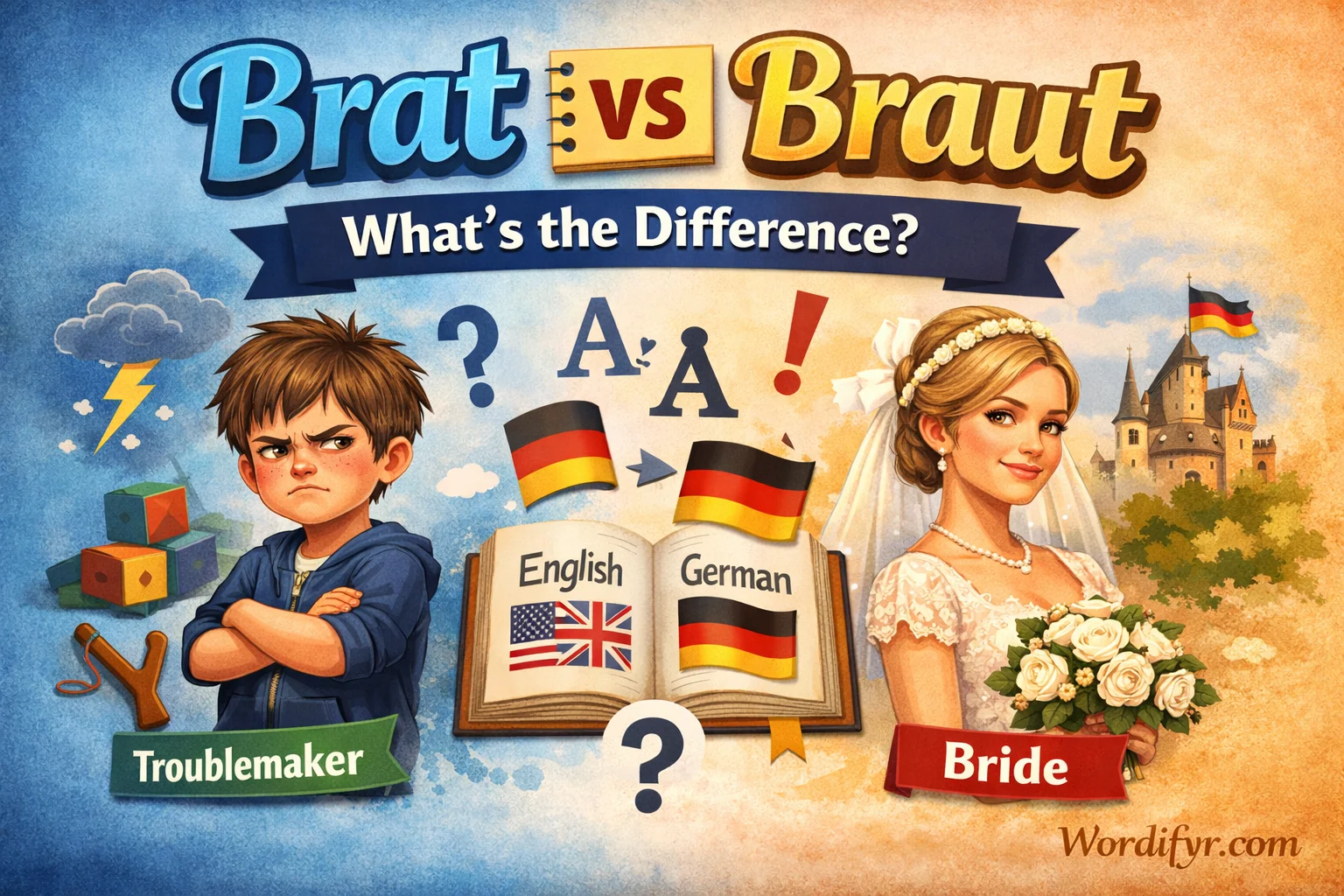
Introduction
Have you ever seen the words brat and braut and wondered whether one is a typo of the other? You are not alone. These two terms often confuse readers, writers, and even advanced English learners because they look and sound deceptively similar. Add to that the fact that one word belongs to everyday English while the other comes from a foreign language, and the confusion becomes inevitable.
People commonly encounter this mix-up online, in wedding-related content, social media captions, or translated texts. The problem is not pronunciation alone—it is about language origin, meaning, and usage context. Although they look/sound similar, they serve completely different purposes.
In this guide, we will break down brat vs braut in simple, conversational English. You will learn what each word really means, where it comes from, how it is used, and how to avoid embarrassing mistakes in real-life writing and conversation.
What Is “Brat”?
Meaning
The word brat is an English noun that refers to a badly behaved or annoying child. It is informal and often carries a negative or playful tone, depending on context.
How It’s Used
“Brat” is used to describe behavior rather than age alone. A child does not have to be young to be called a brat—it is their attitude, actions, or manners that matter.
In some contexts, adults may jokingly call friends or even themselves “brats” to describe stubborn or mischievous behavior.
Where It’s Used
- Common in American English and British English
- Informal speech and casual writing
- Parenting discussions, humor, storytelling, and pop culture
There are no special grammar rules beyond standard noun usage.
Examples in Sentences
- “That kid keeps yelling in the store—what a brat.”
- “I was a bit of a brat when I was younger.”
- “Stop acting like a brat and listen for once.”
- “She’s not mean, just a playful brat.”
Short Usage Note
Historically, “brat” originally meant a child or offspring without a negative meaning. Over time, its usage shifted to describe spoiled or misbehaving children, which is how it is commonly understood today.
What Is “Braut”?
Meaning
The word braut is not an English word. It comes from German, where “Braut” means “bride.” It refers specifically to a woman who is about to get married or has just been married.
How It’s Used
“Braut” is used in German-language contexts, wedding traditions, cultural discussions, and translated content. In English writing, it may appear when referencing German customs or when someone mistakenly uses it instead of “bride.”
Where It’s Used
- German-speaking countries (Germany, Austria, Switzerland)
- Cultural or linguistic discussions
- Wedding-related translations
- Academic or travel writing involving German terms
It does not follow English grammar rules because it is a loanword, not a standard English noun.
Examples in Sentences
- “The Braut wore a traditional white dress.” (German context)
- “In German, the word for bride is Braut.”
- “The photographer focused on the Braut and groom.”
- “She learned that Braut means bride in German.”
Regional and Grammatical Notes
- Capitalized as a noun in German (Braut)
- Feminine noun in German grammar
- Not interchangeable with “brat” in English
Using “braut” in English without context is usually a spelling or language error.
Key Differences Between Brat and Braut
Quick Breakdown
- Brat is an English word; braut is German
- Brat describes behavior; braut describes marital status
- Brat often has a negative tone; braut is neutral or respectful
- Brat is common in daily English; braut is not
- Mixing them up can completely change meaning
Comparison Table
| Feature | Brat | Braut |
|---|---|---|
| Language Origin | English | German |
| Meaning | Misbehaving or spoiled child | Bride |
| Part of Speech | Noun | Noun |
| English Usage | Common and informal | Rare / contextual |
| Emotional Tone | Negative or playful | Neutral / respectful |
| Used in Weddings? | ❌ No | ✔️ Yes |
| Risk if Misused | Insulting someone | Confusing or incorrect |
Real-Life Conversation Examples
Dialogue 1
A: “Why did he call the bride a brat?”
B: “I think he meant Braut, not brat.”
🎯 Lesson: One spelling mistake can turn a compliment into an insult.
Dialogue 2
A: “Is ‘braut’ an English word?”
B: “No, it’s German. In English, we say bride.”
🎯 Lesson: “Braut” belongs to another language entirely.
Dialogue 3
A: “That child is such a braut.”
B: “You mean brat. ‘Braut’ means bride.”
🎯 Lesson: Similar sounds do not mean similar meanings.
Dialogue 4
A: “Why did my article confuse readers?”
B: “You used ‘braut’ instead of ‘brat’.”
🎯 Lesson: Correct spelling protects your credibility.
Dialogue 5
A: “I saw ‘Braut’ in a wedding blog.”
B: “It’s fine if they’re discussing German traditions.”
🎯 Lesson: Context determines correctness.
When to Use Brat vs Braut
Use “Brat” When:
- You are writing in English
- You are describing bad or childish behavior
- The tone is informal or conversational
- You mean attitude, not relationship status
Memory Trick:
👉 Brat = Behavior
Use “Braut” When:
- You are referencing German language or culture
- You are translating or explaining foreign terms
- The context is weddings or marriage
- Your audience understands the linguistic reference
Memory Trick:
👉 Braut = Bride (both start with “Br”)
US vs UK Writing
There is no difference between US and UK English for “brat.” Both use it the same way. “Braut” remains foreign in both regions.
Fun Facts or History
1. “Brat” Was Once Neutral
In older English, “brat” simply meant a child or descendant. The negative meaning developed later through social usage.
2. German Capitalization Matters
In German, all nouns are capitalized. That is why you will always see Braut, not braut, in correct German writing.
Conclusion
The difference between brat vs braut is not small—it is fundamental. Brat is an English word used to describe annoying or misbehaving behavior, usually in children. Braut, on the other hand, is a German word that means bride and has no place in standard English unless used intentionally for cultural or linguistic reasons.
Understanding this distinction protects you from awkward mistakes, misunderstandings, and credibility loss in writing. Once you remember that one describes behavior and the other describes a bride, the confusion disappears. Next time someone uses these two words, you’ll know exactly what they mean!