Introduction
English spelling has a way of surprising even the most confident writers. One moment you’re typing smoothly, and the next you’re stuck wondering: Is it “targeting” or “targetting”? This confusion pops up frequently in marketing, business writing, academics, and even casual emails. Since both spellings look logical and sound identical, it’s easy to assume they’re interchangeable.
That assumption is where most mistakes begin.
Although they look/sound similar, they serve completely different purposes.
In reality, only one spelling is accepted in modern English, while the other is considered incorrect almost everywhere today. In this guide, we’ll break down the difference between targeting vs targetting, explain why the confusion exists, show real-life examples, and give you simple rules so you never hesitate again—whether you’re writing for US, UK, or global audiences.
Section 1: What Is “Targeting”?
Clear Meaning
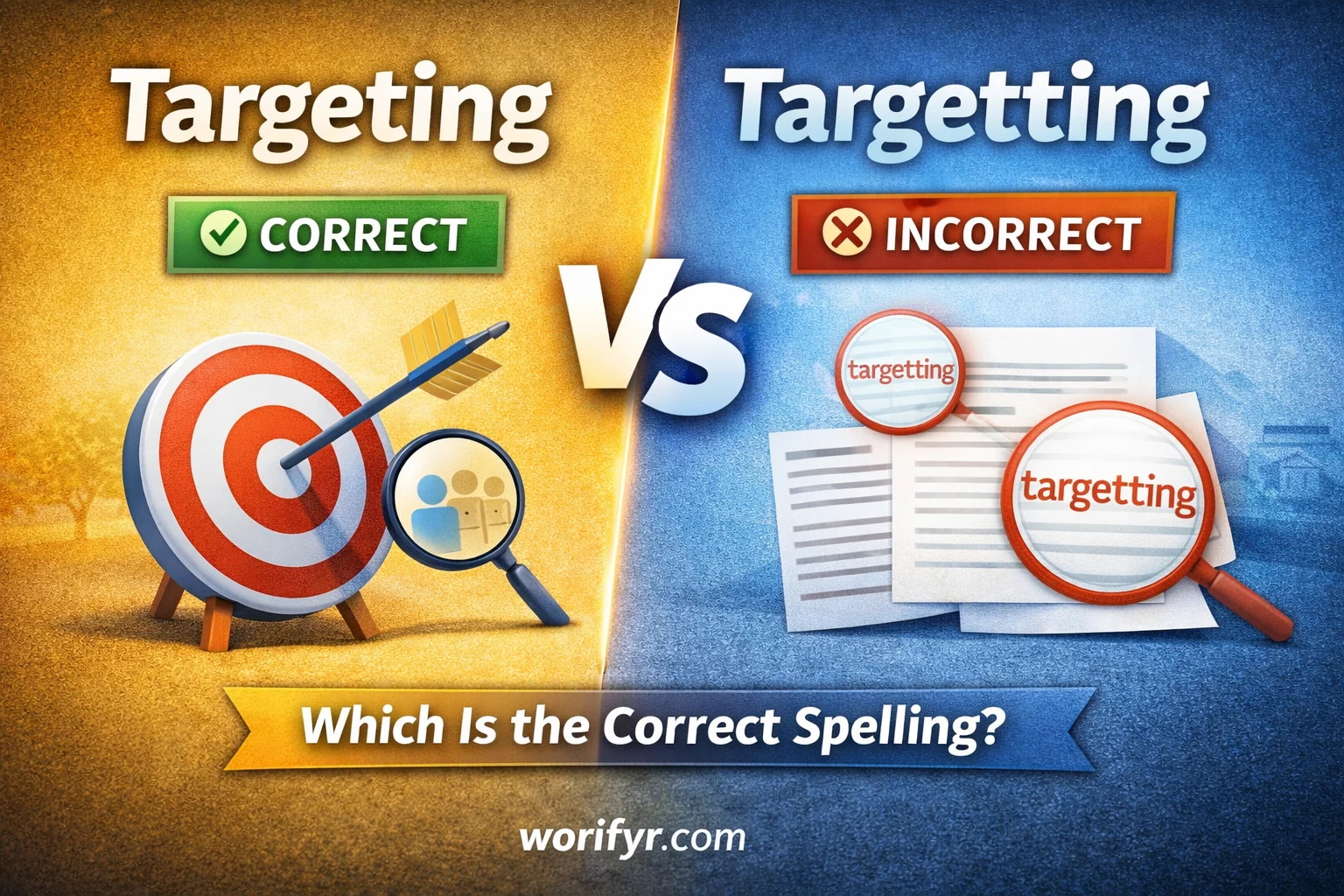
Targeting is the correct and standard spelling of the word. It is the present participle or gerund form of the verb target, meaning to aim at, focus on, or direct efforts toward a specific goal, group, or object.
In the targeting vs targetting debate, targeting is the form you should always use.
How It’s Used
“Targeting” is commonly used to describe:
- Marketing strategies
- Advertising campaigns
- Military or strategic actions
- Academic research focus
- Personal or professional goals
It functions as:
- A verb (“We are targeting new customers.”)
- A noun/gerund (“Targeting young adults is effective.”)
Where It’s Used (Regional Rules)
Targeting is used in:
- American English ✅
- British English ✅
- Australian English ✅
- Canadian English ✅
- International English ✅
There are no regional exceptions. Unlike words such as travelling or cancelling, this spelling does not change by country.
Examples in Sentences
- “The company is targeting a younger audience this year.”
- “Digital targeting has transformed online advertising.”
- “They are targeting cost reduction across departments.”
- “Proper targeting improves conversion rates.”
Short Historical or Usage Note
The word target comes from Middle English, originally referring to a shield or object aimed at. When verbs ending in -et form participles, modern English does not double the final ‘t’. That rule explains why targeting is correct and targetting is not.
Section 2: What Is “Targetting”?
Clear Meaning
Targetting is considered a misspelling in modern English. It is not accepted in standard dictionaries, professional writing, or academic publishing.
In discussions about targeting vs targetting, this spelling is the source of confusion—but not a valid alternative.
Why People Think It’s Correct
The confusion comes from English spelling rules where final consonants are doubled:
- run → running
- plan → planning
- travel → travelling (UK)
Writers assume the same rule applies to target, leading them to write targetting.
Why It’s Incorrect
The doubling rule only applies when:
- The word ends in one vowel + one consonant, and
- The stress falls on the final syllable
The word target fails both conditions:
- It ends in -et, not a stressed consonant
- The stress is on the first syllable (TAR-get)
Therefore, the extra “t” is never added.
Examples of Incorrect Usage (For Learning Only)
❌ “We are targetting a new market.”
❌ “Audience targetting improves ROI.”
These forms are flagged by grammar checkers and editors.
Regional or Grammatical Notes
- ❌ Not British English
- ❌ Not American English
- ❌ Not Australian or Canadian English
- ❌ Not accepted in SEO, academic, or legal writing
Even in regions that use double consonants elsewhere, targetting is still wrong.
Key Differences Between Targeting vs Targetting
Quick Bullet Points
- Targeting is correct worldwide
- Targetting is a spelling error
- No regional spelling variation exists
- Used heavily in marketing and strategy
- Only one form is SEO-safe
Mandatory Comparison Table
| Feature | Targeting | Targetting |
|---|---|---|
| Spelling Status | ✅ Correct | ❌ Incorrect |
| Dictionary Accepted | Yes | No |
| Used in US English | Yes | No |
| Used in UK English | Yes | No |
| SEO & Professional Writing | Safe | Risky |
| Grammar Check Approval | Passes | Flagged |
| Recommended Usage | Always | Never |
Real-Life Conversation Examples
Dialogue 1
A: “Is it targeting or targetting?”
B: “It’s always targeting—no double T.”
🎯 Lesson: Only one spelling is correct.
Dialogue 2
A: “Why did my editor change targetting?”
B: “Because it’s a spelling error.”
🎯 Lesson: Editors universally reject “targetting.”
Dialogue 3
A: “But British English doubles letters, right?”
B: “Not with this word.”
🎯 Lesson: British English still uses “targeting.”
Dialogue 4
A: “Will targetting hurt SEO?”
B: “Yes—search engines treat it as incorrect.”
🎯 Lesson: Correct spelling matters for rankings.
Dialogue 5
A: “So I should never use targetting?”
B: “Exactly—never.”
🎯 Lesson: Avoid the incorrect form completely.
When to Use Targeting vs Targetting
Use Targeting When:
- Writing marketing or SEO content
- Creating ads or campaign copy
- Writing academic or business documents
- Posting on websites or blogs
- Writing for US, UK, or global audiences
Examples:
- “The campaign is targeting remote workers.”
- “Effective targeting increases engagement.”
Never Use Targetting When:
- Writing professionally
- Publishing content online
- Submitting academic work
- Optimizing for search engines
Reason: It reduces credibility and may affect readability and trust.
Simple Memory Trick
👉 Target + ing = targeting
👉 No word ends with “gett”, so no double t
If you wouldn’t write marketting or budgetting, don’t write targetting.
Fun Facts or History
1️⃣ Why This Mistake Is So Common
Words like admitting and forgetting train writers to double consonants. “Target” looks similar, but its pronunciation follows a different stress pattern.
2️⃣ SEO Tools Penalize “Targetting”
Most SEO tools and spell-checkers flag targetting as an error, which can affect content quality scores and user trust.
Conclusion
The confusion between targeting vs targetting is understandable, but the rule is simple. Targeting is the only correct spelling in modern English, used across all regions and industries. Targetting, on the other hand, is a spelling mistake that should be avoided in every context. Whether you’re writing marketing copy, academic research, or everyday content, choosing the correct spelling improves clarity, professionalism, and SEO performance. Once you remember that “target” doesn’t follow the double-consonant rule, the hesitation disappears. Next time someone uses these two words, you’ll know exactly what they mean!