
Introduction
English verbs can be tricky, especially when they refuse to follow predictable rules. One of the most common confusions learners and even native speakers face is swinged vs swung. At first glance, both forms look possible. After all, many verbs simply add -ed to form the past tense. So why does “swinged” sound wrong, yet people still use it?
This confusion usually happens because English mixes regular and irregular verbs, and “swing” happens to fall into the irregular category. That means it doesn’t behave the way most verbs do.
Although they look/sound similar, they serve completely different purposes.
In this guide, you’ll learn the correct usage of swinged vs swung, why one is right and the other is not, real-life examples, memory tricks, and clear grammar rules—so you never make this mistake again.
What Is Swinged?
Clear Meaning
Swinged is a non-standard and incorrect past tense of the verb swing in modern English.
How It’s Used
In standard grammar, swinged is not accepted as the past tense or past participle of “swing.” It occasionally appears in:
- Learner mistakes
- Informal or incorrect speech
- Very rare poetic or experimental writing
Where It’s Used
- ❌ Not used in American English
- ❌ Not used in British English
- ❌ Not accepted in academic, professional, or standard writing
Examples (Incorrect Usage)
- ❌ “He swinged the bat hard.”
- ❌ “The door swinged open.”
These sentences are grammatically incorrect.
Historical or Usage Note
In Old English, verb forms were less standardized. However, modern English has fully adopted swung as the correct past form. Today, swinged is considered an error rather than an alternative.
What Is Swung?
Clear Meaning
Swung is the correct past tense and past participle of the verb swing.
How It’s Used
“Swung” is used when describing:
- Past actions
- Completed movements
- Passive constructions involving swing
Where It’s Used
✔️ American English
✔️ British English
✔️ Academic writing
✔️ Professional communication
It is universally accepted across all English dialects.
Examples (Correct Usage)
- “He swung the bat with confidence.”
- “The door swung open slowly.”
- “She has swung from the rope before.”
Grammar Note
“Swing” is an irregular verb, meaning:
- Present: swing
- Past: swung
- Past participle: swung
There is no “-ed” form.
Key Differences Between Swinged and Swung
Bullet-Point Differences
- Swung is grammatically correct
- Swinged is incorrect in standard English
- Swing is an irregular verb
- Swung works for both past tense and past participle
- Swinged appears only as a common mistake
Comparison Table: Swinged vs Swung
| Feature | Swinged | Swung |
|---|---|---|
| Grammatical Status | Incorrect | Correct |
| Verb Type | Incorrect regular form | Irregular past form |
| Accepted in English | ❌ No | ✔️ Yes |
| Used in US English | ❌ No | ✔️ Yes |
| Used in UK English | ❌ No | ✔️ Yes |
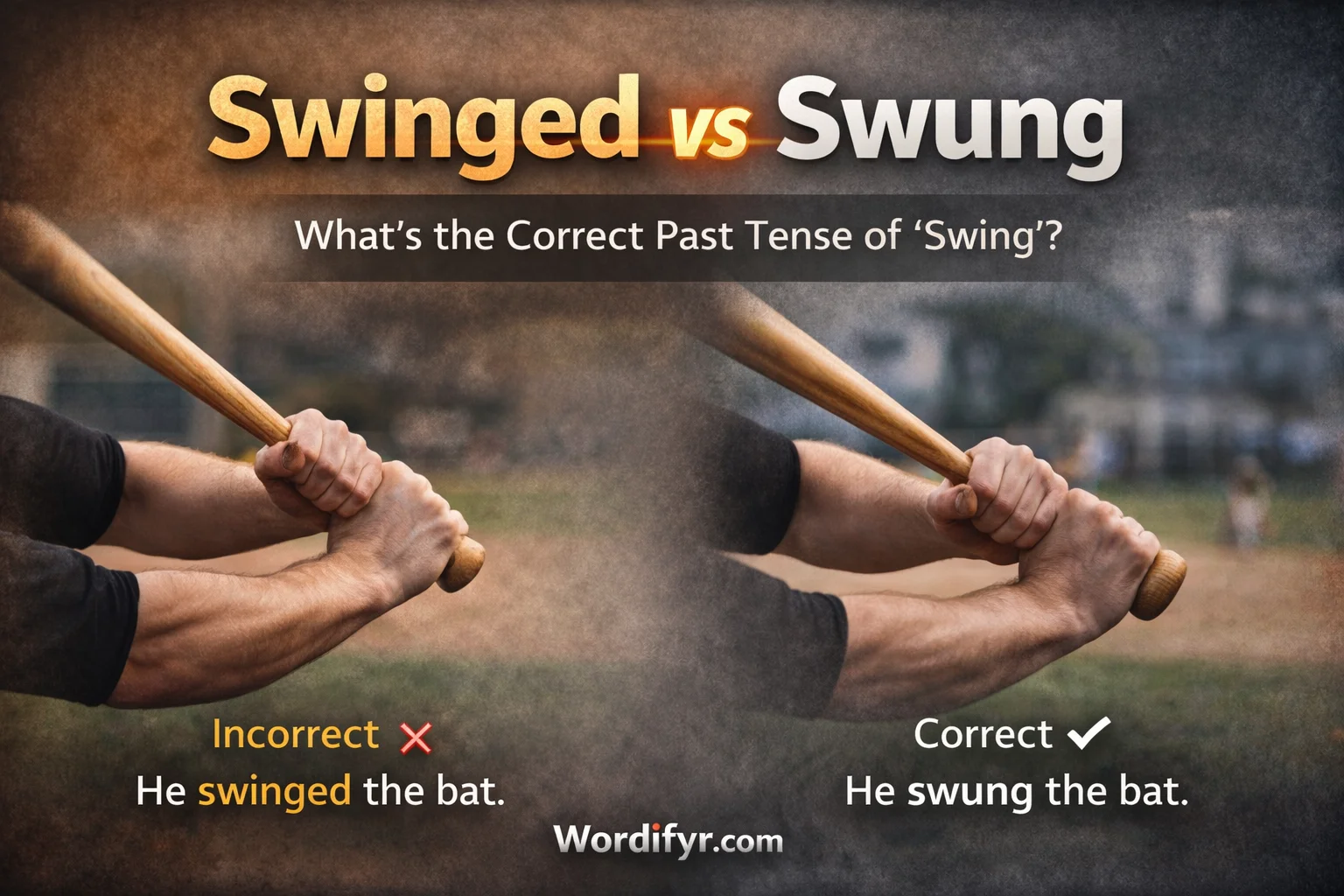
| Example | ❌ “He swinged the bat.” | ✔️ “He swung the bat.” |
Real-Life Conversation Examples
Dialogue 1
A: “He swinged the bat really hard.”
B: “You mean he swung the bat.”
🎯 Lesson: “Swung” is the correct past tense.
Dialogue 2
A: “Is ‘swinged’ ever correct?”
B: “No, ‘swing’ is irregular. It’s always ‘swung.’”
🎯 Lesson: Irregular verbs don’t follow -ed rules.
Dialogue 3
A: “The gate swinged open last night.”
B: “It actually swung open.”
🎯 Lesson: Objects swing → they swung.
Dialogue 4
A: “I’ve swinged on that swing before.”
B: “You’ve swung on it before.”
🎯 Lesson: Past participle is also “swung.”
Dialogue 5
A: “Why does English do this?”
B: “Irregular verbs keep things interesting.”
🎯 Lesson: Memorization beats logic with irregular verbs.
When to Use Swinged vs Swung
Use Swung When:
- Talking about past actions
- Writing formally or academically
- Speaking correct English
- Using perfect tenses
Examples:
- “She swung the hammer.”
- “They have swung across the river.”
Never Use Swinged When:
- Writing standard English
- Speaking professionally
- Taking exams or tests
Memory Trick:
👉 If the verb changes inside the word (sing → sang → sung), it’s irregular.
👉 Swing → swung, not swinged.
US vs UK Usage
There is no difference between American and British English here. Both use swung exclusively.
Fun Facts or History
- Pattern Family
“Swing” follows the same pattern as:
- Sing → sang → sung
- Ring → rang → rung
- Why It Sounds Wrong
Native speakers instinctively reject “swinged” because English preserves sound-based patterns for irregular verbs.
Conclusion
The confusion between swinged vs swung comes from trying to apply regular verb rules to an irregular verb. While “swinged” may look logical, it is not grammatically correct in modern English. The correct past tense and past participle of “swing” is always swung, regardless of context or region. Once you remember that “swing” behaves like “sing” or “ring,” the mistake disappears. Next time someone uses these two words, you’ll know exactly what they mean!