Introduction
English can be tricky, especially when two words sound exactly the same but mean entirely different things. One common pair that causes confusion is sighted vs sited. You may see them used incorrectly in emails, news articles, or even academic writing. Because both words share the same pronunciation, many people assume they’re interchangeable.
They’re not.
The confusion usually happens because both words are past forms of verbs, and context is the only clue to their meaning. Although they look/sound similar, they serve completely different purposes. One relates to seeing or vision, while the other refers to location or placement. In this guide, we’ll clearly explain the meaning, usage, examples, and differences between sighted vs sited, so you can use each word with confidence every time.
Section 1: What Is “Sighted”?
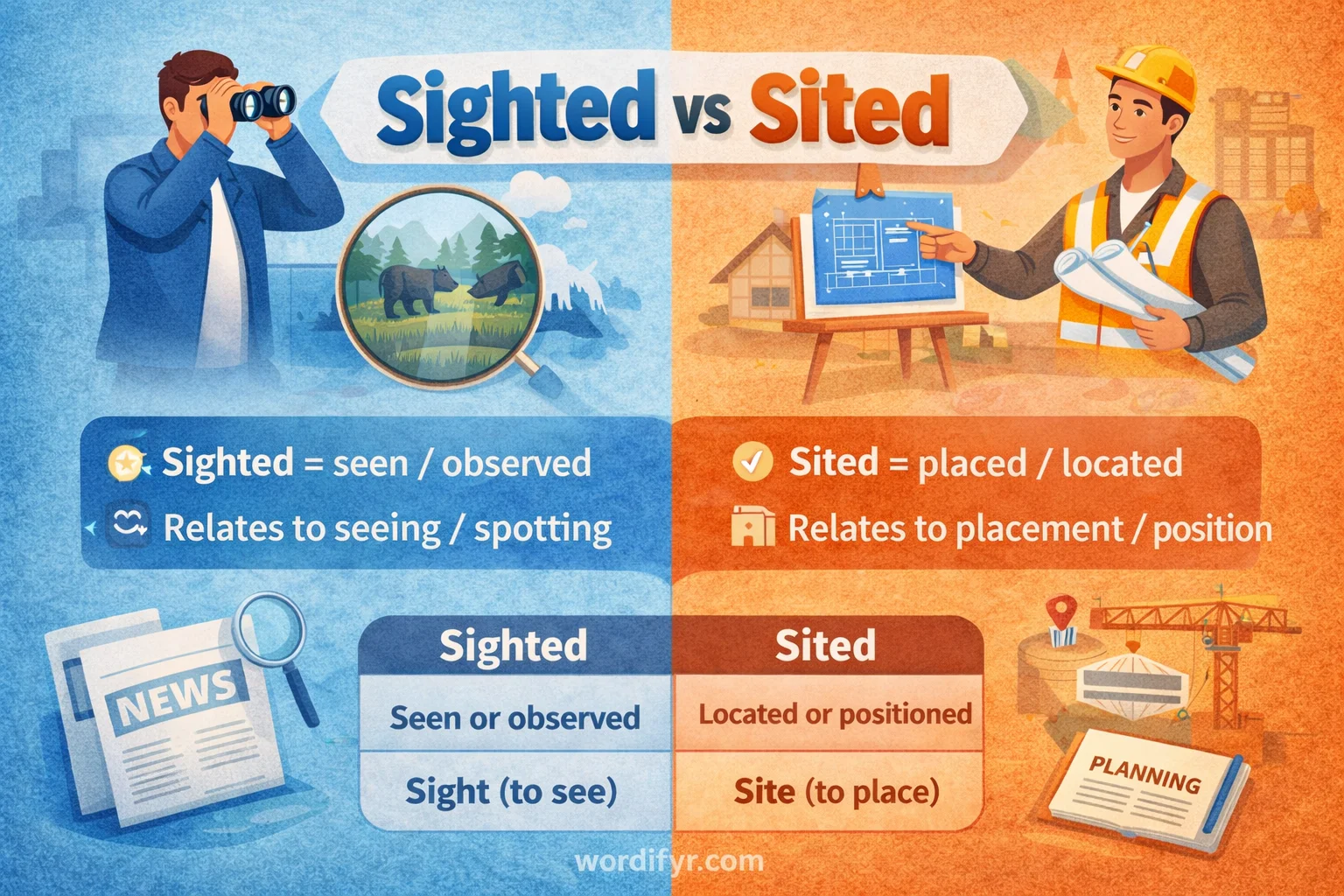
Sighted is the past tense and past participle of the verb “to sight,” which means to see, notice, or observe something.
Clear Meaning
Sighted refers to the act of seeing something, either literally with the eyes or metaphorically by noticing or identifying it.
How It’s Used
In the sighted vs sited comparison, sighted always relates to vision, observation, or detection.
Where It’s Used
- General English (US & UK)
- News reporting
- Military and aviation contexts
- Wildlife and scientific observation
Examples in Sentences
- “The suspect was sighted near the airport.”
- “A rare bird was sighted by researchers.”
- “The lighthouse was sighted from miles away.”
Short Historical or Usage Note
The word sight comes from Old English siht, meaning “the power of seeing.” Over time, sighted became widely used to describe confirmed visual observation, especially in formal or official reports.
Section 2: What Is “Sited”?
Sited is the past tense and past participle of the verb “to site,” which means to place or locate something in a specific position.
Clear Meaning
Sited refers to where something is placed, not whether it is seen.
How It’s Used
In sighted vs sited, sited is strictly about location, placement, or positioning—often in construction, planning, or geography.
Where It’s Used
- Architecture and construction
- Urban planning
- Geography and engineering
- Academic and technical writing
Spelling and Usage Differences
Although site is commonly known as a noun (website, location), sited functions as a verb form describing placement.
Examples in Sentences
- “The factory was sited near the river.”
- “The school is sited on higher ground.”
- “Wind turbines are carefully sited for efficiency.”
Regional or Grammatical Notes
- Used equally in British and American English
- Often appears in passive constructions
- Rare in casual conversation, common in formal writing
Key Differences Between Sighted and Sited
Bullet Point Summary
- Sighted = seen or observed
- Sited = placed or located
- Same pronunciation, different meanings
- Different root verbs: sight vs site
- Context determines correct usage
Sighted vs Sited Comparison Table
| Feature | Sighted | Sited |
|---|---|---|
| Root Verb | Sight (to see) | Site (to place) |
| Meaning | Observed or seen | Located or positioned |
| Usage Context | Vision, detection | Location, planning |
| Common Fields | News, wildlife, military | Construction, geography |
| Pronunciation | Same | Same |
| Interchangeable? | ❌ No | ❌ No |
Real-Life Conversation Examples
Dialogue 1
A: “Was the ship sighted yet?”
B: “Yes, it was sighted early this morning.”
🎯 Lesson: Use sighted when something is seen.
Dialogue 2
A: “Where is the new hospital?”
B: “It’s sited outside the city center.”
🎯 Lesson: Use sited for location.
Dialogue 3
A: “The report says the tower was sighted there.”
B: “You mean sited, not seen.”
🎯 Lesson: Choose the word based on meaning, not sound.
Dialogue 4
A: “The animal was sited in the forest.”
B: “No, it was sighted in the forest.”
🎯 Lesson: Animals are seen, not placed.
Dialogue 5
A: “The bridge was carefully sited.”
B: “That makes sense for construction.”
🎯 Lesson: Infrastructure is sited, not sighted.
When to Use Sighted vs Sited
Use Sighted When:
- Talking about seeing or noticing something
- Referring to visual confirmation
- Writing news or observation-based content
Examples:
- “The helicopter was sighted offshore.”
- “The error was sighted during review.”
Use Sited When:
- Talking about where something is placed
- Describing design or planning decisions
- Writing formal or technical content
Examples:
- “The facility was sited strategically.”
- “Homes are sited away from flood zones.”
Simple Memory Trick
- Sighted → has ‘sight’ → seeing
- Sited → has ‘site’ → location
US vs UK Usage
There is no regional difference here—both words are used the same way in American and British English.
Fun Facts or History
- Homophones in English
Sighted and sited are classic homophones—words that sound the same but differ in spelling and meaning. - Common Editing Error
“Sited” is frequently misused in journalism when writers mean “sighted,” making this pair a favorite among editors.
Conclusion
The difference between sighted vs sited comes down to a simple question: Was something seen, or was it placed? If it was observed, the correct word is sighted. If it refers to location or positioning, sited is the right choice. Despite sounding identical, these words serve very different purposes and should never be used interchangeably. Once you connect sight with seeing and site with location, the confusion disappears. Next time someone uses these two words, you’ll know exactly what they mean!