Introduction
Have you ever paused mid-sentence and wondered whether to write princesses or princess’s? You’re not alone. This is one of those classic English grammar problems that confuses students, bloggers, and even native speakers. The confusion usually happens because both words look almost identical, sound the same when spoken, and appear frequently in everyday writing—from fairy tales to formal essays. Apostrophes, in particular, have a reputation for causing trouble.
The issue becomes even more common in digital writing, where grammar rules are often overlooked. Although they look/sound similar, they serve completely different purposes. One form shows plurality, while the other shows possession. Once you understand this distinction, the confusion disappears entirely.
In this guide, we’ll break down princesses vs princess’s in simple, practical terms so you can use both with confidence every time.
What Is “Princesses”?
Meaning
Princesses is the plural form of the noun princess. It simply means more than one princess.
How It’s Used
You use princesses when you are talking about two or more princesses and not showing ownership of anything.
There is no apostrophe because nothing is being possessed.
Where It’s Used
This usage is universal across:
- American English
- British English
- All formal and informal writing
Plural nouns never require an apostrophe unless they show possession.
Examples in Sentences
- The castle was filled with princesses from different kingdoms.
- Many Disney princesses are known for their bravery.
- The story focuses on three powerful princesses.
- All the princesses attended the royal ball.
Short Usage Note
In English, most nouns become plural by adding -s or -es. Since princess already ends in -ss, we add -es, forming princesses. This rule has existed for centuries and is consistent across modern English grammar.
What Is “Princess’s”?
Meaning
Princess’s is the singular possessive form of princess. It means something belongs to one princess.
How It’s Used
You use princess’s when:
- There is one princess
- She owns or is associated with something
The apostrophe + s indicates ownership, not plurality.
Where It’s Used
This rule applies in:
- American English
- British English
- Academic, professional, and creative writing
Examples in Sentences
- The princess’s crown was made of gold.
- Everyone admired the princess’s kindness.
- The princess’s horse was waiting outside.
- The tale describes the princess’s journey to power.
Grammar Rule Explained
In English:
- Singular noun + ’s = possession
Even though princess already ends in s, we still add ’s to show possession. This is grammatically correct and widely accepted.
Key Differences Between Princesses and Princess’s
Quick Summary (Bullet Points)
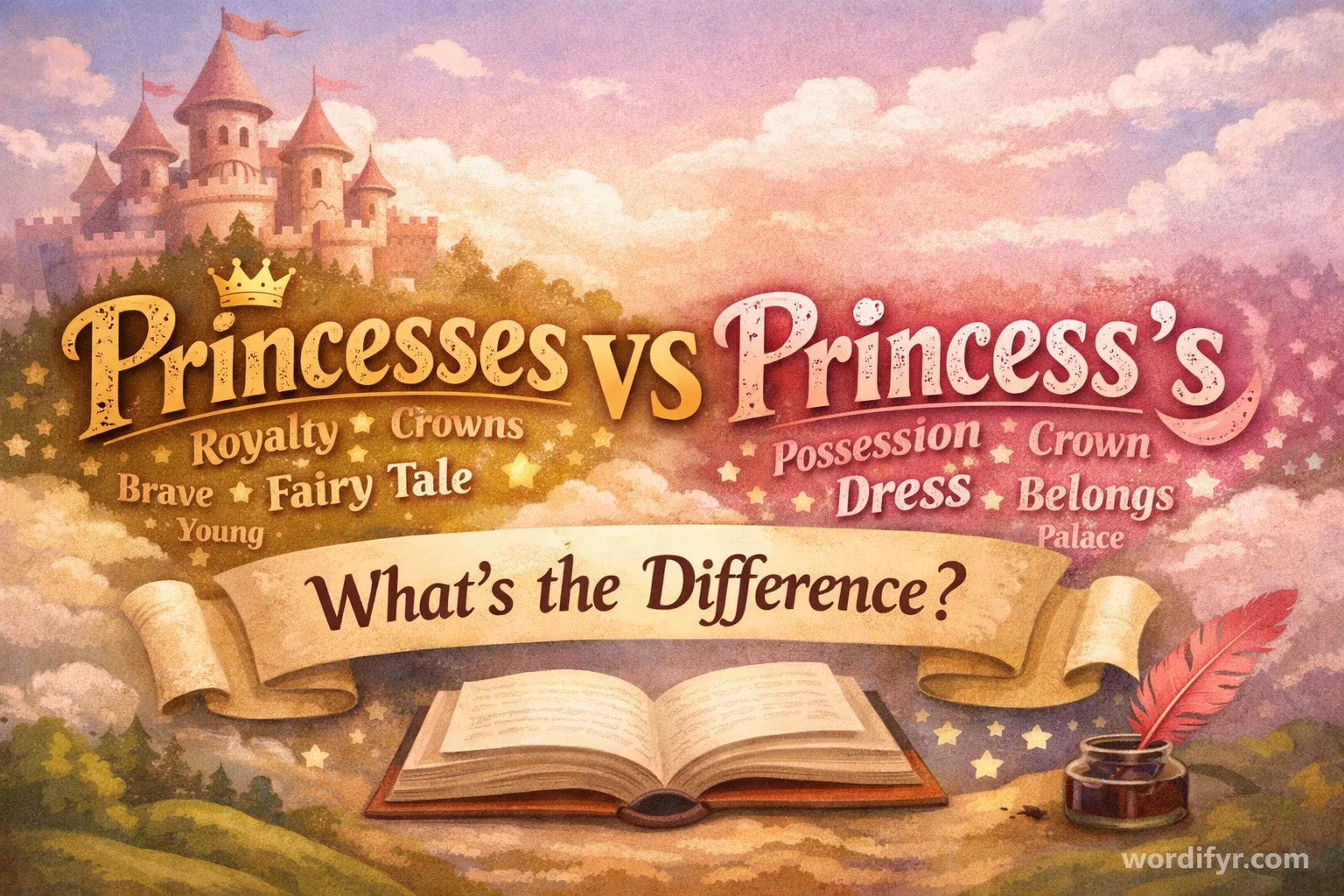
- Princesses = plural (more than one princess)
- Princess’s = possessive (something belongs to one princess)
- Princesses has no apostrophe
- Princess’s always includes an apostrophe
- One shows quantity, the other shows ownership
Comparison Table
| Feature | Princesses | Princess’s |
|---|---|---|
| Grammar Type | Plural noun | Singular possessive noun |
| Apostrophe Used | ❌ No | ✅ Yes |
| Meaning | More than one princess | Belonging to one princess |
| Example | The princesses arrived. | The princess’s crown sparkled. |
| Common Mistake | Adding an apostrophe | Using it for plurals |
Real-Life Conversation Examples
Dialogue 1
A: I wrote “the princess’s attended the ceremony.”
B: That’s incorrect. Are you talking about more than one princess?
A: Yes.
B: Then it should be “princesses.”
🎯 Lesson: Apostrophes are not used for plurals.
Dialogue 2
A: Is “princesses dress” correct?
B: No, that sounds wrong. Who owns the dress?
A: One princess.
B: Then write “the princess’s dress.”
🎯 Lesson: Use ’s to show ownership.
Dialogue 3
A: Why does autocorrect keep confusing these words?
B: Because they sound the same but follow different grammar rules.
A: So meaning matters more than sound?
B: Exactly.
🎯 Lesson: Always focus on meaning, not pronunciation.
Dialogue 4
A: My teacher crossed out “princess’s” in my essay.
B: Were you talking about more than one princess?
A: Yes.
B: That’s why—it should be “princesses.”
🎯 Lesson: Plural nouns never need apostrophes.
When to Use Princesses vs Princess’s
Use Princesses When:
- You mean two or more princesses
- No ownership is involved
- You’re listing characters or people
- Writing stories, articles, or descriptions
Examples:
- The princesses ruled together.
- Several princesses were invited.
- The book features strong princesses.
Use Princess’s When:
- You mean one princess
- You’re showing possession
- Something belongs to or describes her
Examples:
- The princess’s palace was enormous.
- Everyone admired the princess’s bravery.
- The princess’s voice echoed through the hall.
Easy Memory Tricks
- Plural? No apostrophe → princesses
- Ownership? Apostrophe + s → princess’s
- Ask yourself: Can I replace it with “belonging to the princess”?
If yes → princess’s
US vs UK Usage
There is no difference between American and British English here. Both follow the same grammar rules for plurals and possessives, making this one of the rare cases where English is fully consistent.
Fun Facts & History
1. Apostrophes Were Never Meant for Plurals
The apostrophe was introduced in English in the 16th century only to show possession or omission, not plurality. Using it for plurals is one of the most common grammar mistakes today.
2. “Princesses” Is One of the Most Misspelled Royal Words
Because princess already ends in s, many writers mistakenly think it needs an apostrophe when pluralized—but it never does.
Conclusion
The difference between princesses vs princess’s is much simpler than it looks. Princesses refers to more than one princess, while princess’s shows that something belongs to a single princess. The apostrophe is the key—it signals possession, never plurality. Once you focus on meaning rather than spelling alone, choosing the correct form becomes effortless. These rules apply universally, regardless of whether you’re writing in American or British English. Next time someone uses these two words, you’ll know exactly what they mean!