Introduction
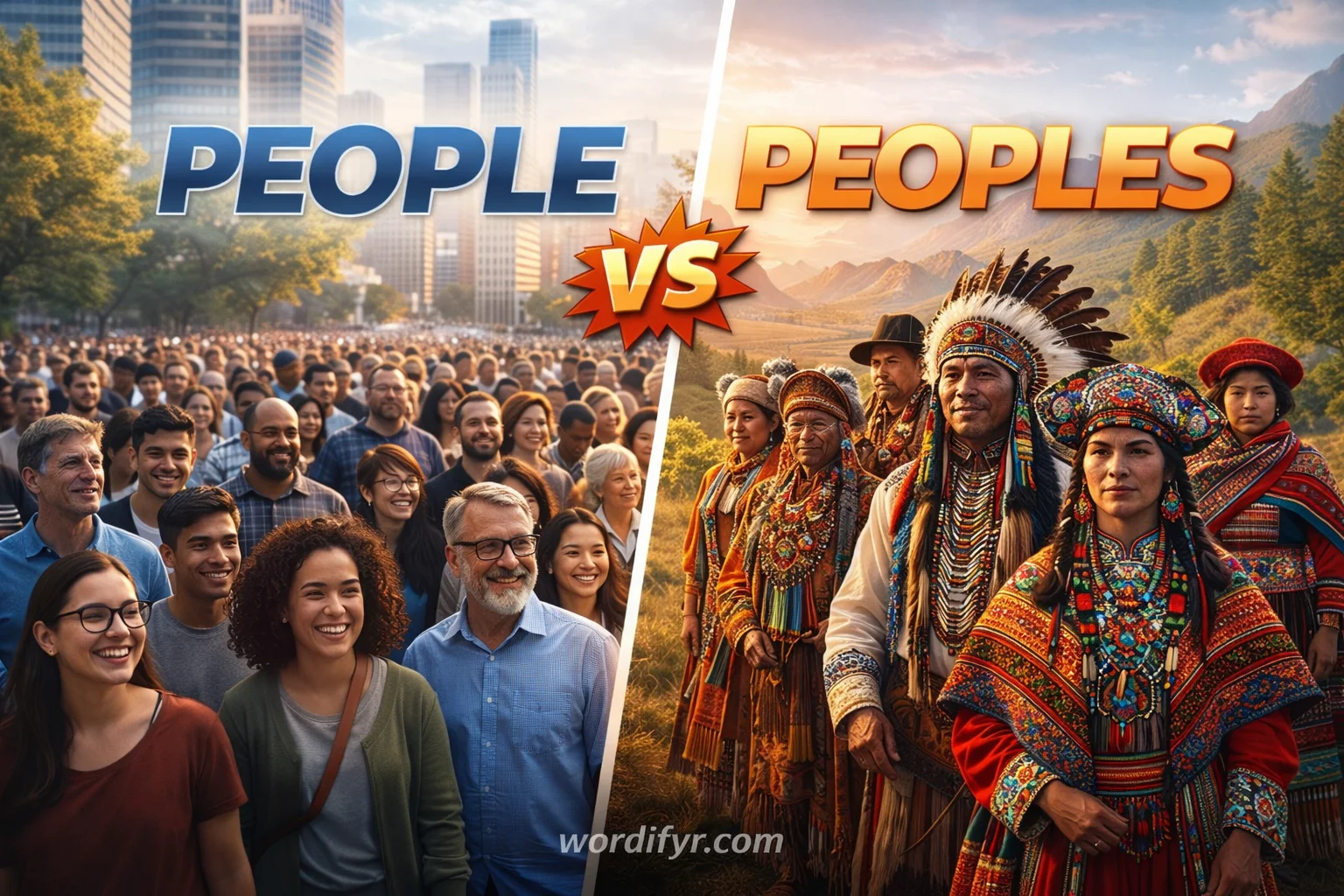
English has many word pairs that look almost identical but carry different meanings depending on context. One example that often confuses learners and even native speakers is people vs peoples. At first glance, it might seem that “peoples” is simply the plural of “people.” However, the reality is more nuanced.
Both words exist in English, but they are used in very different situations and grammatical contexts. This confusion usually happens because “people” already functions as a plural noun, so many writers assume “peoples” must be incorrect.
Although they look similar, they serve completely different purposes.
In this complete guide to people vs peoples, you’ll learn their meanings, when to use each one, examples, real-life dialogues, grammar rules, and an easy comparison table so you never mix them up again.
What Is People?
The word people is the standard plural form of “person.” It refers to more than one individual human being.
In everyday English, people is one of the most commonly used nouns when talking about groups of humans.
Meaning
People means:
- A group of individuals
- Human beings in general
- Citizens of a country
- Members of a community
Because it already functions as a plural noun, English speakers almost always use people instead of “persons” in casual conversation.
How “People” Is Used
You’ll see people used in situations such as:
- Everyday conversations
- General references to humans
- Social discussions
- Public or community references
Examples in Sentences
Here are some natural examples:
- “Many people enjoy traveling during summer.”
- “The park was full of people.”
- “Young people use social media frequently.”
- “Some people prefer coffee over tea.”
In the people vs peoples comparison, people is the word you’ll use almost all the time.
Grammar Note
Although “persons” is technically the plural of person, modern English rarely uses it outside of legal or formal contexts.
Example:
- “Two persons were arrested.” (legal usage)
Most writers prefer:
- “Two people were arrested.”
Historical Usage
The word people comes from the Latin word populus, meaning a nation or group of individuals. Over centuries, it evolved into the standard plural form used in everyday English.
What Is Peoples?
The word peoples is also correct English, but it has a completely different meaning from people.
Instead of referring to a group of individuals, peoples refers to multiple distinct ethnic groups, nations, or cultures.
Meaning
Peoples means:
- Different groups of humans with separate identities
- Multiple ethnic communities
- Several nations or cultural groups
When discussing people vs peoples, the key difference is that peoples focuses on different societies or cultures, not just individuals.
Where “Peoples” Is Used
You will usually see peoples in contexts such as:
- Anthropology
- History
- Cultural studies
- Politics
- Geography
For example:
- “The indigenous peoples of the Americas.”
- “The peoples of Europe have diverse cultures.”
- “Ancient peoples built remarkable civilizations.”
Examples in Sentences
Here are examples showing correct usage:
- “The festival celebrates the traditions of many peoples.”
- “Historians study the migration of ancient peoples.”
- “The United Nations protects the rights of indigenous peoples.”
In the people vs peoples discussion, remember that peoples refers to groups of cultures, not just a large number of individuals.
Usage Note
Because peoples is used mainly in academic or cultural contexts, you won’t see it very often in everyday conversation.
Key Differences Between People and Peoples
Understanding the difference between people vs peoples becomes easy once you focus on what the words represent.
Quick Differences
- People = individuals or humans in general
- Peoples = multiple cultural or ethnic groups
- People is common in everyday speech
- Peoples is mostly used in academic or historical contexts
These points summarize the main distinction in the people vs peoples debate.
Comparison Table: People vs Peoples
| Feature | People | Peoples |
|---|---|---|
| Meaning | Individuals or humans | Different ethnic or cultural groups |
| Usage | Everyday conversation | Academic or cultural contexts |
| Grammar Role | Plural of “person” | Plural of “people” (cultural sense) |
| Frequency | Very common | Rare |
| Example | “Many people attended the event.” | “The indigenous peoples preserved their traditions.” |
This table clearly explains the people vs peoples difference.
Real-Life Conversation Examples
Dialogue 1
A: “There were many peoples at the concert.”
B: “You mean many people, not peoples.”
🎯 Lesson: Use people when referring to individuals.
Dialogue 2
A: “The museum shows artifacts from ancient peoples.”
B: “That’s correct because it refers to different cultures.”
🎯 Lesson: Use peoples when discussing multiple civilizations or ethnic groups.
Dialogue 3
A: “Why can’t we say ‘peoples’ for a crowd?”
B: “Because ‘people’ already works as the plural.”
🎯 Lesson: People already means more than one person.
Dialogue 4
A: “The conference focused on indigenous peoples.”
B: “Yes, because it discusses multiple cultural groups.”
🎯 Lesson: Cultural or ethnic groups use peoples.
Dialogue 5
A: “There were hundreds of peoples at the stadium.”
B: “The correct word is ‘people.’”
🎯 Lesson: Peoples is rarely used for crowds.
When to Use People vs Peoples
Choosing between people vs peoples becomes simple when you apply a few practical rules.
Use People When:
✔ Talking about multiple individuals
✔ Referring to humans in general
✔ Describing crowds or groups
✔ Writing everyday English
Examples:
- “Many people enjoy hiking.”
- “The restaurant was full of people.”
- “Some people prefer working at night.”
In most situations, people is the correct choice.
Use Peoples When:
✔ Talking about multiple ethnic groups
✔ Discussing cultures or civilizations
✔ Writing academic or historical content
✔ Describing different societies
Examples:
- “The peoples of Africa have rich traditions.”
- “Ancient peoples developed early writing systems.”
- “Anthropologists study indigenous peoples.”
Simple Memory Trick
Here’s an easy way to remember:
People = individuals
Peoples = cultures
This trick helps avoid mistakes in the people vs peoples comparison.
Fun Facts About the Word “People”
1. “People” Can Also Mean a Nation
Sometimes people refers to all citizens of a country.
Example:
- “The people voted in the election.”
This meaning appears frequently in politics and law.
2. Famous Political Phrase
One of the most famous uses of people appears in the United States Constitution opening line:
“We the People…”
This phrase refers to all citizens collectively.
Conclusion
The difference between people vs peoples becomes clear once you understand their purpose. People refers to multiple individuals and is the word used in everyday English conversations. Peoples, on the other hand, refers to multiple ethnic, cultural, or national groups and appears mostly in academic or historical contexts.
Because people already functions as a plural noun, most situations require the word people, not peoples. Remember the simple rule: people refers to individuals, while peoples refers to cultures or societies.
Next time someone uses these two words, you’ll know exactly what they mean!