
Introduction
Have you ever wondered why doctors sometimes say infection and other times mention inflammation? 🤔 These two words often get mixed up because they both describe health problems that can cause pain, swelling, or fever. Many people assume they mean the same thing, but in reality, they point to very different processes happening inside the body.
Although they look/sound similar, they serve completely different purposes. Knowing the difference between infection vs inflammation is more than just a grammar lesson—it’s essential for understanding your health, medical reports, and even everyday conversations. In this guide, we’ll break down both terms in simple language, explore their usage, highlight key differences, and give you easy memory tricks to never confuse them again.
Section 1: What Is “Infection”?
Meaning
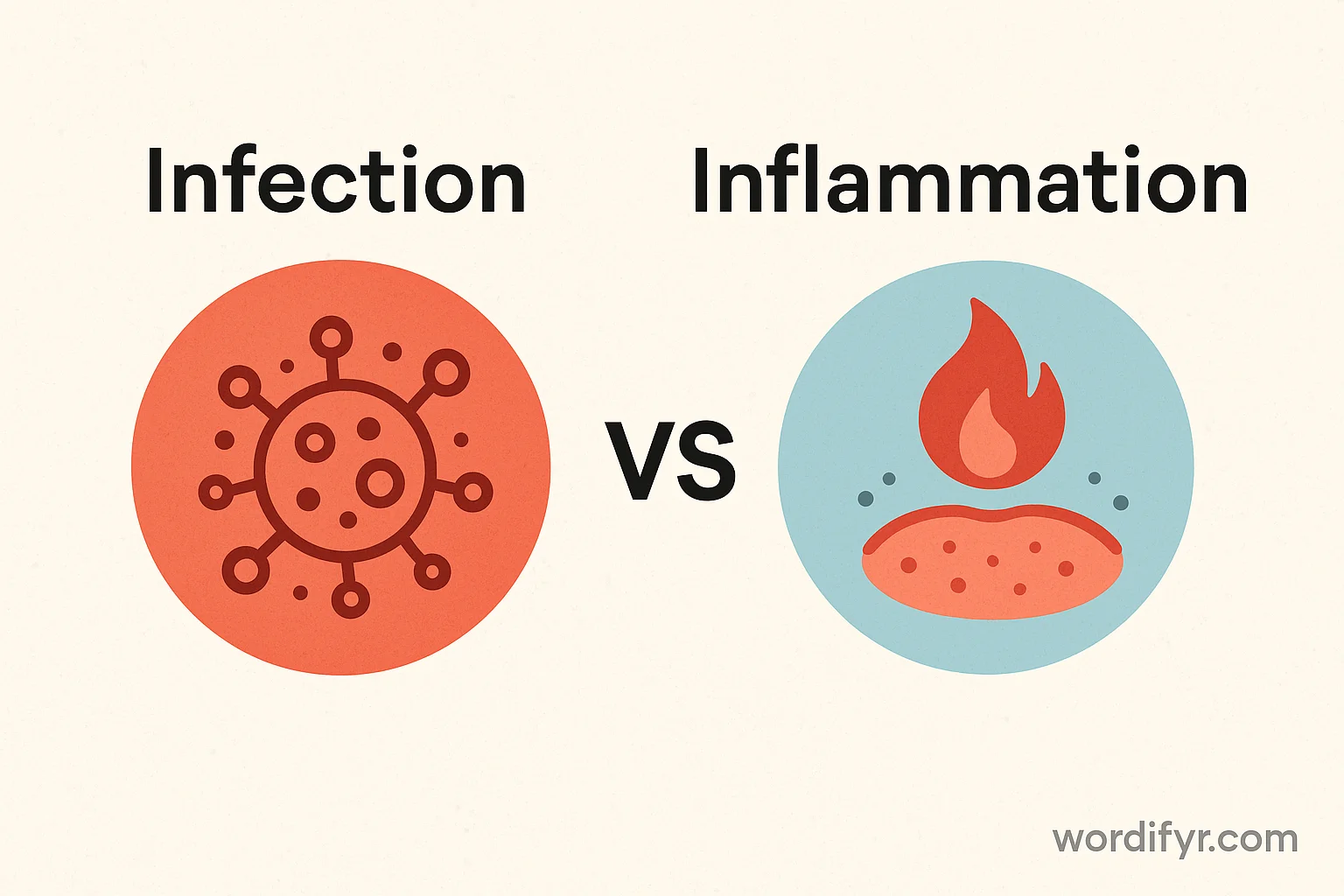
An infection occurs when harmful microorganisms—such as bacteria, viruses, fungi, or parasites—enter the body and start multiplying. These invaders disrupt normal functions and can spread from one part of the body to another.
How It’s Used
Doctors use the word infection to describe conditions caused by germs. It’s often linked with contagious diseases, meaning it can spread from person to person.
Where It’s Used
The term is universal across English-speaking countries. Whether in the US, UK, or elsewhere, infection always refers to the presence of pathogens.
Examples in Sentences
- “She has a throat infection caused by bacteria.”
- “The wound developed an infection after being exposed to dirt.”
- “Viral infections like the flu spread quickly in winter.”
Historical Note
The word infection comes from Latin infectio, meaning “to stain or taint.” Historically, it was used to describe the spread of disease through contaminated air or surfaces.
Section 2: What Is “Inflammation”?
Meaning
Inflammation is the body’s natural defense response to injury, irritation, or infection. It’s not caused by germs directly but by the immune system reacting to a problem. Classic signs include redness, swelling, heat, and pain.
How It’s Used
Doctors use inflammation to describe the body’s reaction, not the cause. It can happen with or without infection. For example, arthritis involves inflammation but no germs.
Where It’s Used
Like infection, the term is globally recognized. In medical writing, inflammation is often paired with suffixes like -itis (e.g., gastritis = stomach inflammation).
Examples in Sentences
- “Her knee shows signs of inflammation after the injury.”
- “Inflammation of the lungs is called pneumonia.”
- “Anti-inflammatory drugs reduce swelling and pain.”
Historical Note
The word inflammation comes from Latin inflammare, meaning “to set on fire.” Ancient physicians described it as the body’s “flame” response to damage.
Key Differences Between Infection vs Inflammation
Quick Points
- Infection = caused by germs (bacteria, viruses, fungi, parasites).
- Inflammation = body’s immune response (can occur with or without infection).
- Infection often triggers inflammation, but inflammation can exist without infection.
- Infection is contagious; inflammation is not.
- Treatments differ: infections need antimicrobials, inflammation needs anti-inflammatory care.
Comparison Table
| Feature | Infection | Inflammation |
|---|---|---|
| Cause | Microorganisms (bacteria, viruses, fungi, parasites) | Body’s immune response to injury, irritation, or infection |
| Contagious? | ✔️ Often | ❌ Never |
| Signs | Fever, pus, spreading illness | Redness, swelling, heat, pain |
| Treatment | Antibiotics, antivirals, antifungals | Anti-inflammatory drugs, rest, lifestyle changes |
| Example | “He has a skin infection.” | “Her ankle shows inflammation after the sprain.” |
Real-Life Conversation Examples
Dialogue 1
A: “I think I have an infection in my knee.” B: “Did the doctor say germs are involved?” A: “No, just inflammation from the injury.” 🎯 Lesson: Infection = germs, inflammation = body’s reaction.
Dialogue 2
A: “Why did my doctor prescribe antibiotics?” B: “Because you have an infection, not just inflammation.” 🎯 Lesson: Antibiotics treat infections, not inflammation.
Dialogue 3
A: “My arthritis causes inflammation, but is it an infection?” B: “No, arthritis is inflammation without germs.” 🎯 Lesson: Not all inflammation means infection.
Dialogue 4
A: “I caught an infection from my coworker.” B: “Inflammation can’t spread like that.” 🎯 Lesson: Infection is contagious, inflammation is not.
Dialogue 5
A: “I confused infection vs inflammation in my report.” B: “Just remember: infection = invader, inflammation = response.” 🎯 Lesson: Easy trick—invader vs response.
When to Use Infection vs Inflammation
- Use infection when germs are the cause.
- Use inflammation when describing the body’s reaction.
- Simple memory trick:
- Infection = invader
- Inflammation = immune response
- Writing for US vs UK audiences: Both terms are identical in spelling and meaning worldwide, so no regional differences apply.
Fun Facts & History
- The suffix “-itis” in medical terms (like bronchitis, gastritis) always means inflammation, not infection.
- Ancient Greek physicians described inflammation as the “four cardinal signs”: redness, heat, swelling, and pain—still used today.
Conclusion
Understanding infection vs inflammation is crucial for clear communication in health and everyday life. Infection refers to harmful germs invading the body, while inflammation is the body’s defense response. They often occur together but are not the same. Remember the simple trick: infection = invader, inflammation = response.
Next time someone uses these two words, you’ll know exactly what they mean!