Introduction
The words immigrant and emigrant confuse a lot of people—and honestly, that’s completely understandable. They look similar, sound related, and both involve people moving from one country to another. Even native English speakers often mix them up in conversations, writing, and online searches. You’ll see them used interchangeably in news articles, blogs, and social media, even though they don’t mean the same thing. The confusion mainly comes from perspective—whether you’re focusing on the country someone leaves or the country they enter. Although they look/sound similar, they serve completely different purposes. Once you understand this key idea, the difference becomes surprisingly simple. In this guide, we’ll clearly explain immigrant vs emigrant, show real-life examples, provide easy memory tricks, and help you use both terms correctly in everyday speech, academic writing, and professional content.
What Is Immigrant?
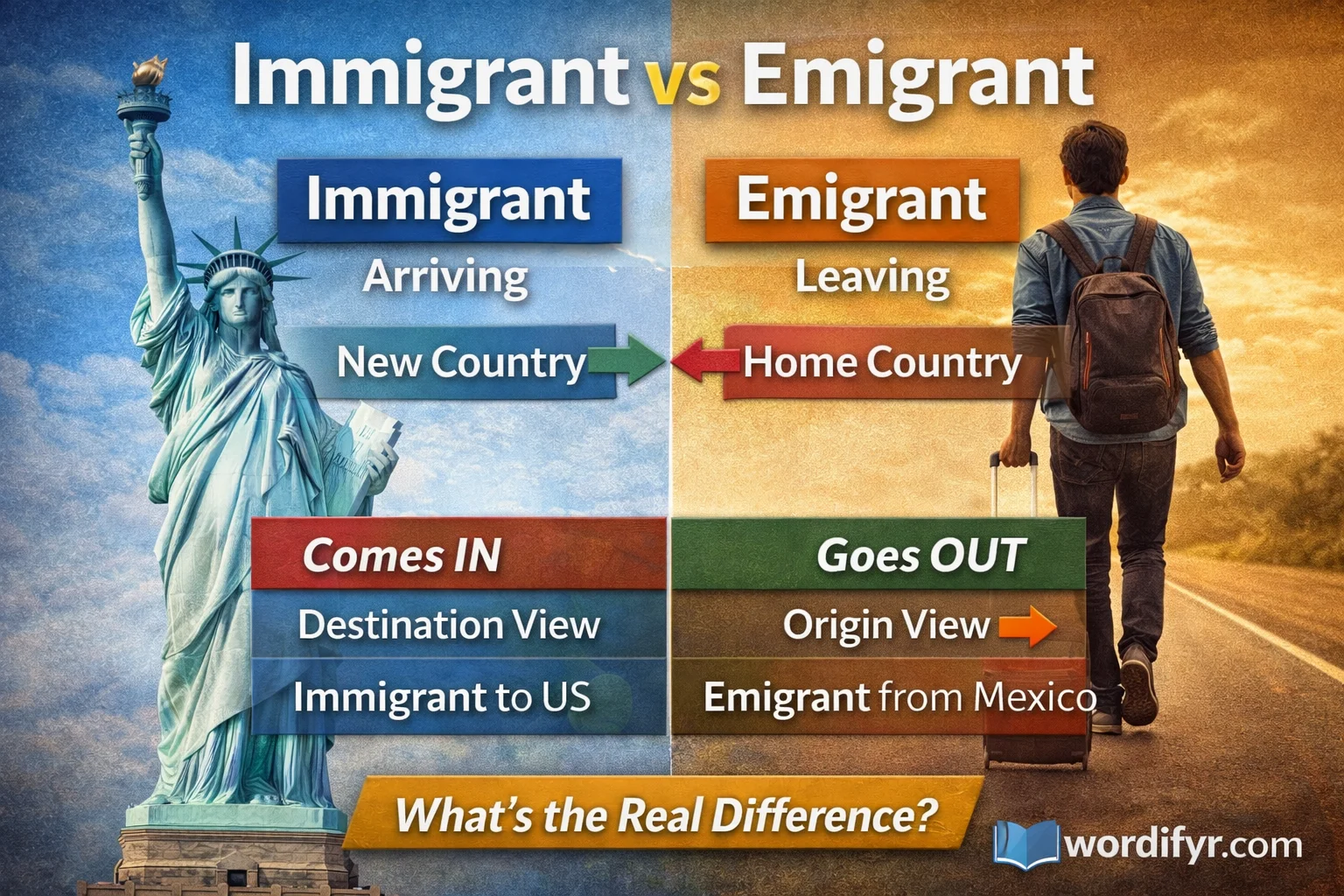
An immigrant is a person who moves into a new country to live there permanently or for a long period of time.
Meaning and Definition
An immigrant is someone who comes into a country from another country to settle, work, study, or build a new life.
Think of it from the destination country’s point of view.
How It’s Used
- Used as a noun
- Focuses on arrival
- Common in social, political, legal, and demographic contexts
Examples:
- “She is an immigrant in Canada.”
- “The country welcomes skilled immigrants.”
Where It’s Used
- Global English (US, UK, international)
- Immigration law and policy
- News media
- Academic and sociological studies
Grammar Notes
- Singular: immigrant
- Plural: immigrants
- Common collocations: illegal immigrant, legal immigrant, skilled immigrant
Short Historical Note
The word immigrant comes from the Latin immigrare, meaning “to move into.” Historically, it has always described people entering a new land rather than leaving one.
Example Sentences
- “Many immigrants contribute to the economy.”
- “She became an immigrant when she moved to Germany.”
- “The city has a large immigrant population.”
What Is Emigrant?
An emigrant is a person who leaves their home country to live in another country.
Meaning and Definition
An emigrant is someone who moves out of their country of origin to settle elsewhere.
This term is used from the origin country’s point of view.
How It’s Used
- Used as a noun
- Focuses on departure
- Less common in everyday conversation than “immigrant”
Examples:
- “He became an emigrant when he left Italy.”
- “Irish emigrants settled in the US.”
Where It’s Used
- Historical writing
- Population studies
- Government records
- Academic contexts
Grammar Notes
- Singular: emigrant
- Plural: emigrants
- Often paired with verbs like leave, depart, move
Short Historical Note
The word emigrant comes from the Latin emigrare, meaning “to move out.” It has been used historically to describe large population movements, especially during wars or economic crises.
Example Sentences
- “Economic hardship forced many emigrants to leave.”
- “She was an emigrant from her home country.”
- “The ship carried thousands of emigrants.”
Key Differences Between Immigrant and Emigrant
Bullet Point Summary
- Immigrant focuses on entering a country
- Emigrant focuses on leaving a country
- Same person can be both
- Difference depends on perspective
- Both are nouns
- Both relate to migration
Comparison Table
| Feature | Immigrant | Emigrant |
|---|---|---|
| Focus | Arrival | Departure |
| Perspective | Destination country | Origin country |
| Meaning | Person who comes in | Person who leaves |
| Common Usage | Very common | Less common |
| Context | Law, media, society | History, demographics |
| Verb Root | Immigrate (move into) | Emigrate (move out) |
| Example | “Immigrant to Canada” | “Emigrant from India” |
Real-Life Conversation Examples
Dialogue 1
A: “Is she an immigrant or an emigrant?”
B: “She’s an immigrant in the US, but an emigrant from Mexico.”
🎯 Lesson: The same person can be both, depending on viewpoint.
Dialogue 2
A: “Why does the article say emigrant?”
B: “Because it’s talking about people leaving their country.”
🎯 Lesson: Emigrant focuses on departure.
Dialogue 3
A: “My grandparents were immigrants.”
B: “Yes, and they were emigrants from their homeland.”
🎯 Lesson: Arrival vs origin changes the word.
Dialogue 4
A: “Which word should I use in my essay?”
B: “Ask yourself—are you talking about coming in or going out?”
🎯 Lesson: Perspective determines usage.
Dialogue 5
A: “Why do people confuse these words?”
B: “Because the action is the same, but the direction is different.”
🎯 Lesson: Direction matters more than movement.
When to Use Immigrant vs Emigrant
Use Immigrant When:
- Talking about people arriving in a country
- Writing from the destination’s perspective
- Discussing immigration laws, policies, or integration
- Writing for modern news or general audiences
Examples:
- “Immigrants contribute to society.”
- “The city supports new immigrants.”
Use Emigrant When:
- Talking about people leaving their home country
- Writing historical or academic content
- Focusing on population loss or migration causes
- Describing origin-based movement
Examples:
- “Emigrants left due to poverty.”
- “The country lost many emigrants.”
Simple Memory Tricks
- IMMIGRANT → IN (comes in)
- EMIGRANT → EXIT (goes out)
If the person is entering, use immigrant.
If the person is exiting, use emigrant.
Fun Facts or History
- The same person is never just one—they are an emigrant from one country and an immigrant to another.
- In everyday speech, immigrant is far more common, which is why emigrant feels unfamiliar to many people.
Conclusion
The difference between immigrant vs emigrant is all about perspective. An immigrant is someone who enters a new country, while an emigrant is someone who leaves their home country. The movement is the same—the viewpoint changes the word. Understanding this distinction makes your writing clearer, more accurate, and more professional, especially in academic, legal, or SEO-focused content. Once you remember that immigrant comes in and emigrant exits, the confusion disappears completely. Next time someone uses these two words, you’ll know exactly what they mean!