Introduction
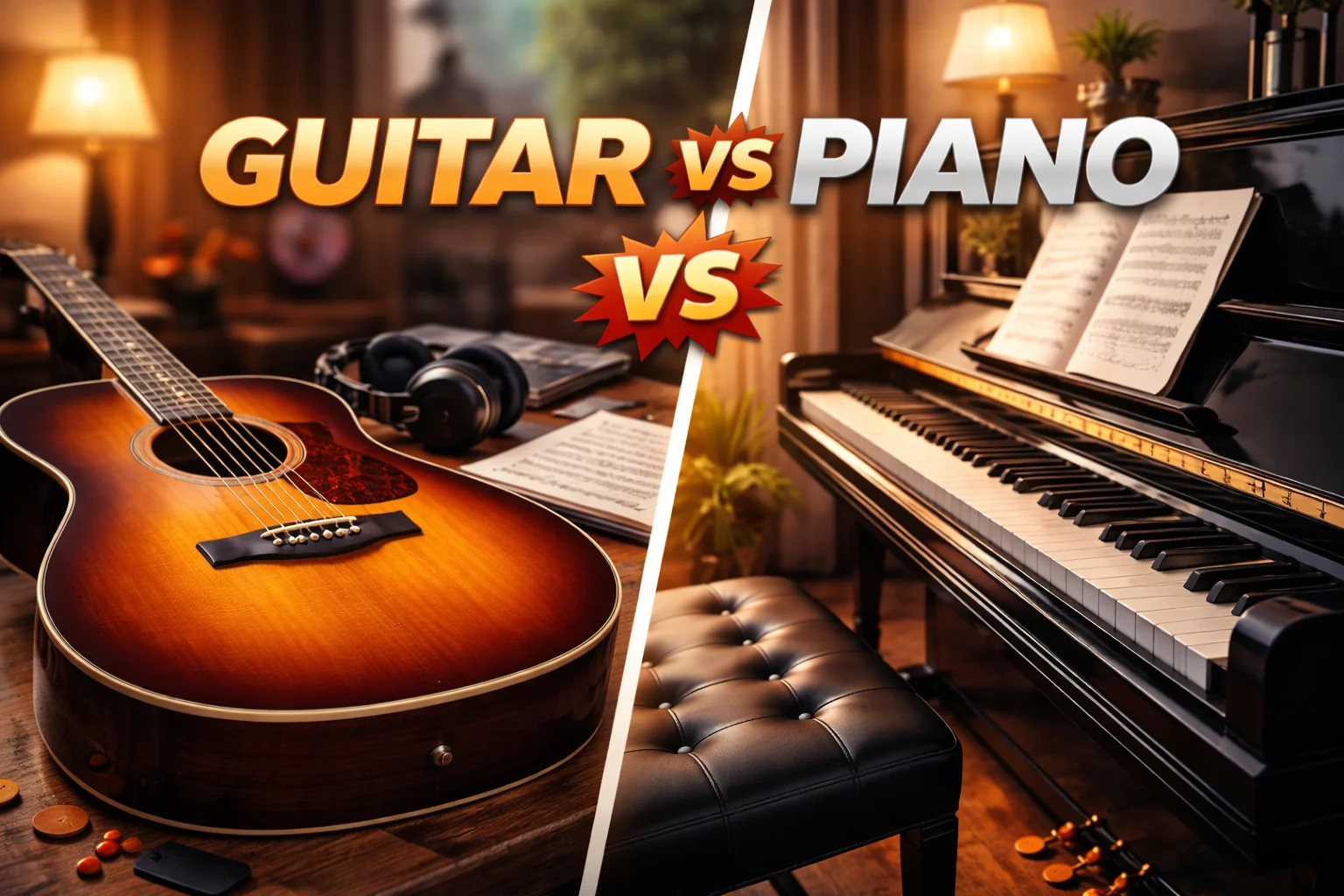
When people start learning music, one of the first decisions they face is choosing an instrument. Two of the most popular options are the guitar and the piano. Both instruments appear everywhere—from live concerts and studio recordings to beginner music classes and online tutorials. Because they’re so common, many beginners compare them when deciding which one to learn first.
However, these instruments work in completely different ways. Their playing styles, sound production, and learning curves are very different. That’s why many learners search for guitar vs piano comparisons before starting their musical journey.
Although they look similar, they serve completely different purposes. Understanding how each instrument works can help you choose the right one for your musical goals.
In this guide, we’ll explore guitar vs piano, how they work, their key differences, and when you might prefer one over the other.
What Is a Guitar?
A guitar is a stringed musical instrument that produces sound when its strings vibrate. Musicians play it by plucking, strumming, or picking the strings, usually with their fingers or a pick.
In the guitar vs piano comparison, the guitar stands out because of its portability and versatility. It is widely used in genres like rock, pop, blues, country, and folk music.
How a Guitar Works
A standard guitar typically has six strings stretched over a long neck and body. When a player presses a string against the fretboard and plucks it, the vibration produces a specific musical note.
The main parts include:
- Body
- Neck
- Frets
- Strings
- Tuning pegs
- Sound hole (on acoustic guitars)
Types of Guitars
When discussing guitar vs piano, it’s important to know there are several guitar types:
- Acoustic Guitar – Produces sound naturally through its hollow body.
- Electric Guitar – Uses electronic pickups and amplifiers.
- Classical Guitar – Uses nylon strings and is common in classical music.
Where the Guitar Is Used
The guitar is incredibly versatile and appears in many musical settings:
- Solo performances
- Bands
- Studio recordings
- Street performances
- Music education
Because of its portability, the guitar is often the preferred choice in the guitar vs piano debate for musicians who travel or perform live.
Examples in Sentences
Here are some natural examples:
- She learned to play the guitar when she was twelve.
- He brought his guitar to the campfire and started singing.
- The rock band’s lead guitar solo impressed the audience.
Historical Note
The modern guitar evolved from earlier stringed instruments used in Spain during the 16th century. Over time, innovations like steel strings and electric pickups transformed it into one of the world’s most popular instruments.
Today, when people compare guitar vs piano, the guitar often represents freedom, mobility, and expressive playing styles.
What Is a Piano?
A piano is a keyboard instrument that produces sound when its keys are pressed, causing small hammers inside the instrument to strike strings.
In the guitar vs piano discussion, the piano is often considered one of the most complete musical instruments because it can play melody, harmony, and rhythm simultaneously.
How a Piano Works
A piano has 88 keys, each connected to a hammer and string. When a player presses a key:
- A hammer strikes a string.
- The string vibrates.
- The vibration creates sound.
This mechanical system gives the piano its distinctive tone.
Types of Pianos
In the guitar vs piano comparison, the piano also comes in several forms:
- Grand Piano – Large concert instrument with horizontal strings.
- Upright Piano – Vertical design commonly used in homes.
- Digital Piano – Electronic version that simulates piano sound.
Where the Piano Is Used
The piano appears in many musical environments:
- Classical concerts
- Jazz performances
- Music composition
- Film scoring
- Music education
Because of its wide range of notes, the piano is often the foundation instrument in music theory classes. This is one reason many teachers recommend piano when discussing guitar vs piano for beginners.
Examples in Sentences
Examples include:
- She practices the piano every evening.
- The hotel lobby had a beautiful grand piano.
- He composed his first song on the piano.
Historical Note
The piano was invented around 1700 by Bartolomeo Cristofori, an Italian instrument maker. His invention allowed musicians to control the volume and intensity of notes, which is why the instrument was originally called the pianoforte.
In the guitar vs piano comparison, the piano often represents structure, musical theory, and full harmonic capability.
Key Differences Between Guitar and Piano
Understanding the core distinctions helps clarify the guitar vs piano debate.
Main Differences
- Instrument Type
Guitar is a string instrument, while piano is a keyboard instrument. - Portability
Guitars are lightweight and portable, whereas pianos are large and stationary. - Learning Approach
Piano is often easier for beginners to understand music theory, while guitar requires finger strength and chord shapes. - Sound Production
Guitar strings vibrate when plucked; piano strings vibrate when struck by hammers. - Musical Role
Guitar is commonly used in bands; piano often leads composition and solo performance.
Comparison Table
| Feature | Guitar | Piano |
|---|---|---|
| Instrument Type | String instrument | Keyboard instrument |
| Number of Notes | Typically 6 strings | 88 keys |
| Portability | Highly portable | Usually stationary |
| Learning Curve | Requires finger positioning and chords | Visual layout helps beginners |
| Music Styles | Rock, pop, blues, folk | Classical, jazz, pop |
| Sound Production | Strings are plucked or strummed | Hammers strike strings |
| Role in Music | Often part of bands | Often used for composing |
This comparison highlights the fundamental differences in the guitar vs piano discussion.
Real-Life Conversation Examples
Dialogue 1
Alex: I’m thinking about learning music. Should I start with guitar or piano?
Sara: It depends. Do you want something portable?
🎯 Lesson: The guitar vs piano choice often depends on lifestyle and portability.
Dialogue 2
Tom: I bought a piano last week.
Jake: That’s great! I prefer guitar because I can take it anywhere.
🎯 Lesson: Portability is a major factor in the guitar vs piano debate.
Dialogue 3
Emma: My teacher says piano helps with music theory.
Liam: True, but guitar is great for playing in bands.
🎯 Lesson: Piano builds theory skills, while guitar shines in group performances.
Dialogue 4
Mike: Which is harder, guitar or piano?
Lisa: They’re difficult in different ways.
🎯 Lesson: The guitar vs piano difficulty depends on learning style.
When to Use Guitar vs Piano
Choosing between guitar vs piano often depends on your goals, environment, and musical interests.
Choose Guitar If
- You want a portable instrument
- You enjoy singing with accompaniment
- You want to play in bands
- You prefer rock, pop, or folk music
Choose Piano If
- You want to learn music theory faster
- You enjoy classical or jazz music
- You plan to compose music
- You prefer visual learning with keys
Simple Memory Trick
Think of it this way:
- Guitar = Mobility
- Piano = Musical Foundation
When comparing guitar vs piano, the best choice depends on what kind of musician you want to become.
Fun Facts About Guitar and Piano
🎵 The piano has the widest range of notes of any standard instrument, covering over seven octaves.
🎸 The guitar is one of the most recorded instruments in modern music, especially in rock and pop genres.
Another interesting fact in the guitar vs piano discussion: many famous musicians learn both instruments because they complement each other.
For example, songwriters often compose melodies on the piano and perform them on guitar.
Conclusion
The guitar vs piano comparison highlights two of the most influential instruments in music history. The guitar is portable, expressive, and widely used in modern bands, making it ideal for performers who enjoy mobility and live performances. On the other hand, the piano offers a full range of notes, making it excellent for learning music theory, composing, and classical performance.
Both instruments have unique strengths, and neither is universally better than the other. Your choice should depend on your musical goals, preferred genres, and learning style.
No matter which instrument you choose, both open the door to creativity and musical expression.
Next time someone compares guitar vs piano, you’ll know exactly what makes each instrument special!