Introduction
Have you ever paused while writing a sentence and wondered whether to use food or foods? You’re not alone. This confusion is extremely common—even among fluent English speakers—because both words come from the same root and often appear interchangeable in everyday conversations. You’ll see them used in menus, blogs, academic writing, and casual speech, sometimes correctly and sometimes not. The problem is that English treats these two forms slightly differently depending on context, grammar, and intent. Although they look/sound similar, they serve completely different purposes. Understanding when to use food versus foods can instantly improve your writing clarity, professionalism, and accuracy—especially if you write for blogs, SEO, academic work, or international audiences. In this guide, we’ll break down the exact meanings, usage rules, real-life examples, and simple tricks so you never get confused again.
What Is Food?
The word food is a noun that refers to anything people or animals eat to survive, grow, and stay healthy. It is usually treated as an uncountable noun in English.
Meaning and Definition
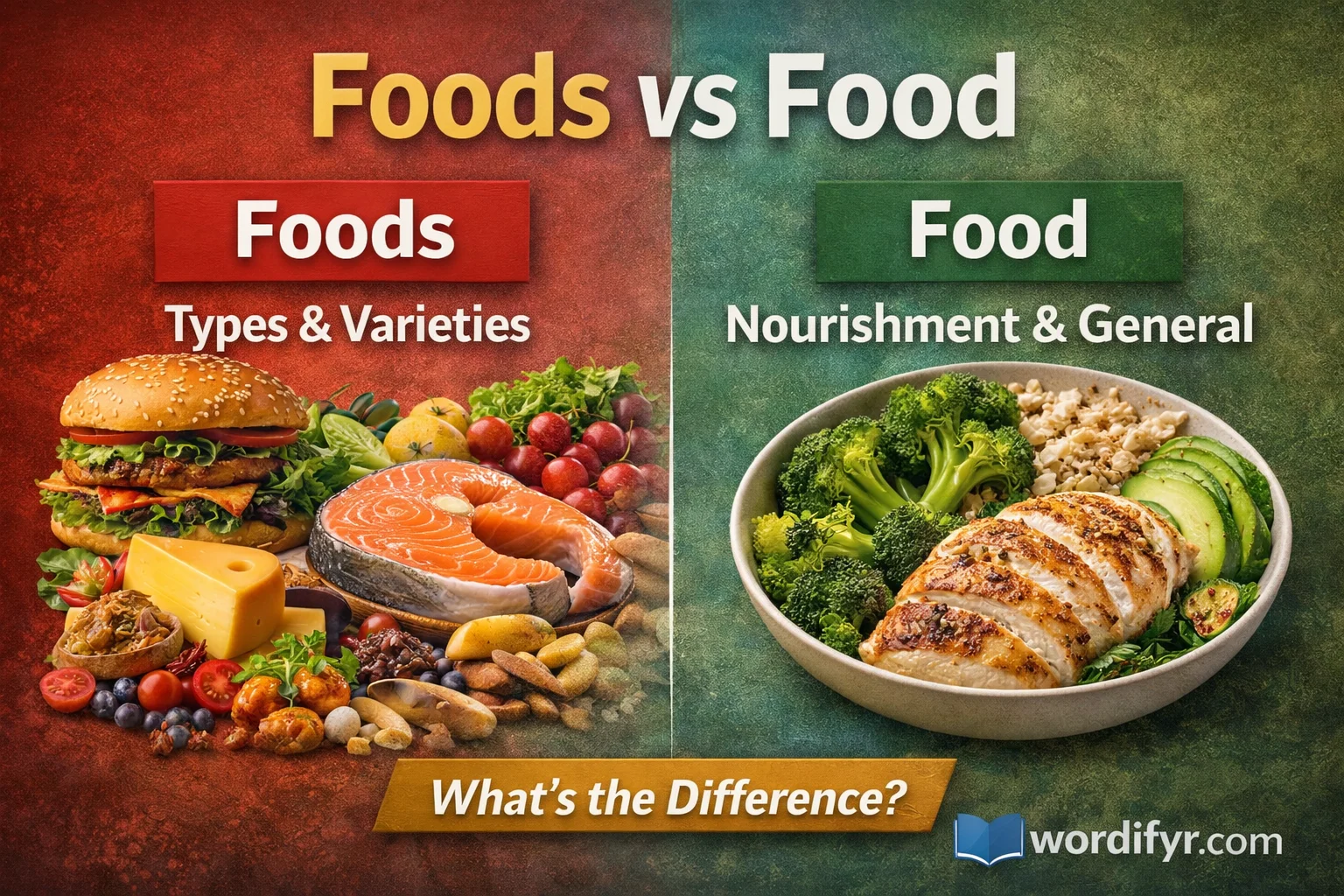
Food refers to nourishment in a general or collective sense. It does not focus on individual items but rather on food as a concept, substance, or category.
How It’s Used
- Used as a mass noun
- Refers to food in general
- Common in scientific, health, and everyday contexts
Examples:
- “Food is essential for life.”
- “This restaurant serves good food.”
Where It’s Used
- Universal English (US, UK, global)
- Common in nutrition, biology, hospitality, and daily conversation
- Preferred in formal and neutral writing
Grammar Rules
- Usually not pluralized
- Does not take “a” or “an”
- Uses quantifiers like some, much, little
Examples:
- “Too much food was wasted.”
- “We need more food.”
Short Historical Note
The word food comes from Old English fōda, meaning nourishment or sustenance. Historically, it always referred to nourishment as a whole, which explains why it remains uncountable in most contexts.
Example Sentences
- “Healthy food improves overall well-being.”
- “Food prices have increased this year.”
- “She donated food to the shelter.”
What Is Foods?
Foods is the plural form of food, but it is used in a specific and limited way. It refers to different types, varieties, or categories of food, not food as a general concept.
Meaning and Definition
Foods means multiple kinds of food, often emphasizing diversity, classification, or comparison.
How It’s Used
- Used as a countable noun
- Common in formal, academic, cultural, or technical contexts
- Highlights variety rather than quantity
Examples:
- “Processed foods are high in sodium.”
- “Traditional foods vary by culture.”
Where It’s Used
- Nutrition science
- Academic writing
- Cultural discussions
- Marketing and labeling
- Government and health publications
Grammar Rules
- Always plural
- Often paired with adjectives like processed, fermented, local, ethnic
Examples:
- “These foods are rich in protein.”
- “Avoid sugary foods.”
Regional or Usage Notes
- More common in formal English
- Rare in casual speech
- Frequently used in health guidelines
Example Sentences
- “Fermented foods support gut health.”
- “Street foods are popular worldwide.”
- “Imported foods require inspection.”
Key Differences Between Food and Foods
Bullet Point Summary
- Food is usually uncountable and general
- Foods refers to different types or categories
- Food is more common in daily conversation
- Foods appears more in formal or academic writing
- Meaning changes based on context, not spelling
Comparison Table
| Feature | Food | Foods |
|---|---|---|
| Noun Type | Uncountable | Countable (plural) |
| Meaning | Food in general | Types or varieties of food |
| Everyday Use | Very common | Less common |
| Academic Use | Moderate | Very common |
| Example | “Food is expensive.” | “Frozen foods last longer.” |
| Grammar | No plural form | Always plural |
| Focus | Substance or concept | Categories or diversity |
Real-Life Conversation Examples
Dialogue 1
A: “Should I say healthy food or healthy foods?”
B: “If you mean eating well in general, use food.”
🎯 Lesson: Use food for general meaning.
Dialogue 2
A: “My doctor told me to avoid certain foods.”
B: “Right, because they’re talking about specific types.”
🎯 Lesson: Use foods when listing categories.
Dialogue 3
A: “This country has amazing food.”
B: “Yes, the flavors are incredible!”
🎯 Lesson: Culture + experience = food, not foods.
Dialogue 4
A: “Packaged foods are convenient.”
B: “True, but fresh food is healthier.”
🎯 Lesson: Contrast between types vs general nourishment.
Dialogue 5
A: “Why does the label say ‘foods’?”
B: “Because it includes multiple product categories.”
🎯 Lesson: Formal labeling favors foods.
When to Use Food vs Foods
Use Food When:
- Speaking generally
- Talking about eating, hunger, or meals
- Writing casually or conversationally
- Describing quality, taste, or experience
Examples:
- “The food was delicious.”
- “We don’t have enough food.”
Use Foods When:
- Talking about types or groups
- Writing academic or professional content
- Discussing nutrition categories
- Referring to classifications
Examples:
- “Low-carb foods help with weight loss.”
- “Genetically modified foods are regulated.”
Simple Memory Trick
- Food = one idea, general concept
- Foods = many kinds, many categories
If you can add “types of” before the word, foods is correct.
Fun Facts or History
- The phrase “health foods” became popular in the 20th century with the rise of nutrition science.
- Many languages do not pluralize food at all, making foods uniquely English and context-driven.
Conclusion
The difference between foods vs food is subtle but important. Food refers to nourishment in a general, uncountable sense, while foods highlights different types, categories, or varieties. Most everyday conversations use food, but formal, academic, or nutritional discussions often require foods for clarity and precision. Once you understand the intent behind your sentence—general meaning or specific categories—the correct choice becomes obvious. Mastering this distinction improves your writing, boosts clarity, and makes your English sound more natural and confident. Next time someone uses these two words, you’ll know exactly what they mean!