Introduction
Have you ever seen the words deadline and dateline used interchangeably and felt unsure which one was right? You’re definitely not alone. These two terms look similar, sound related to time and dates, and are commonly used in professional writing, journalism, academics, and business communication. That overlap is exactly why people confuse them so often. One deals with time limits, while the other focuses on time and place in writing. Although they look/sound similar, they serve completely different purposes.
Understanding the difference between deadline vs dateline is especially important if you write emails, reports, articles, or academic content. Using the wrong one can make your writing sound unprofessional or unclear. In this guide, we’ll explain both terms in a simple, friendly way with examples, comparisons, and real-life conversations—so you can use them confidently every time.
Section 1: What Is “Deadline”?
Meaning of Deadline
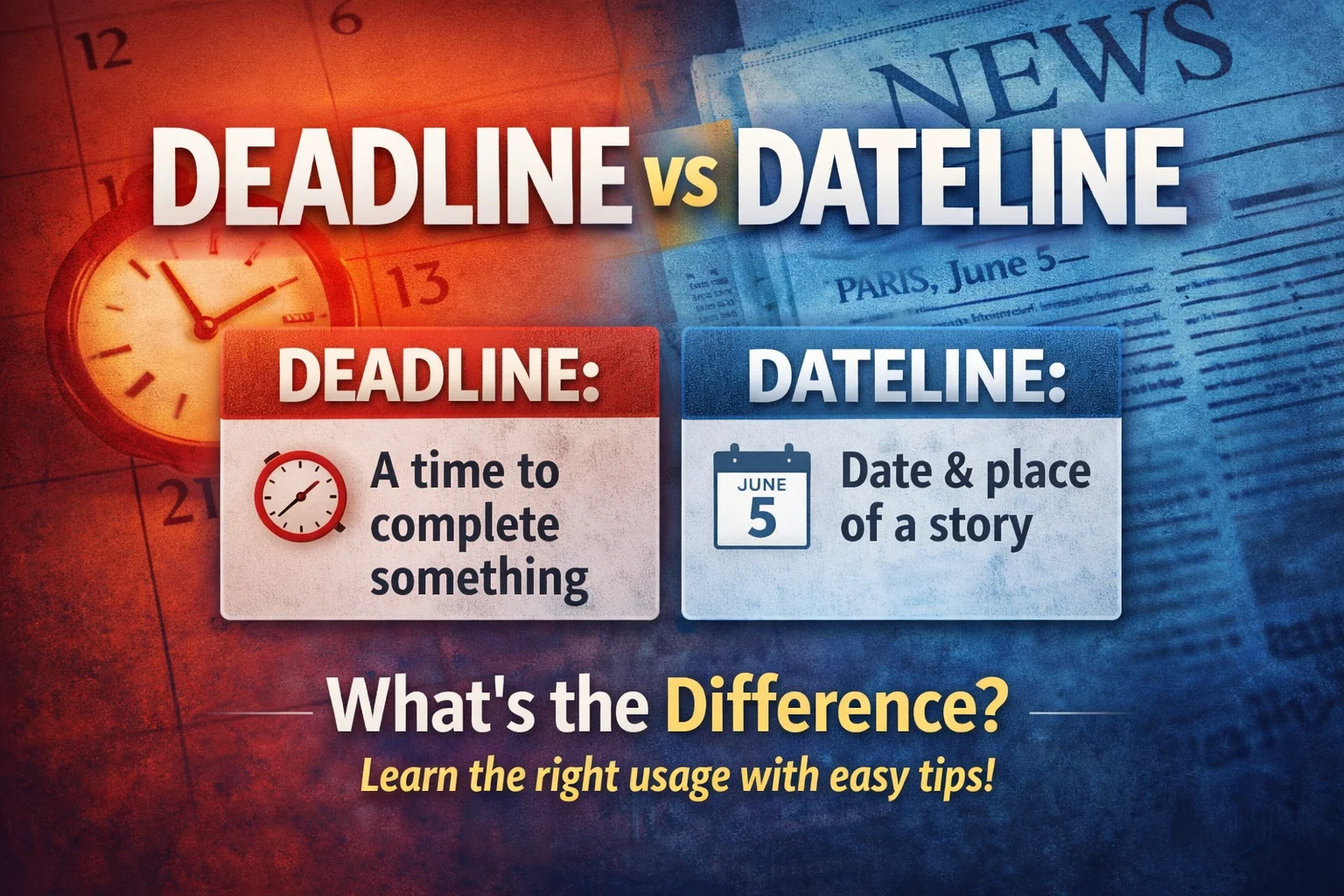
A deadline is the latest possible time or date by which something must be completed. It represents a cutoff point—miss it, and there may be consequences. In the deadline vs dateline comparison, deadline is all about urgency and completion.
How It’s Used
You use deadline when:
- Referring to due dates
- Talking about time limits
- Setting expectations for work, tasks, or submissions
It answers the question: By when must this be done?
Where It’s Used (Grammar & Context)
- Common in business, education, journalism, and law
- Used identically in US and UK English
- Functions primarily as a noun
Examples in Sentences
- The project deadline is Friday.
- I can’t submit this after the deadline.
- The editor extended the deadline by two days.
- Missing the deadline could delay publication.
In deadline vs dateline, notice how deadline always involves pressure and timing.
Short Historical Note
The word deadline originally appeared in the 19th century, referring to a literal line prisoners could not cross without being shot. Over time, the meaning softened into the modern sense of a strict time limit—still serious, but thankfully less dramatic.
Section 2: What Is “Dateline”?
Meaning of Dateline
A dateline is a line in a news article or formal report that shows the date and place where the story was written or reported. In the deadline vs dateline distinction, dateline has nothing to do with urgency—it’s about context and attribution.
How It’s Used
You use dateline when:
- Writing or reading news articles
- Referring to journalistic formatting
- Indicating location + date of a report
It answers the question: Where and when was this written?
Spelling, Usage, and Grammar Notes
- Same spelling in American and British English
- Functions mainly as a noun
- Commonly appears at the top of news stories
Examples in Sentences
- The article’s dateline reads: London, June 12.
- Always check the dateline to verify the report’s origin.
- The journalist updated the dateline after traveling.
- Older newspapers relied heavily on the dateline for credibility.
In deadline vs dateline, remember: dateline belongs to journalism, not scheduling.
Regional or Professional Notes
Outside journalism or formal reporting, dateline is rarely used. This limited usage is one reason people confuse it with the much more common deadline.
Key Differences Between Deadline and Dateline
Bullet-Point Differences
- Deadline refers to a time limit
- Dateline refers to date and location in writing
- Deadline creates urgency
- Dateline provides context
- Deadline is common in daily life
- Dateline is mostly used in journalism
Understanding these basics clears up most deadline vs dateline confusion.
Comparison Table
| Feature | Deadline | Dateline |
|---|---|---|
| Meaning | Final time limit | Date and place of a story |
| Purpose | Enforce completion | Provide context |
| Common Field | Work, school, business | Journalism, news |
| Part of Speech | Noun | Noun |
| Involves Urgency | ✅ Yes | ❌ No |
| Example | Meet the deadline | Check the dateline |
Real-Life Conversation Examples
Dialogue 1
A: What’s the deadline for the article?
B: Tomorrow. Don’t confuse it with the dateline at the top.
🎯 Lesson: Deadline is about when to finish; dateline is about article details.
Dialogue 2
A: Why does this story say “Paris, July 3”?
B: That’s the dateline, not the deadline.
🎯 Lesson: A dateline shows place and date, not urgency.
Dialogue 3
A: I missed the deadline again.
B: At least you didn’t forget the dateline in the report.
🎯 Lesson: One affects timing; the other affects formatting.
Dialogue 4
A: The editor asked me to update the dateline.
B: Good—just don’t miss the deadline doing it!
🎯 Lesson: Both matter, but for very different reasons.
When to Use Deadline vs Dateline
Practical Usage Rules
Use deadline when:
- Talking about due dates
- Managing tasks or schedules
- Referring to time pressure
Use dateline when:
- Writing or analyzing news articles
- Identifying where and when something was reported
- Following journalistic style rules
This rule alone solves most deadline vs dateline mistakes.
Simple Memory Tricks
- Deadline = miss it, and it’s serious ⏰
- Dateline = has the word date in it 🗓️
If it stresses you out, it’s probably a deadline.
If it appears at the top of an article, it’s a dateline.
US vs UK Usage
There’s no difference between US and UK usage for deadline vs dateline. Both terms are spelled and used the same way across English-speaking regions.
Fun Facts or History
- The dateline became standard in newspapers during the 19th century to establish trust and transparency.
- The modern deadline meaning evolved from military and prison terminology into workplace language.
These histories explain why deadline vs dateline feel related—but aren’t interchangeable.
Conclusion
The confusion between deadline vs dateline disappears once you focus on their core purposes. A deadline is about when something must be finished, often carrying pressure and consequences. A dateline, on the other hand, simply tells you where and when a story was written. One controls time; the other provides context. By using a few memory tricks and understanding their roles, you can avoid embarrassing mistakes and write with confidence. Next time someone uses these two words, you’ll know exactly what they mean!