Introduction
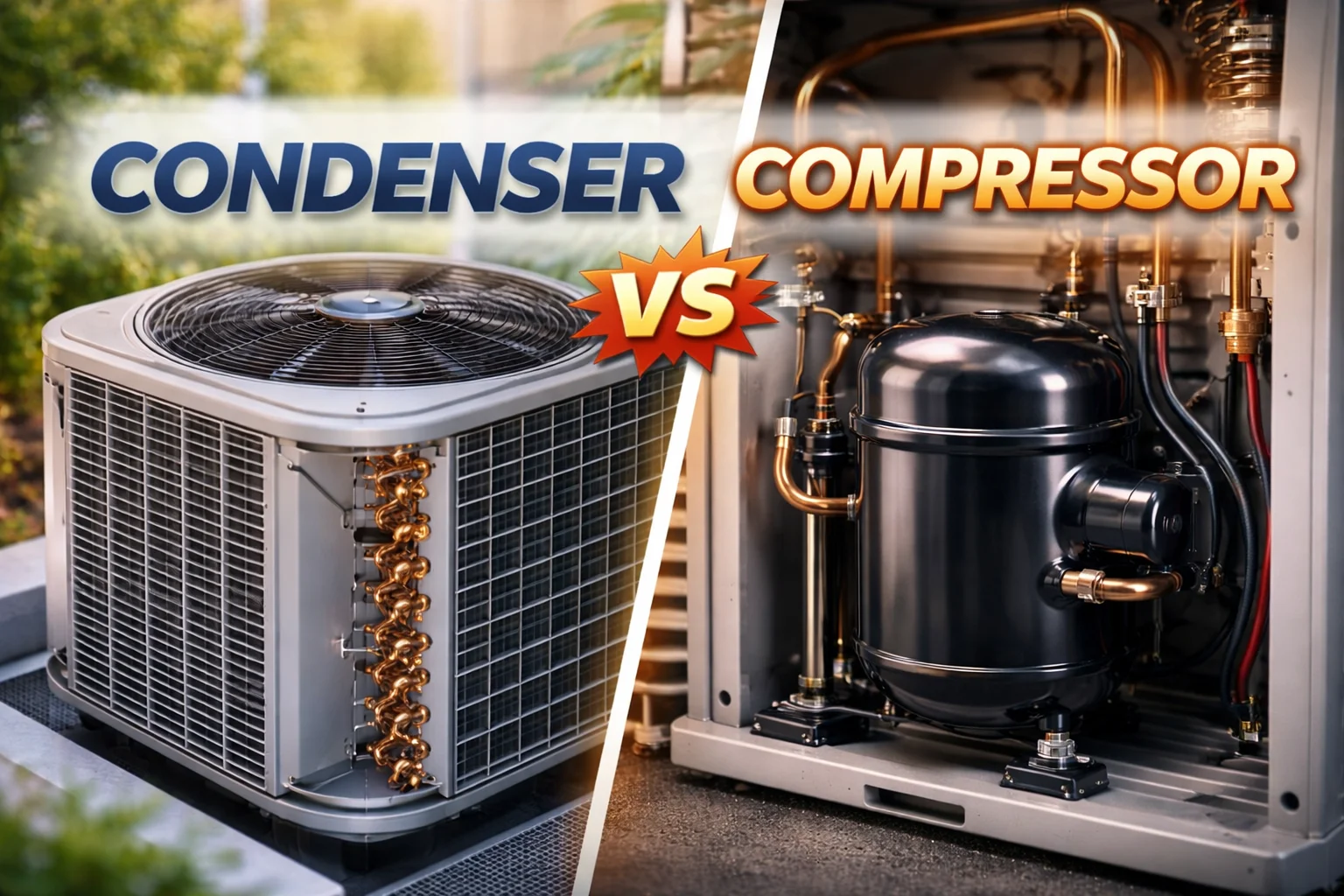
If you’ve ever looked inside an air conditioner or refrigerator, you’ve probably heard the terms condenser and compressor. These two components are essential parts of cooling systems, but many people confuse them because they both play roles in regulating temperature. When researching how air conditioners work, you’ll frequently see discussions comparing condenser vs compressor.
The confusion happens because both parts work together in the refrigeration cycle, and they’re often located close to each other inside the system. However, their functions are very different.
Although they look similar, they serve completely different purposes.
In this guide to condenser vs compressor, you’ll learn what each component does, how they work in cooling systems, examples of real-world use, key differences, and when each one plays its role in refrigeration and air conditioning systems.
What Is a Compressor?
A compressor is one of the most important components in cooling systems such as air conditioners, refrigerators, and heat pumps. Its main job is to compress refrigerant gas and increase its pressure and temperature.
In the condenser vs compressor comparison, the compressor acts as the starting point of the refrigeration cycle.
Meaning and Function
A compressor takes low-pressure refrigerant gas and compresses it into high-pressure, high-temperature gas. This process allows the refrigerant to move through the cooling system efficiently.
In simple terms:
The compressor pumps and pressurizes refrigerant.
Where Compressors Are Used
Compressors appear in many cooling and industrial systems, including:
- Air conditioners
- Refrigerators
- Heat pumps
- Industrial cooling systems
They are essential for circulating refrigerant throughout the system.
How the Compressor Works
The process happens in several steps:
- Refrigerant enters the compressor as low-pressure gas.
- The compressor squeezes the gas, increasing pressure and temperature.
- The high-pressure gas moves toward the condenser.
In the condenser vs compressor cycle, the compressor prepares the refrigerant for heat release.
Example Sentences
- “The air conditioner stopped working because the compressor failed.”
- “The compressor pushes refrigerant through the cooling system.”
- “In the condenser vs compressor process, the compressor raises pressure.”
Types of Compressors
Common compressor types include:
- Reciprocating compressors
- Rotary compressors
- Scroll compressors
- Screw compressors
Each type is used depending on system size and efficiency requirements.
What Is a Condenser?
A condenser is another critical component in cooling systems. Its main function is to release heat from the refrigerant and convert it from gas into liquid.
In the condenser vs compressor comparison, the condenser handles the cooling stage of the refrigeration cycle.
Meaning and Function
The condenser removes heat from the refrigerant after it leaves the compressor.
This process causes the refrigerant to condense from hot gas into high-pressure liquid.
Simply put:
The condenser removes heat from the system.
Where Condensers Are Used
Condensers are commonly found in:
- Air conditioning systems
- Refrigerators
- Automotive AC systems
- Industrial refrigeration equipment
They are usually located outside the building or appliance to release heat into the surrounding air.
How the Condenser Works
The process typically follows these steps:
- High-pressure gas enters the condenser.
- Cooling fans or coils remove heat.
- The refrigerant condenses into liquid form.
In the condenser vs compressor cycle, the condenser prepares refrigerant for the next stage of cooling.
Example Sentences
- “The outdoor unit contains the condenser coil.”
- “Dust on the condenser can reduce AC efficiency.”
- “In the condenser vs compressor process, the condenser removes heat.”
Types of Condensers
Several types of condensers exist:
- Air-cooled condensers
- Water-cooled condensers
- Evaporative condensers
Each type is designed for specific cooling environments.
Key Differences Between Condenser and Compressor
Understanding condenser vs compressor becomes easier when you compare their roles in the refrigeration cycle.
Quick Differences
- Compressor increases refrigerant pressure
- Condenser removes heat from refrigerant
- Compressor pumps refrigerant through the system
- Condenser converts gas into liquid
- Compressor starts the cooling cycle
These differences explain why both parts are necessary in cooling systems.
Comparison Table: Condenser vs Compressor
| Feature | Compressor | Condenser |
|---|---|---|
| Main Function | Compress refrigerant gas | Remove heat from refrigerant |
| Refrigerant State | Low-pressure gas → high-pressure gas | Gas → liquid |
| Role in Cycle | Beginning of refrigeration cycle | Heat rejection stage |
| Location | Inside indoor or outdoor unit | Usually outdoor unit |
| Purpose | Increase pressure and circulation | Release heat and condense refrigerant |
| Importance | Drives the system | Enables cooling process |
This table highlights the essential differences in the condenser vs compressor comparison.
Real-Life Conversation Examples
Dialogue 1
A: “Why is my air conditioner not cooling?”
B: “The compressor might not be running.”
🎯 Lesson: The compressor is essential for circulating refrigerant.
Dialogue 2
A: “Why is the outdoor unit so hot?”
B: “Because the condenser is releasing heat.”
🎯 Lesson: The condenser removes heat from the system.
Dialogue 3
A: “Which part pumps the refrigerant?”
B: “That’s the compressor.”
🎯 Lesson: Compressors pressurize and move refrigerant.
Dialogue 4
A: “What happens after refrigerant leaves the compressor?”
B: “It goes to the condenser to cool down.”
🎯 Lesson: The condenser cools high-pressure gas.
Dialogue 5
A: “Why are both components important?”
B: “Because without the compressor or condenser, the cooling cycle cannot work.”
🎯 Lesson: Both components are essential.
When to Use Condenser vs Compressor
Understanding condenser vs compressor is important when discussing cooling systems.
Use “Compressor” When Referring To
✔ The component that compresses refrigerant
✔ Pressure increase in refrigeration systems
✔ The pump driving refrigerant circulation
Example:
- “The refrigerator compressor is making noise.”
Use “Condenser” When Referring To
✔ Heat removal from refrigerant
✔ Cooling coils outside AC units
✔ Gas-to-liquid conversion stage
Example:
- “The condenser coil needs cleaning.”
Simple Memory Trick
Here’s an easy way to remember:
Compressor = Compresses gas
Condenser = Condenses gas
This simple rule helps clarify condenser vs compressor usage.
Fun Facts About Cooling Systems
1. The Refrigeration Cycle Has Four Main Components
Most cooling systems include:
- Compressor
- Condenser
- Expansion valve
- Evaporator
Each part performs a specific role in the cooling process.
2. Air Conditioners Reverse the Cycle
Heat pumps and some AC systems can reverse the refrigeration cycle, allowing them to heat buildings in winter and cool them in summer.
Conclusion
Understanding condenser vs compressor is essential when learning how cooling systems work. The compressor increases the pressure and temperature of refrigerant, pushing it through the system. The condenser, on the other hand, removes heat and converts refrigerant gas into liquid form.
Both components are crucial in the refrigeration cycle, and neither can function effectively without the other. By remembering that compressors compress gas and condensers condense gas, you can easily understand their roles in air conditioners, refrigerators, and industrial cooling systems.
Next time someone mentions condenser vs compressor, you’ll know exactly what they mean!