Introduction
If you’ve recently been told you need multifocal lenses, chances are you’re now comparing bifocals vs progressives—and feeling a bit overwhelmed. Both are designed to help people who struggle to see clearly at more than one distance, especially as eyesight changes with age. On the surface, they seem to solve the same problem, which is exactly why so many people confuse them.
But here’s the key truth: although they look/sound similar, they serve completely different purposes.
The difference isn’t just about comfort—it affects vision clarity, appearance, daily convenience, and long-term eye health. Choosing the wrong option can lead to headaches, eye strain, or frustration with your glasses. In this in-depth guide, we’ll clearly explain bifocals vs progressives, how they work, who they’re best for, and how to choose the right lenses with confidence 👓.
What Is Bifocals?
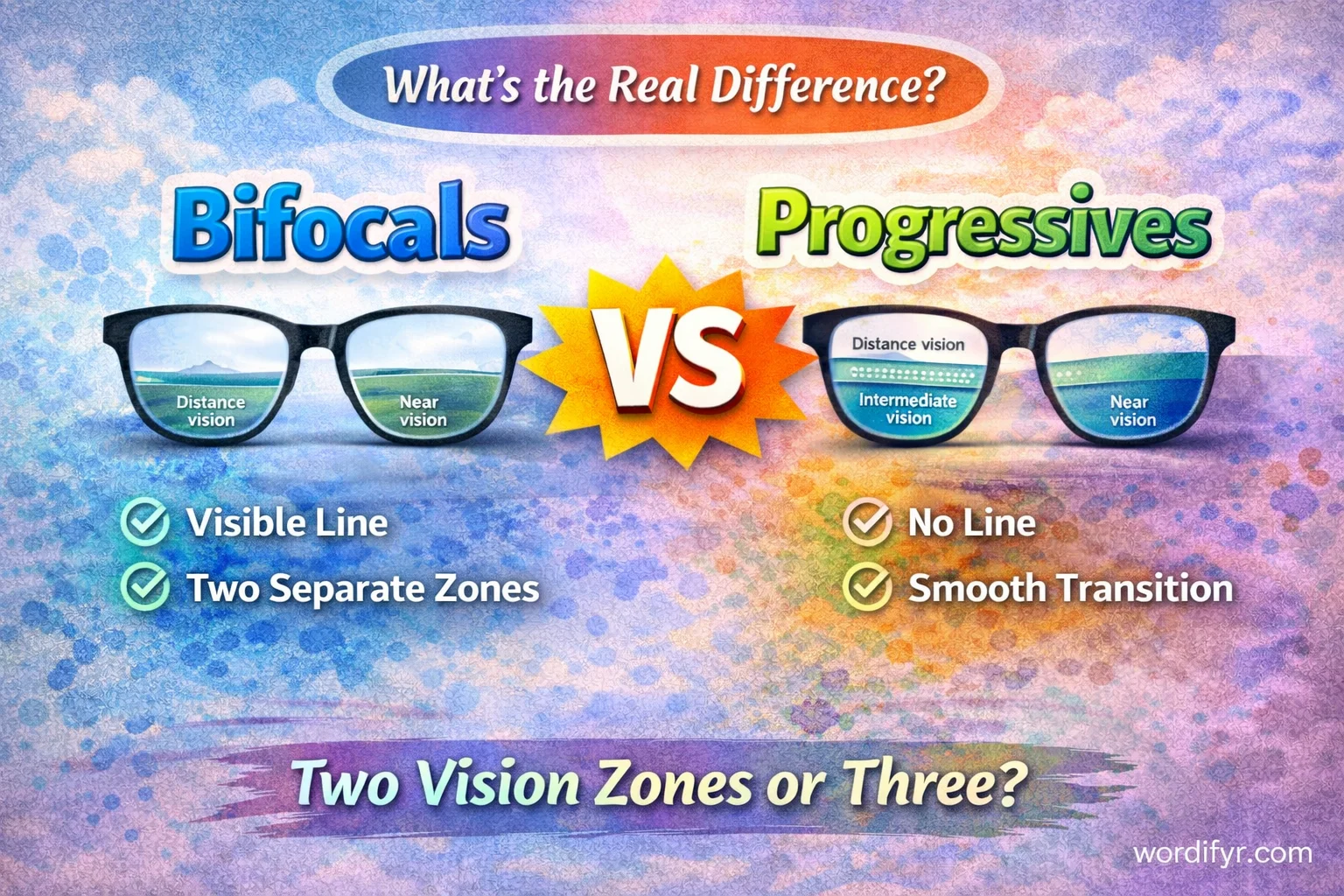
Bifocals are eyeglass lenses that contain two distinct vision zones, each designed for a specific viewing distance.
Meaning and How It’s Used
Bifocals are:
- Lenses with two separate prescriptions
- Typically divided into distance vision (top) and near vision (bottom)
- Easily recognizable by a visible horizontal line
They’re commonly prescribed to people with presbyopia, an age-related condition that makes close-up tasks like reading difficult.
Where They’re Used
- Reading and everyday activities
- Traditional eyewear solutions
- Often recommended for first-time multifocal users
Example Sentences
- He uses bifocals to read and drive without switching glasses.
- Her bifocals have a visible line between vision zones.
- Bifocals make reading menus much easier.
Short Historical or Usage Note
Bifocals date back to the 18th century and are often associated with early innovations in vision correction. Their simple design made them the standard solution for decades before more advanced lenses were developed.
What Is Progressives?
Progressives, also called progressive addition lenses (PALs), are advanced multifocal lenses that offer a smooth transition between multiple vision distances.
Meaning and How It’s Used
Progressive lenses:
- Have no visible lines
- Provide near, intermediate, and distance vision
- Change prescription strength gradually from top to bottom
This design closely mimics how natural vision works, making them a popular modern alternative.
Where They’re Used
- Office work and screen use
- Driving, reading, and multitasking
- Lifestyle-focused eyewear
Example Sentences
- She chose progressives for a more natural viewing experience.
- Progressives allow clear vision at all distances.
- These lenses look just like single-vision glasses.
Regional and Medical Notes
Progressives are widely recommended by eye-care professionals, including organizations like the American Academy of Ophthalmology, because they reduce the need for multiple pairs of glasses and improve visual comfort.
Key Differences Between Bifocals and Progressives
The bifocals vs progressives debate comes down to design, comfort, aesthetics, and adaptability.
Bullet Point Differences
- Bifocals have visible lines; progressives don’t
- Progressives offer intermediate vision; bifocals don’t
- Bifocals are easier to adapt to initially
- Progressives look more modern and natural
- Bifocals are usually more affordable
Comparison Table
| Feature | Bifocals | Progressives |
|---|---|---|
| Vision Zones | Two (near & distance) | Three (near, intermediate, distance) |
| Visible Line | Yes | No |
| Visual Transition | Abrupt | Smooth |
| Appearance | Traditional | Modern |
| Adaptation Time | Short | Moderate |
| Cost | Lower | Higher |
Real-Life Conversation Examples
Dialogue 1
Patient: Why do I see a line in my lenses?
Optician: Those are bifocals.
🎯 Lesson: Bifocals have visible divisions.
Dialogue 2
Friend: Your glasses look normal.
You: They’re progressives—no lines.
🎯 Lesson: Progressives are visually seamless.
Dialogue 3
Customer: I work on a computer all day.
Doctor: Progressives will suit you better.
🎯 Lesson: Progressives support intermediate vision.
Dialogue 4
Senior: These lenses feel strange at first.
Optician: That’s normal with progressives.
🎯 Lesson: Progressives require adjustment time.
When to Use Bifocals vs Progressives
Choosing between bifocals vs progressives depends on lifestyle, budget, and visual needs.
Practical Usage Rules
Choose Bifocals if:
- You want a simple, affordable solution
- You mainly need near and distance vision
- You prefer minimal adaptation time
Choose Progressives if:
- You want clear vision at all distances
- You care about aesthetics
- You spend time on computers or multitask
Simple Memory Tricks 🧠
- Bifocals = Two zones, two powers
- Progressives = Progressive, smooth change
Lifestyle Tip
If you’re active, tech-focused, or image-conscious, progressives usually offer a better long-term experience.
Fun Facts or History
- Bifocals were among the first multifocal lenses ever created.
- Progressives were designed to eliminate the “jump effect” seen in bifocals.
- Most first-time multifocal wearers today choose progressives.
Conclusion
The choice between bifocals vs progressives isn’t about which lens is better—it’s about which one fits your eyes and lifestyle. Bifocals provide a straightforward, budget-friendly solution with clearly defined vision zones. Progressives, on the other hand, deliver a seamless, modern experience with natural vision at all distances.
By understanding how each lens works and what it offers, you can make a confident, informed decision that supports long-term eye comfort and clarity. Next time someone mentions bifocals or progressives, you’ll know exactly what they mean—and which one might be right for you! 😊