
Introduction
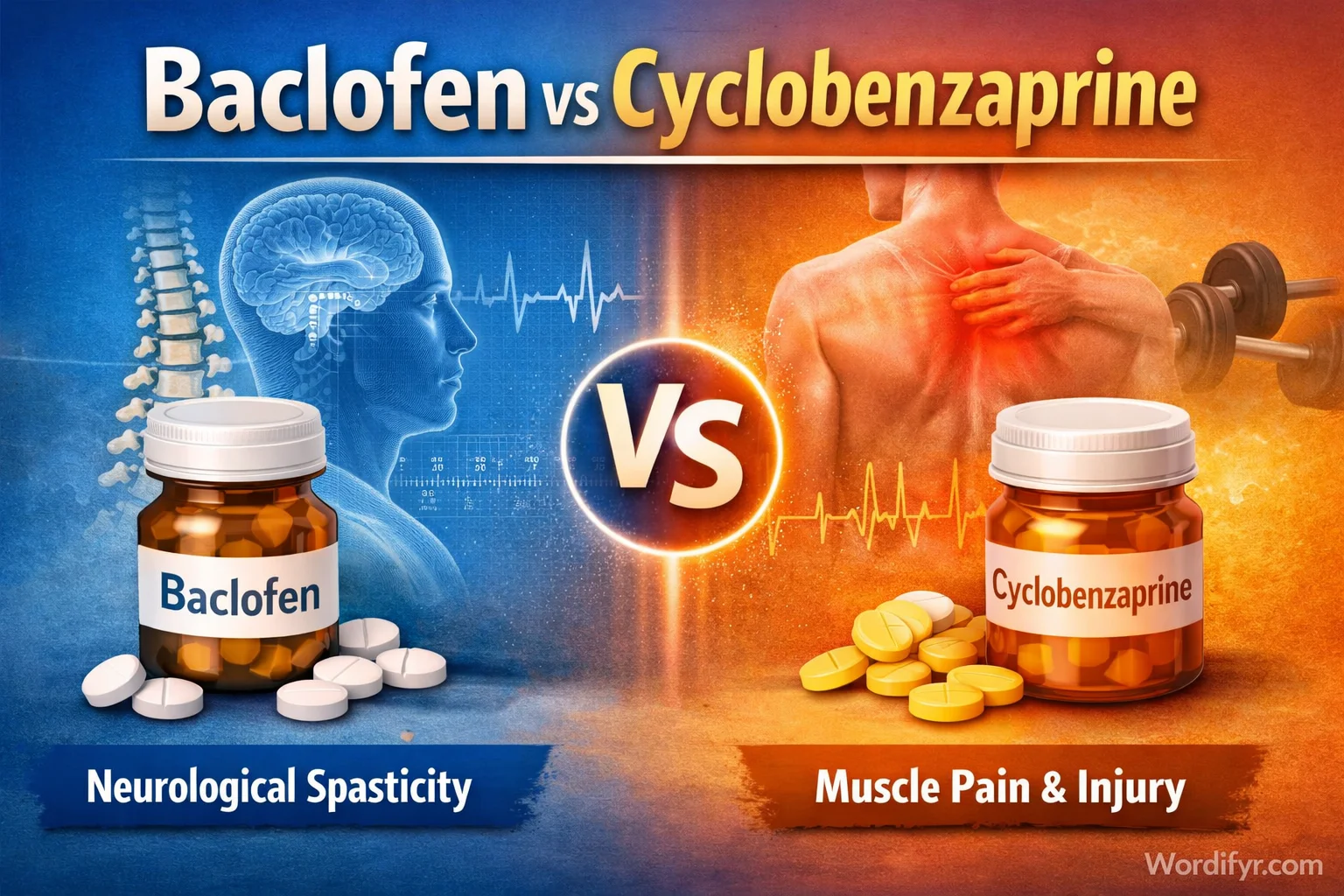
Muscle pain, spasms, and stiffness can stop you from living normally. If you have ever searched for muscle relaxants, you have probably seen baclofen vs cyclobenzaprine mentioned together—and that is where confusion starts. Both medications are prescribed for muscle-related problems, both affect the nervous system, and both are commonly called “muscle relaxers.” Because of this overlap, many patients assume they are interchangeable.
However, that assumption can be misleading and sometimes unsafe. These two drugs work in very different ways, treat different medical conditions, and have different side-effect profiles. Doctors choose one over the other for specific clinical reasons.
Although they look/sound similar, they serve completely different purposes.
In this guide, you will learn exactly what baclofen is, what cyclobenzaprine is, how they differ, when each is used, and how to remember the distinction easily—all explained clearly and practically.
What Is Baclofen?
Baclofen is a prescription muscle relaxant that primarily works on the central nervous system (CNS). It is classified as an antispasticity agent, not a general pain reliever.
Meaning and Purpose
Baclofen is designed to reduce muscle spasticity, which is a condition where muscles become stiff, tight, and difficult to control due to nerve damage.
It works by activating GABA-B receptors in the spinal cord, which suppress excessive nerve signals that cause involuntary muscle contractions.
How Baclofen Is Used
Doctors typically prescribe baclofen for long-term neurological conditions, not short-term muscle pain.
Common uses include:
- Multiple sclerosis (MS)
- Spinal cord injuries
- Cerebral palsy
- Severe neurological spasticity
- Off-label use for alcohol dependence in some countries
Baclofen can be taken orally or delivered directly into the spinal fluid using an intrathecal pump in severe cases.
Where Baclofen Is Used
Baclofen is widely prescribed in:
- United States
- United Kingdom
- Europe
- Canada
- Australia
Its usage follows strict neurological and rehabilitation guidelines.
Examples in Sentences
- “The neurologist prescribed baclofen to reduce leg stiffness.”
- “Baclofen helped control muscle spasms caused by spinal injury.”
- “She takes baclofen daily as part of her MS treatment.”
Historical and Usage Note
Baclofen was introduced in the 1970s as a targeted treatment for neurological spasticity. Unlike common muscle relaxers, it was never intended for simple muscle strain or sports injuries.
What Is Cyclobenzaprine?
Cyclobenzaprine is also a prescription muscle relaxant, but it belongs to a completely different category. It is structurally similar to tricyclic antidepressants and is used mainly for short-term muscle pain.
Meaning and Purpose
Cyclobenzaprine is intended to relieve muscle spasms caused by acute musculoskeletal conditions, not neurological damage.
It works by blocking pain signals in the brain, rather than directly relaxing muscles at the spinal level.
How Cyclobenzaprine Is Used
Cyclobenzaprine is usually prescribed for:
- Back pain
- Neck pain
- Muscle strains
- Sports injuries
- Post-injury muscle spasms
It is meant for short-term use, typically 2–3 weeks, alongside rest and physical therapy.
Where Cyclobenzaprine Is Used
Cyclobenzaprine is most commonly prescribed in:
- United States
- Canada
- Some parts of Latin America
It is less commonly used in Europe compared to baclofen.
Examples in Sentences
- “The doctor prescribed cyclobenzaprine for my lower back pain.”
- “Cyclobenzaprine made him sleepy but reduced muscle tightness.”
- “She took cyclobenzaprine after a gym injury.”
Spelling and Usage Notes
Cyclobenzaprine is often sold under the brand name Flexeril, which many patients recognize more easily.
Key Differences Between Baclofen and Cyclobenzaprine
Understanding baclofen vs cyclobenzaprine becomes simple once you compare their core purposes.
Key Differences at a Glance
- Baclofen treats neurological muscle spasticity
- Cyclobenzaprine treats acute muscle pain
- Baclofen acts mainly on the spinal cord
- Cyclobenzaprine acts mainly on the brain
- Baclofen is used long-term
- Cyclobenzaprine is used short-term
Comparison Table
| Feature | Baclofen | Cyclobenzaprine |
|---|---|---|
| Drug Class | Antispasticity agent | Muscle relaxant |
| Primary Use | Neurological spasticity | Acute muscle pain |
| Acts On | Spinal cord (GABA-B) | Brain (CNS) |
| Duration of Use | Long-term | Short-term (2–3 weeks) |
| Common Conditions | MS, spinal injury | Back pain, strains |
| Sedation | Moderate | High |
| Addiction Risk | Low | Low–moderate |
| Brand Name | Lioresal | Flexeril |
Real-Life Conversation Examples
Dialogue 1
Patient: “My friend takes baclofen. Should I use it for my back pain?”
Doctor: “No, baclofen is for neurological muscle stiffness, not injury pain.”
🎯 Lesson: Baclofen is not for simple muscle pain.
Dialogue 2
Patient: “Why did you give me cyclobenzaprine instead of baclofen?”
Doctor: “Your pain is muscular, not neurological.”
🎯 Lesson: The cause of muscle pain determines the drug.
Dialogue 3
Friend A: “Cyclobenzaprine made me very sleepy.”
Friend B: “That’s common. Baclofen works differently.”
🎯 Lesson: Side effects differ significantly.
Dialogue 4
Patient: “Can I take cyclobenzaprine long-term?”
Pharmacist: “No, it’s meant for short-term use only.”
🎯 Lesson: Cyclobenzaprine is not for chronic conditions.
When to Use Baclofen vs Cyclobenzaprine
Use Baclofen When:
- Muscle stiffness is caused by nerve damage
- Spasticity is chronic
- The condition is neurological
- Long-term treatment is required
Memory Trick:
Baclofen = Brain-to-Spine problem
Use Cyclobenzaprine When:
- Muscle pain is due to injury or strain
- Pain is short-term
- No neurological disease is involved
- Muscle spasms follow physical exertion
Memory Trick:
Cyclo = Cycle injury, gym strain, sudden pain
US vs UK Prescribing Notes
- In the US, cyclobenzaprine is extremely common for back pain
- In the UK, baclofen is more commonly used in neurological rehabilitation
Fun Facts and History
- Cyclobenzaprine was originally researched as an antidepressant, but its muscle-relaxing effects became more useful clinically.
- Baclofen pumps allow medication delivery directly into spinal fluid—one of the most advanced treatments for severe spasticity.
Conclusion
The difference between baclofen vs cyclobenzaprine is not subtle—it is clinical, practical, and essential. Baclofen is a targeted treatment for neurological muscle spasticity, while cyclobenzaprine is designed for short-term muscle pain and injury-related spasms. They work on different parts of the nervous system, serve different patient populations, and are prescribed for entirely different reasons. Understanding this distinction helps patients ask better questions and avoid misuse.
Next time someone uses these two words, you’ll know exactly what they mean!