Introduction
The words above and below look simple—and they are—but they’re also among the most commonly confused direction words in English writing. You’ll find them everywhere: emails, instructions, exams, blog posts, legal documents, and everyday conversations. Because they are opposites and often appear together, people sometimes use them interchangeably or choose the wrong one without realizing it.
The confusion usually happens because both words can describe position, rank, quantity, and even text references. One small mistake can change meaning, clarity, or professionalism—especially in formal or instructional writing.
Although they look/sound similar, they serve completely different purposes.
In this complete guide, you’ll learn the exact difference between above vs below, how each word is used, real-life examples, common mistakes, and easy memory tricks to help you use them confidently every time.
What Is “Above”?
Meaning of Above
Above means at a higher position, level, rank, or value than something else. It can refer to physical location, numerical amount, hierarchy, or written content.
In simple terms, above = higher than.
How Above Is Used
The word above is used in several ways:
- To describe physical position
- To refer to higher numbers or values
- To indicate rank or importance
- To point to earlier text in writing
Where Above Is Used
- Common in both American and British English
- Used in:
- Instructions and manuals
- Academic writing
- Business communication
- Everyday speech
- Functions as:
- Preposition
- Adverb
- Adjective
Examples of Above in Sentences
- The picture is hanging above the fireplace.
- Temperatures rose above 40 degrees.
- Students above grade 10 must attend the meeting.
- Please refer to the paragraph above.
- His performance was above average this year.
Short Historical / Usage Note
The word above comes from Old English abufan, meaning “over” or “on top of.” Over centuries, its usage expanded beyond physical height to include abstract ideas like status, value, and reference in written text.
What Is “Below”?
Meaning of Below
Below means at a lower position, level, rank, or value than something else. Like above, it can be used both literally and figuratively.
In simple terms, below = lower than.
How Below Is Used
Below is commonly used to:
- Describe physical position
- Indicate lower numbers or values
- Refer to lower rank or status
- Point to text that follows
Where Below Is Used
- Common in US and UK English
- Frequently used in:
- Instructions
- Exams and forms
- Articles and reports
- Everyday conversation
- Can act as:
- Preposition
- Adverb
- Adjective
Examples of Below in Sentences
- The storage room is below the main hall.
- Children below the age of five enter free.
- Please read the instructions below.
- The temperature dropped below freezing.
- Her score was below average.
Spelling & Grammar Notes
There are no regional spelling differences for below. Its meaning remains consistent across all forms of English.
Key Differences Between Above and Below
Quick Bullet Summary
- Above means higher than
- Below means lower than
- Above often refers to earlier text
- Below often refers to later text
- Above implies increase or superiority
- Below implies decrease or inferiority
- They are direct opposites
Above vs Below Comparison Table
| Feature | Above | Below |
|---|---|---|
| Core Meaning | Higher than | Lower than |
| Direction | Upward | Downward |
| Numeric Use | More than | Less than |
| Text Reference | Earlier content | Later content |
| Rank/Status | Higher level | Lower level |
| Common Pair | Above average | Below average |
| Opposite Of | Below | Above |
Real-Life Conversation Examples
Dialogue 1
A: Where should I place the shelf?
B: Put it above the desk.
🎯 Lesson: Above indicates higher physical position.
Dialogue 2
A: What score did I get?
B: It’s below the class average.
🎯 Lesson: Below refers to lower value.
Dialogue 3
A: Should I read this part first?
B: Yes, check the paragraph above.
🎯 Lesson: Above refers to earlier text.
Dialogue 4
A: Are kids under 10 allowed?
B: Only those below 10 get free entry.
🎯 Lesson: Below is used with limits and age.
Dialogue 5
A: Was her performance good?
B: It was above expectations.
🎯 Lesson: Above implies better than expected.
When to Use Above vs Below
Use Above When:
- Something is higher in position
- A number or value is greater
- Referring to earlier written content
- Talking about rank, quality, or standards
Examples:
- Above the limit
- Above sea level
- Above-mentioned points
- Above expectations
Use Below When:
- Something is lower in position
- A number or value is less
- Referring to text that follows
- Talking about minimums or thresholds
Examples:
- Below freezing
- Below average
- Below the line
- See details below
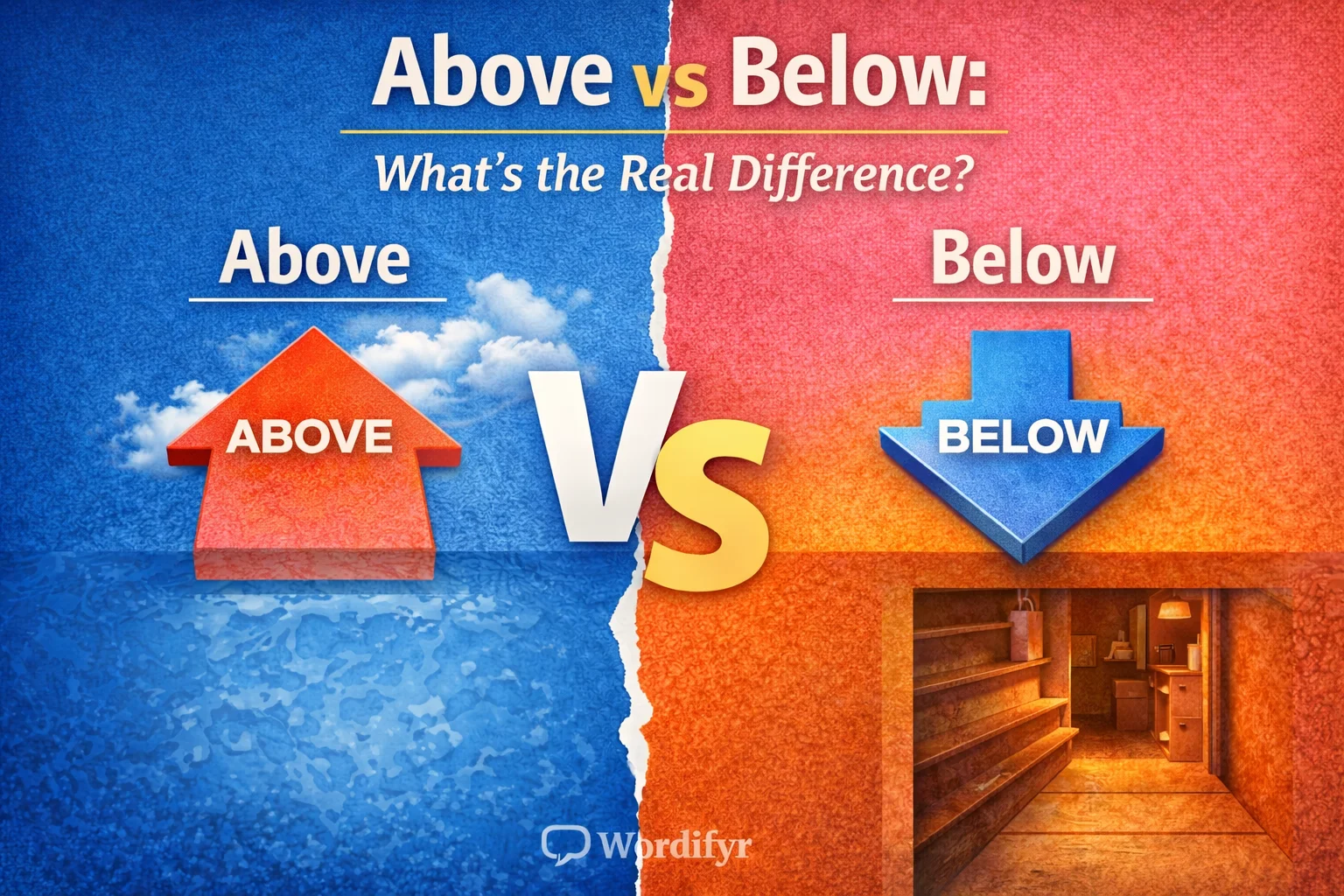
Simple Memory Tricks 🧠
- Above = Air (up high)
- Below = Basement (down low)
- Think “up arrow” → Above
- Think “down arrow” → Below
US vs UK Usage Notes
- Both words are used identically in US and UK English
- No spelling or grammatical differences
- Widely accepted in formal and informal writing
- Preferred in professional writing over “over” and “under” in some cases
Fun Facts or History
1️⃣ Why “Above Average” Sounds Positive
Psychologically, humans associate up with success and down with failure—making “above average” feel encouraging and “below average” discouraging.
2️⃣ Legal and Academic Preference
In formal writing, above and below are preferred over casual terms like up there or down there for clarity and precision.
Conclusion
The difference between above vs below is straightforward once you understand their direction and context. Above always points to something higher—whether it’s position, value, rank, or earlier text. Below does the opposite, referring to something lower, lesser, or later in writing.
These two words may seem simple, but using them correctly improves clarity, accuracy, and professionalism in your writing.
Next time someone uses these two words, you’ll know exactly what they mean! 😊